01Facts
The petitioner claimed to be the legally wedded wife of Nachi, a sanitary worker employed by the fifth respondent, and said they had two children.
pp. 2–5 · ¶ 1, 3, 5, 8, 10She sought family pension and terminal benefits following his death, relying on a civil-court order directing him to pay her maintenance.
pp. 2–5 · ¶ 1, 3, 5, 8, 10The fifth respondent stated that Nachi had later cancelled his nomination of the petitioner and nominated Mohanambal; at retirement, he identified Palaniammal as his wife and Mohanambal as his daughter.
pp. 2–5 · ¶ 1, 3, 5, 8, 10Family pension had been paid to Palaniammal until her death, while terminal benefits of Rs.86,181 had been paid to Mohanambal.
pp. 2–5 · ¶ 1, 3, 5, 8, 10The petitioner filed this Article 226 petition seeking consideration of her representation dated 4 April 2022.
pp. 2–5 · ¶ 1, 3, 5, 8, 1002Issues
i.Whether the petitioner, whose marriage to Nachi was not shown to have been dissolved, was entitled to family pension despite Nachi’s later declaration of Palaniammal as his wife
pp. 4–5 · ¶ 8–9ii.Whether the petitioner could obtain the terminal benefits already paid to Mohanambal in this writ petition, or should pursue a civil remedy
pp. 5–6 · ¶ 10–1103Law Applied
The Court applied the Tamil Nadu Pension Rules, stating that a nomination must be in favour of a family member; it did not specify a particular rule number.
p. 5 · ¶ 9It held that where the first marriage remained subsisting, the subsequent marriage was void ab initio and the subsequent spouse could not be treated as a family member for the relevant pension entitlement.
p. 5 · ¶ 9The Court also treated a civil court as the appropriate forum for the petitioner’s claim against Mohanambal concerning terminal benefits already disbursed.
p. 6 · ¶ 11No precedent was cited.
04Reasoning
The maintenance order supported the petitioner’s claim that she was Nachi’s legally wedded wife, and the respondents did not establish that the marriage had been dissolved.
pp. 4–6 · ¶ 8–11The Court held that the authorities should have verified the status of that marriage before accepting Nachi’s later declaration naming Palaniammal as his wife.
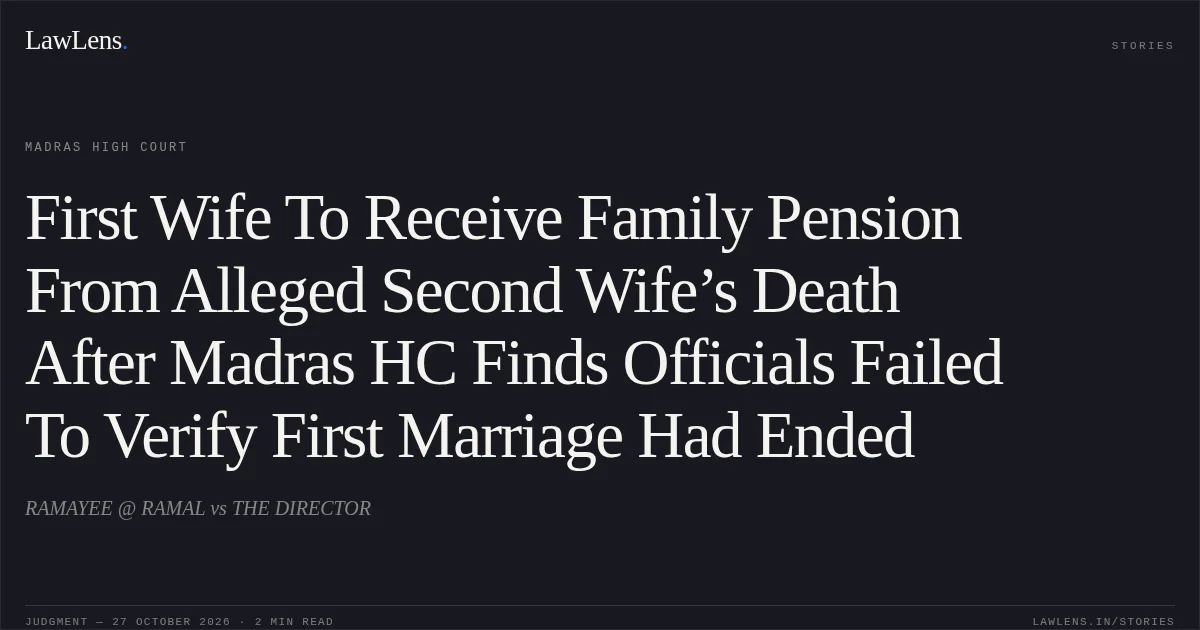
pp. 4–6 · ¶ 8–11Because the first marriage subsisted, the later marriage did not make Palaniammal a family member for pension purposes, and the petitioner was entitled to family pension.
pp. 4–6 · ¶ 8–11However, the terminal benefits had already been paid to Mohanambal as nominee; the Court left any claim to that amount to civil proceedings.
pp. 4–6 · ¶ 8–1105Holding
The Court held that the petitioner was entitled to family pension from the date of Palaniammal’s death.
p. 6 · ¶ 11–12It directed the fifth respondent to send a proposal to the competent authorities and to sanction the pension, together with arrears, within twelve weeks of receiving a copy of the order.
p. 6 · ¶ 11–12The petitioner was left to pursue any claim for the terminal benefits against Mohanambal before the appropriate civil court.
p. 6 · ¶ 11–12The writ petition was disposed of without costs, and the connected miscellaneous petition was closed.
p. 6 · ¶ 11–12Original Court PDF
RAMAYEE @ RAMALvsTHE DIRECTOR
Click to open original judgment
Original judgment, available to read, download and summarize on LawLens.in