Facts
The twelve petitioners were appointed by Respondent No. 2 on a contractual basis for 11-month terms with fixed remuneration between 2009 and 2017
Source reference: p. 3The petitioners approached the High Court seeking a writ of mandamus for regularization of their services and the grant of regular pay scales (Class III) from the date of their appointments, citing their continued service through periodic contract renewals
Source reference: p. 2They relied upon Government Resolution (GR) dated 16.02.2006, which provides for regular pay scales upon completion of five years of service
Source reference: p. 4The respondents contended that the appointments were purely ad-hoc and temporary, governed by specific contract conditions that explicitly barred claims for permanent employment or additional benefits
Source reference: p. 6-7An ad-interim order protecting the petitioners' services had been in place since 2019
Source reference: para. 15Issues
1. Whether contractual employees appointed on a fixed 11-month term are entitled to regularization and regular pay scales under Government Resolution dated 16.02.2006
Source reference: para. 122. Whether the petitioners possess a fundamental right to seek protection of their contractual service beyond the stipulated contract period
Source reference: para. 15Law Applied
The court applied the principle of "freedom of contract" in public employment, holding that employees who accept appointment orders with explicit restrictive conditions (Conditions 1, 3, 4, and 5) are bound by those terms, specifically those stating the service is temporary and provides no claim for permanency
Source reference: p. 9The court interpreted Government Resolution dated 16.02.2006 as a policy intended for candidates appointed to regular posts through formal recruitment processes, not for ad-hoc contractual staff
Source reference: para. 12It further relied on the principles from State of Karnataka v. Umadevi (2006) 4 SCC 1, which limits regularization to those in sanctioned posts with over ten years of service, and distinguished precedents where discriminatory treatment or long-term "adhocism" was proven
Source reference: para. 16.1-16.3Reasoning
The court reasoned that the nature of the petitioners' appointment was strictly ad-hoc, as evidenced by the recruitment advertisements and the specific terms of their appointment letters, which required them to vacate the post if regular selectees were appointed
Source reference: para. 10-11The court found that GR dated 16.02.2006 was inapplicable because its preamble targets regular recruits placed on a five-year fixed-pay period as an "austere measure," whereas the petitioners were engaged on 11-month renewals
Source reference: para. 12The court dismissed the petitioners' reliance on GR dated 04.03.2024, noting it applied to new posts and did not retroactively change the petitioners' status
Source reference: para. 12.1Furthermore, the court noted that at the time of filing, most petitioners had not completed ten years of service, failing the threshold established in Umadevi
Source reference: para. 16.3.1It concluded that having accepted the contract with "open eyes," the petitioners could not claim fundamental rights to permanent service
Source reference: para. 15Holding
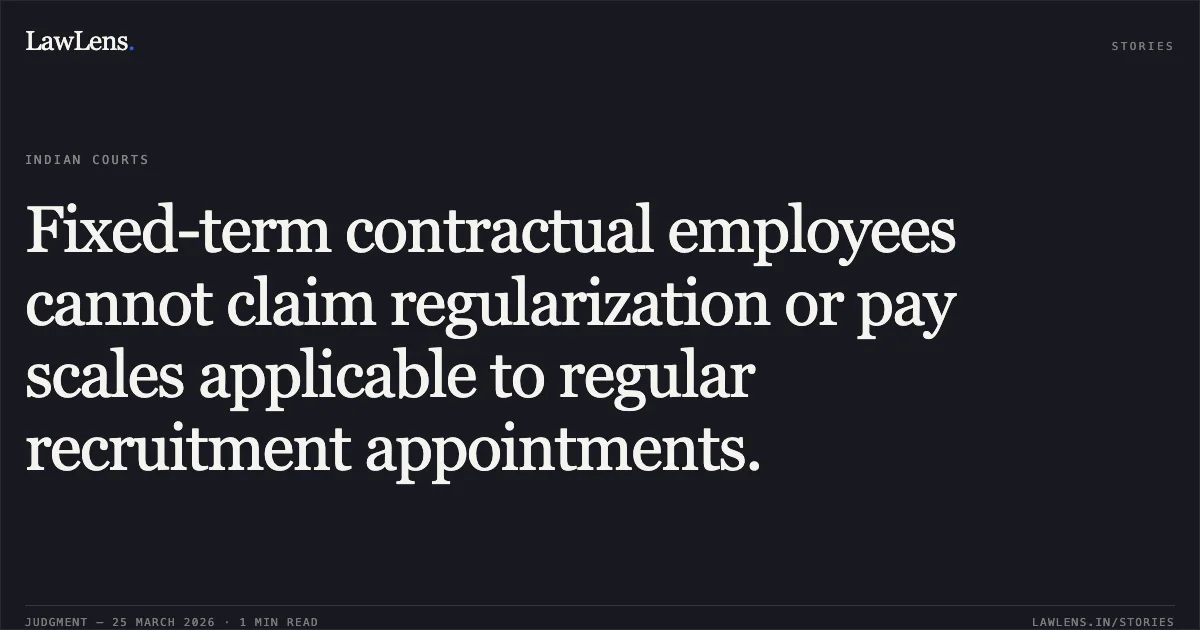
The High Court dismissed the petition, holding that the petitioners are not entitled to regularization or regular pay scales as their appointments were purely ad-hoc and contractual
The court ruled that petitioners have no fundamental right to continue in service beyond the contract term unless renewed by the employer
Source reference: para. 15The Rule was discharged, and the previously granted interim relief was extended only until 24.04.2026 to allow the petitioners time to seek further legal remedies
Source reference: para. 20-21Original Court PDF
HIRAL PRAVINCHANDRA DESAIvsSTATE OF GUJARAT
Click to open original judgment
Original judgment, available to read, download and summarize on LawLens.in


![Subsequent exoneration does not retrospectively invalidate a finalized promotion select list.. UNNIKRISHNAN M vs M/o Environment And Forests. CAT - ['Ernakulam']. LawLens](/stories/thumbnails/subsequent-exoneration-does-not-retrospectively-invalidate-a-finalized-promotion-select-li-ce80a0e84f2f4887857271e8b4341c42.webp)