Facts
The petitioner was convicted by the Chief Metropolitan Magistrate, North-West District, Rohini Courts, of offences under Sections 394/34 and 411 of the Indian Penal Code, 1860. He was sentenced to five years’ rigorous imprisonment and a fine of ₹10,000 for the Section 394/34 offence, and one year’s simple imprisonment for the Section 411 offence, with the sentences to run concurrently.
Source reference: p. 1Pending his criminal revision, he applied under Sections 430 and 528 of the Bharatiya Nagarik Suraksha Sanhita, 2023 (BNSS), for suspension of sentence and release on bail.
Source reference: p. 1The prosecution case relied on the complainant’s testimony, identification of the petitioner, and recovery of the complainant’s Aadhaar card. The petitioner challenged the reliability of the evidence, including the timing of the test identification parade, absence of an MLC, and limited recovery.
Source reference: p. 2The nominal roll recorded actual custody of one year, five months and fourteen days as of 8 December 2025; counsel submitted that the petitioner had been in custody for over two years by the date of the order.
Source reference: p. 3Issues
1. Whether the petitioner’s remaining fixed-term sentence should be suspended pending determination of his criminal revision.
Source reference: pp. 3–42. Whether the petitioner should be released on bail, and on what conditions, during the pendency of the revision.
Source reference: pp. 4–5Law Applied
Section 430 of the BNSS, read with Section 528, formed the statutory basis for the application seeking suspension of sentence and release on bail.
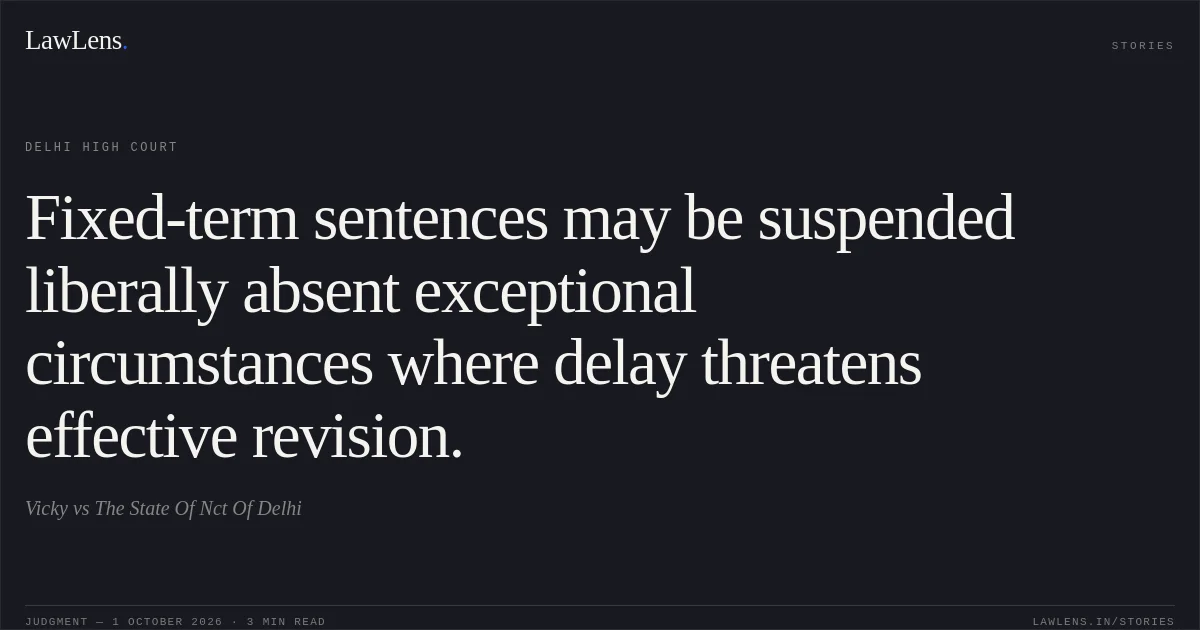
Source reference: p. 1In Bhagwan Rama Shinde Gosai v. State of Gujarat, (1999) 4 SCC 421, the Supreme Court held that where a convicted person is serving a fixed-term sentence and has invoked a statutory appellate remedy, suspension of sentence may be considered liberally unless exceptional circumstances or a statutory restriction apply. If the proceeding cannot be decided expeditiously, the court should give special consideration to suspension so that the remedy is not rendered ineffective by the passage of time; appropriate conditions may be imposed.
Source reference: pp. 3–4Reasoning
The Court treated the petitioner’s challenges to the prosecution evidence as arguable matters for consideration at the revision hearing, without deciding their merits at the bail stage.
Source reference: pp. 2–3It then considered that the sentence was for a fixed period of five years, that the petitioner had already spent a substantial period in custody, and that the time required to decide the revision was uncertain.
Source reference: p. 3In light of the principle in Bhagwan Rama Shinde Gosai, the Court concluded that continued incarceration could account for an appreciable part of the sentence before the revision was adjudicated. It therefore ordered suspension of the remaining sentence subject to stringent conditions.
Source reference: pp. 3–4Holding
The Court allowed the application and suspended the remaining sentence pending the criminal revision.
It directed the petitioner’s release on a personal bond of ₹20,000 with a surety of like amount, to the satisfaction of the Trial Court.
Source reference: p. 4Conditions included remaining within the NCT of Delhi without prior permission, providing and updating residential and contact details, keeping his mobile phone switched on with location services enabled, avoiding contact with the complainant and the complainant’s family, refraining from criminal activity, and reporting to the concerned SHO on the first Monday of each month.
Source reference: pp. 4–5The Court clarified that its order expressed no opinion on the merits of the pending revision.
Source reference: p. 5Acts & Sections Cited
7 provisions across 3 statutes referred to in this judgment. Each provision opens on LawLens.
Bharatiya Nagarik Suraksha Sanhita, 20232
Code of Criminal Procedure, 19732
Indian Penal Code, 18603
Original Court PDF
VickyvsThe State Of Nct Of Delhi
Click to open original judgment
Original judgment, available to read, download and summarize on LawLens.in