Facts
On 14 May 2017, the four appellants were injured when a Tavera car in which they were travelling collided with a tree after its driver lost control.
Source reference: p.5They filed separate compensation petitions. The Motor Accidents Claims Tribunal partly allowed the claims, and the appellants appealed under Section 173(1) of the Motor Vehicles Act, 1988, seeking enhancement.
Source reference: p.6–10The High Court considered the appeals together against the Tribunal’s common award dated 15 July 2020.
Source reference: p.5Issues
Whether the compensation awarded by the Tribunal to each appellant was inadequate and required modification.
Source reference: p.10What order should follow from the determination of the compensation issue.
Source reference: p.10–11Law Applied
The appeals were brought under Section 173(1) of the Motor Vehicles Act, 1988, which provides for an appeal against an award of a Motor Accidents Claims Tribunal.
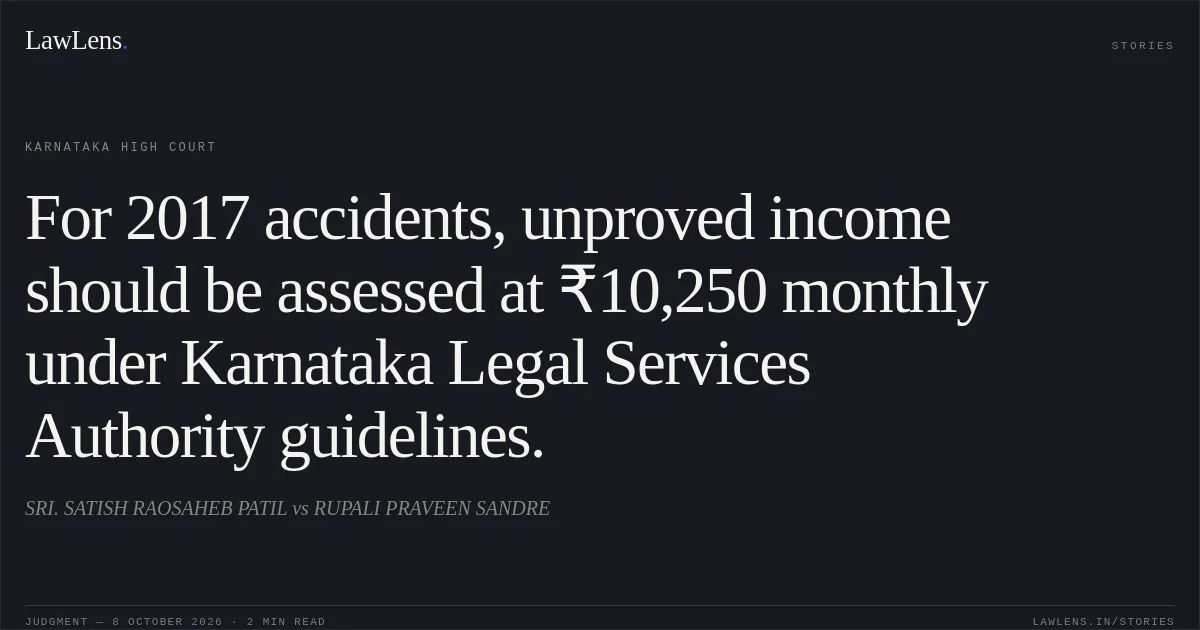
Source reference: p.2–4Where claimants have not proved their income, the court may assess it by reference to the Karnataka Legal Services Authority guidelines; for an accident in 2017, the court adopted a monthly income of ₹10,250.
Source reference: p.12, 15, 18, 21Applying Sarla Verma v. Delhi Transport Corporation, 2009 ACJ 1298, the court selected the multiplier by reference to each claimant’s age.
Source reference: p.12, 16, 19, 22The extent of permanent disability for calculation of future loss of income was assessed on the evidence, including the medical evidence, and applied to the multiplier calculation.
Source reference: p.11–12, 14–15, 18, 21–22Reasoning
The court found that the Tribunal had used a monthly income of ₹7,500, below the applicable 2017 guideline figure, and recalculated future loss of income using ₹10,250 per month, the relevant multiplier and the whole-body disability assessed for each claimant.
Source reference: p.12, 15–16, 18–19, 21–22It otherwise considered each claimant’s injuries, hospitalisation and medical records when adjusting compensation under heads including pain and suffering, laid-up-period income, incidental expenses and loss of amenities; medical expenses and certain other amounts were left undisturbed where the Tribunal’s award was considered appropriate.
Source reference: p.12–14, 16–17, 19–20, 22–23The resulting awards were ₹3,45,600 for Satish, ₹3,73,149 for Sunil, ₹4,87,805 for Ranjit and ₹2,11,050 for Basavaraj.
Source reference: p.14, 17, 20–21, 23–24Holding
The appeals were allowed in part, and the Tribunal’s awards were modified. The total compensation payable was fixed at ₹3,45,600 in MFA No. 101384/2021, ₹3,73,149 in MFA No. 101376/2021, ₹4,87,805 in MFA No. 101409/2021 and ₹2,11,050 in MFA No. 101398/2021.
The enhanced compensation carries interest at 6% per annum from the date of the respective petition until payment; the respondents were held jointly and severally liable, and the insurer was directed to deposit the enhanced amounts with accrued interest within four weeks of receiving the certified judgment.
Source reference: p.25Acts & Sections Cited
1 provisions across 1 statute referred to in this judgment. Each provision opens on LawLens.
Motor Vehicles Act, 19881
Original Court PDF
SRI. SATISH RAOSAHEB PATILvsRUPALI PRAVEEN SANDRE
Click to open original judgment
Original judgment, available to read, download and summarize on LawLens.in