Facts
The claimants, the parents of the deceased, sought compensation under Section 166 of the Motor Vehicles Act, 1988, after their 20-year-old son died from injuries sustained when he fell from a goods-carrying jeep on 25 February 2008.
Source reference: p. 1–2The Tribunal awarded Rs. 8,36,554 with interest at 9% per annum and held the owner, driver and insurer jointly and severally liable.
Source reference: p. 1The insurer appealed, contending that the deceased was an unauthorised passenger in a goods carriage and that the driver lacked a valid LMV licence. The insurer did not press the licence ground, relying on M/s. Bajaj Allianz General Insurance Co. Ltd. v. Rambha Devi & Ors., (2025) 3 SCC 95.
Source reference: p. 3Issues
1. Whether the evidence established that the deceased was travelling in the goods carriage without goods, in breach of the insurance policy.
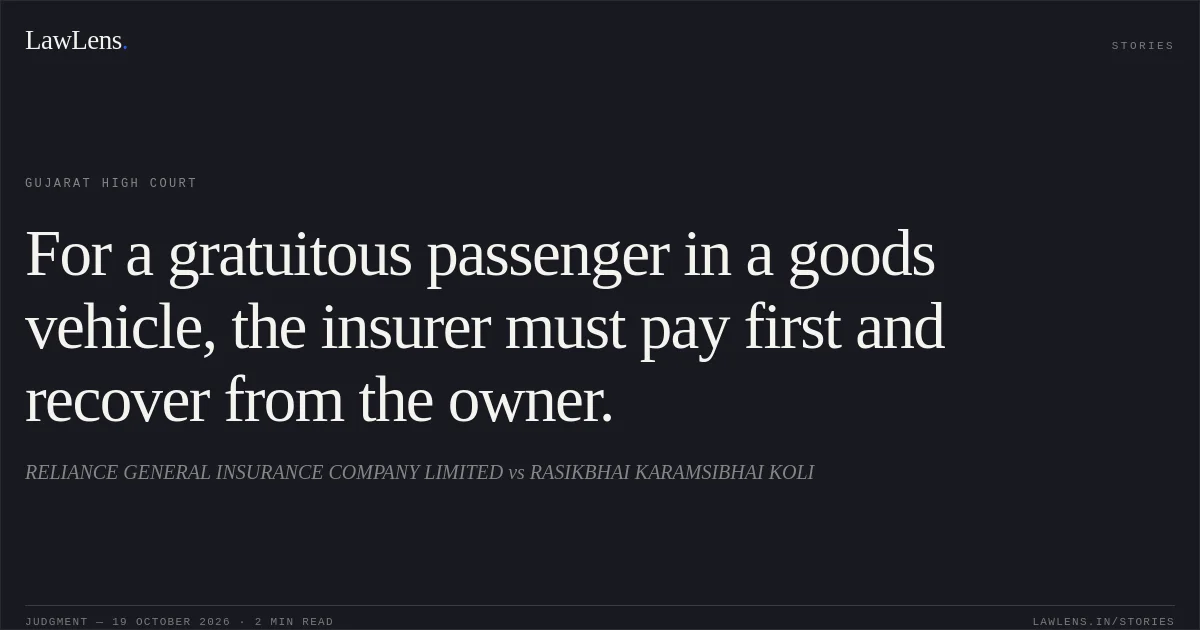
Source reference: p. 4–7, 102. Whether, despite that breach, the insurer should be directed to satisfy the award first and then recover the amount from the vehicle owner.
Source reference: p. 7–10Law Applied
Under the Motor Vehicles Act, 1988, a claim for compensation may be brought under Section 166, and an appeal from the Tribunal’s award lies under Section 173.
Source reference: p. 1–2Where an insurer raises a policy-breach defence, it may establish that defence by relying on evidence adduced by the claimants; it is not invariably required to lead independent evidence.
Source reference: p. 7The Court considered National Insurance Co. Ltd. v. Savitaben Motibhai & Ors., (2006) 2 GLH 468, and the Supreme Court’s decision in Kaminiben v. Oriental Insurance Company Limited, 2026 LiveLaw (SC) 174, including its reliance on Manuara Khatun and National Insurance Co. Ltd. v. Saju P. Paul, (2013) 2 SCC 41. Those authorities support directing the insurer to pay the award first and recover the amount from the insured in the same proceedings, including where the victim was a gratuitous passenger.
Source reference: p. 7–9Reasoning
The claimants’ evidence, rather than independent evidence from the insurer, established that the deceased was travelling without goods. The FIR did not mention any goods; the deceased’s mother’s account that he carried clothes and wheat was weakened by her admissions that she had not identified the goods in the FIR, did not know what happened to them, had not sought their return, and that her son had paid a fare of Rs. 20. The spot panchnama also recorded no goods at the scene.
Source reference: p. 5–6The Court therefore found a policy breach and distinguished Savitaben on the facts.
Source reference: p. 7–9Applying the pay-and-recover principle, it required the insurer to satisfy the award initially, while permitting recovery from the vehicle owner.
Source reference: p. 9–10Holding
The appeal was partly allowed. The Tribunal’s award was modified so that the original opponents Nos. 1 and 2 were jointly and severally liable; the insurer was exonerated from ultimate liability but was directed to satisfy the award first and recover the amount from the vehicle owner by executing the judgment in accordance with law.
The remaining directions were maintained, and the Tribunal was directed to disburse the compensation to claimant No. 2, as claimant No. 1 had died during the appeal.
Source reference: p. 10–11Acts & Sections Cited
3 provisions across 1 statute referred to in this judgment. Each provision opens on LawLens.
Motor Vehicles Act, 19883
Original Court PDF
RELIANCE GENERAL INSURANCE COMPANY LIMITEDvsRASIKBHAI KARAMSIBHAI KOLI
Click to open original judgment
Original judgment, available to read, download and summarize on LawLens.in