Facts
The applicant-appellant was convicted under Section 20(b)(ii)(B) of the Narcotic Drugs and Psychotropic Substances Act, 1985, in FIR No. 07/2016 registered at Police Station Aut, District Mandi.
Source reference: para. 1By judgment and order dated 06.04.2022, he was sentenced to rigorous imprisonment for 10 years, a fine of ₹1,00,000, and, in default of payment of fine, simple imprisonment for one year.
Source reference: para. 1During the pendency of his criminal appeal, he sought suspension of sentence.
Source reference: para. 2The appeal had remained pending since 2025, and the applicant had undergone approximately four years and two months of imprisonment without causing delay in its hearing.
Source reference: paras. 7–8Issues
1. Whether the alleged contradictions and discrepancies in the prosecution evidence justified suspension of the applicant’s sentence at the interlocutory stage.
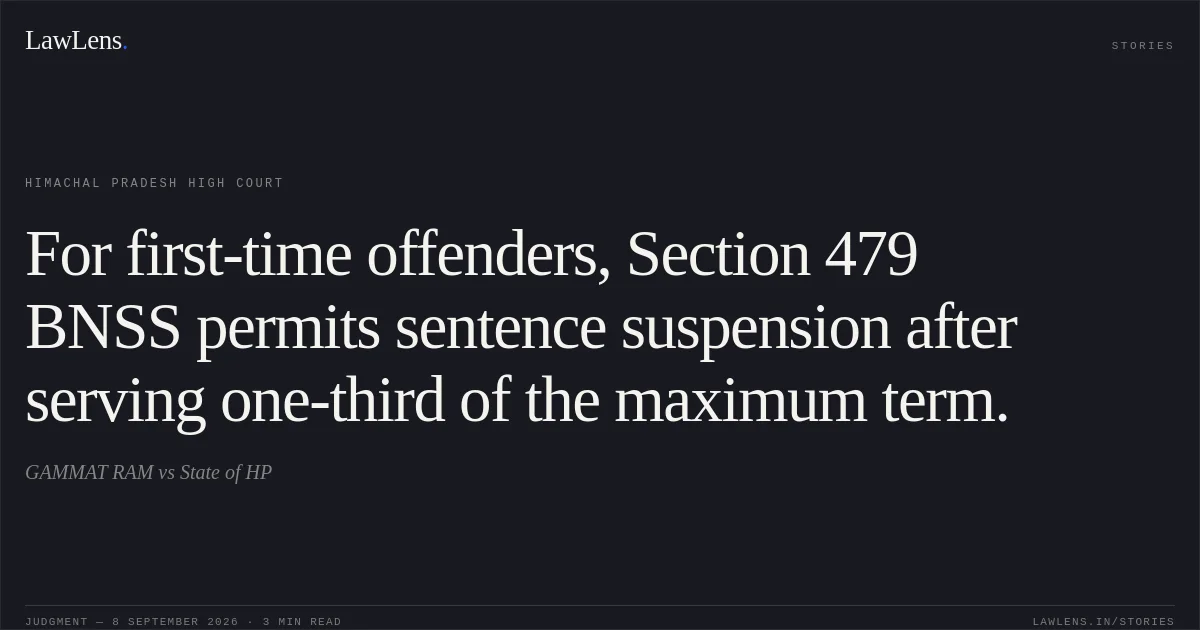
Source reference: paras. 2–52. Whether Section 479 BNSS could be invoked while considering suspension of sentence of a convicted appellant who had undergone more than one-third of the maximum sentence prescribed for the offence and whose appeal was pending.
Source reference: paras. 4–83. Whether the applicant was entitled to suspension of his substantive sentence during the pendency of the appeal, subject to appropriate conditions.
Source reference: paras. 7–10Law Applied
The Court applied Section 20(b)(ii)(B) of the NDPS Act, under which the relevant offence carried a maximum sentence of 10 years’ imprisonment.
Source reference: paras. 1, 4It considered Section 479 BNSS, corresponding to former Section 436A of the Code of Criminal Procedure, 1973, which provides that a first-time offender may be released on bond upon undergoing detention for up to one-third of the maximum period of imprisonment prescribed for the offence, subject to the statutory conditions and exclusions.
Source reference: para. 6The Court further relied on the principle, stated to have been recognised by the Supreme Court, that Section 436A CrPC, now Section 479 BNSS, may be considered while deciding an application for suspension of sentence by a convicted person whose appeal is pending.
Source reference: para. 6At the suspension stage, the Court declined to undertake a detailed assessment of the entire evidence or determine the merits of the appeal.
Source reference: para. 5Reasoning
The Court declined to accept the applicant’s submission that the discrepancies in the witnesses’ statements demonstrated a fair likelihood of acquittal, holding that resolving those contradictions would require examination of the entire evidence and would effectively amount to hearing the pending appeal on merits.
Source reference: para. 5However, the Court accepted the alternative submission based on the applicant’s custody period.
Source reference: para. 7The applicant was a first-time offender, the maximum sentence under Section 20(b)(ii)(B) of the NDPS Act was 10 years, and one-third of that period amounted to three years and four months.
Source reference: paras. 4, 7On the basis of the custody certificate and the period elapsed thereafter, the Court found that he had undergone more than one-third of the maximum sentence.
Source reference: paras. 4, 7Since the appeal had been pending since 2025, the applicant had not contributed to the delay, and the appeal had not been heard due to reasons including paucity of time, the Court considered suspension of sentence appropriate.
Source reference: para. 8Holding
The Court allowed the application and suspended the substantive sentence of Gummat Ram during the pendency of his appeal.
His release was made subject to furnishing a personal bond of ₹1,00,000 with one surety in the like amount to the satisfaction of the Trial Court, along with an undertaking to appear before the High Court as directed and to surrender if the appeal was dismissed so as to serve the remaining sentence.
Source reference: para. 9He was further directed not to commit any illegal, unlawful, or similar offence during the period of suspension, failing which the suspension could be cancelled.
Source reference: para. 10The bail bonds were to be transmitted to the High Court Registry, and the Trial Court was permitted to act on a downloaded copy of the order after verifying it from the High Court website.
Source reference: paras. 11–13Acts & Sections Cited
3 provisions across 3 statutes referred to in this judgment. Each provision opens on LawLens.
Narcotic Drugs and Psychotropic Substances Act, 19851
Bharatiya Nagarik Suraksha Sanhita, 20231
Code of Criminal Procedure, 19731
Original Court PDF
GAMMAT RAMvsState of HP
Click to open original judgment
Original judgment, available to read, download and summarize on LawLens.in