01Facts
The petitioners and private respondents were appointed as Junior Assistants in the District Industries and Commerce Centre, Cachar, Silchar. The petitioners applied pursuant to an advertisement dated 17.01.2016, while the private respondents applied pursuant to a subsequent advertisement dated 09.02.2016. Separate examinations were conducted, but the Department published a combined select list on 26/29.02.2016 and issued appointment orders to all four candidates on 29.02.2016. All joined on 01.03.2016.
¶ 3, 14 · p. 5, 13The merit-cum-seniority list placed the private respondents, who had secured 87.77 and 83.95 marks, above the petitioners, who had secured 81.65 and 69.65 marks.
¶ 3 · p. 6The petitioners challenged the seniority-cum-merit list dated 31.07.2020 and the final gradation list dated 14.03.2022, contending that their selection arose from the earlier advertisement and that they should consequently rank senior to the private respondents.
¶ 2 · p. 4They relied on Office Memorandum No. ABP.51/63/1 dated 05.02.1964 and contended that the two advertisements represented separate selection batches.
¶ 5–8 · pp. 7–10The State and private respondents argued that all candidates were appointed and joined on the same dates, that a combined select list was issued, and that inter se seniority was therefore governed by merit under Rule 11(i) of the Assam Ministerial District Establishment Service Rules, 1967.
¶ 9–12 · pp. 10–1202Issues
i.Whether the petitioners were entitled to seniority over the private respondents merely because they had applied and undergone selection pursuant to an earlier advertisement.
¶ 5–7, 24–27 · pp. 7–9, 18–20ii.Whether the seniority of the candidates was governed by Office Memorandum No. ABP.51/63/1 dated 05.02.1964 or by Rule 11(i) of the Assam Ministerial District Establishment Service Rules, 1967.
¶ 15–21, 24–26 · pp. 14–20iii.Whether the combined select list and the consequential seniority-cum-merit and final gradation lists were legally sustainable.
¶ 14, 23, 26–29 · pp. 13–2103Law Applied
The Court applied the Assam Ministerial District Establishment Service Rules, 1967, which govern the Lower Division cadre, subsequently re-designated as Junior Assistant, in the DICC establishment.
¶ 17–19 · pp. 15–16Under Rule 11(i), seniority is ordinarily determined by the date of appointment where the appointees join within 15 days; where more than one person is appointed on the same date, inter se seniority is determined according to the candidates’ positions in the applicable merit list.
¶ 20–21 · pp. 16–17Rule 6(6) contemplates direct recruitment through competitive examination.
¶ 19 · p. 16Office Memorandum No. ABP.51/63/1 dated 05.02.1964, prescribing seniority according to the merit list of candidates selected in one batch, applies only where no specific statutory service rule governs the matter and does not confer seniority merely from participation in an earlier selection process.
¶ 24–26 · pp. 18–20The Court also relied on K. Meghachandra Singh v. Ningam Siro, (2020) 5 SCC 689, for the principle that seniority cannot be claimed from a date preceding an appointee’s entry into the cadre.
¶ 28 · p. 2004Reasoning
The Court held that although the advertisements and examinations were separate, no separate select list was published for the petitioners’ selection. Instead, the Department issued a combined select list showing all four selected candidates.
¶ 14–15, 23, 26 · pp. 13–14, 17, 20Since all candidates received appointment orders on the same date and joined on the same date, Rule 11(i), rather than the general Office Memorandum, governed their inter se seniority.
¶ 20–21, 26 · pp. 16–17, 20Applying the merit-list criterion under that rule, the private respondents were correctly placed above the petitioners because they had obtained higher marks.
¶ 27 · p. 20Although the Court expressed concern that the Department appeared to have issued a second advertisement after the first selection process without adequately explaining the emergence of subsequent vacancies, it found that this procedural concern did not alter the applicable seniority rule or create a right of seniority in favour of the petitioners.
¶ 22 · p. 17The petitioners could not claim seniority from the date of the earlier examination or advertisement, particularly when they entered the cadre on the same date as the private respondents.
¶ 28 · p. 2005Holding
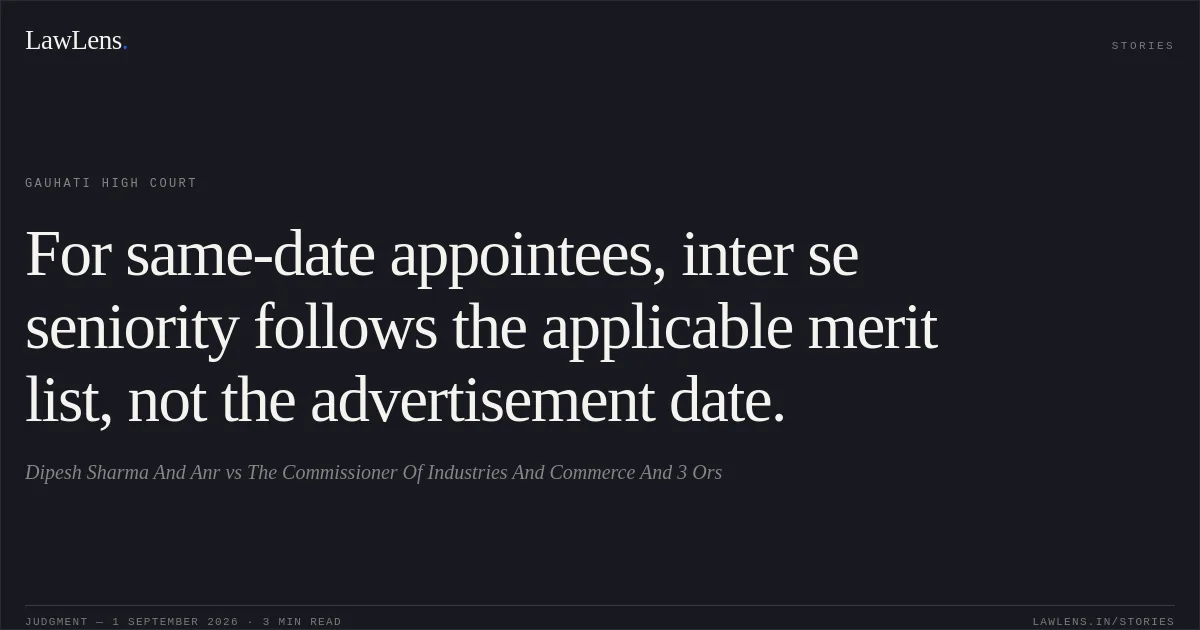
The Court answered the issues against the petitioners. It held that the Assam Ministerial District Establishment Service Rules, 1967 governed seniority; because all four candidates were appointed and joined on the same dates, their inter se seniority was validly determined by their merit positions.
¶ 26–29 · pp. 20–21The private respondents’ higher ranking was therefore upheld.
¶ 26–29 · pp. 20–21Both writ petitions—WP(C) No. 4876/2023 and WP(C) No. 2357/2022—were dismissed. Any interim orders were vacated, and pending interlocutory applications were also dismissed.
¶ 29–32 · p. 21Original Court PDF
Dipesh Sharma And AnrvsThe Commissioner Of Industries And Commerce And 3 Ors
Click to open original judgment
Original judgment, available to read, download and summarize on LawLens.in