Facts
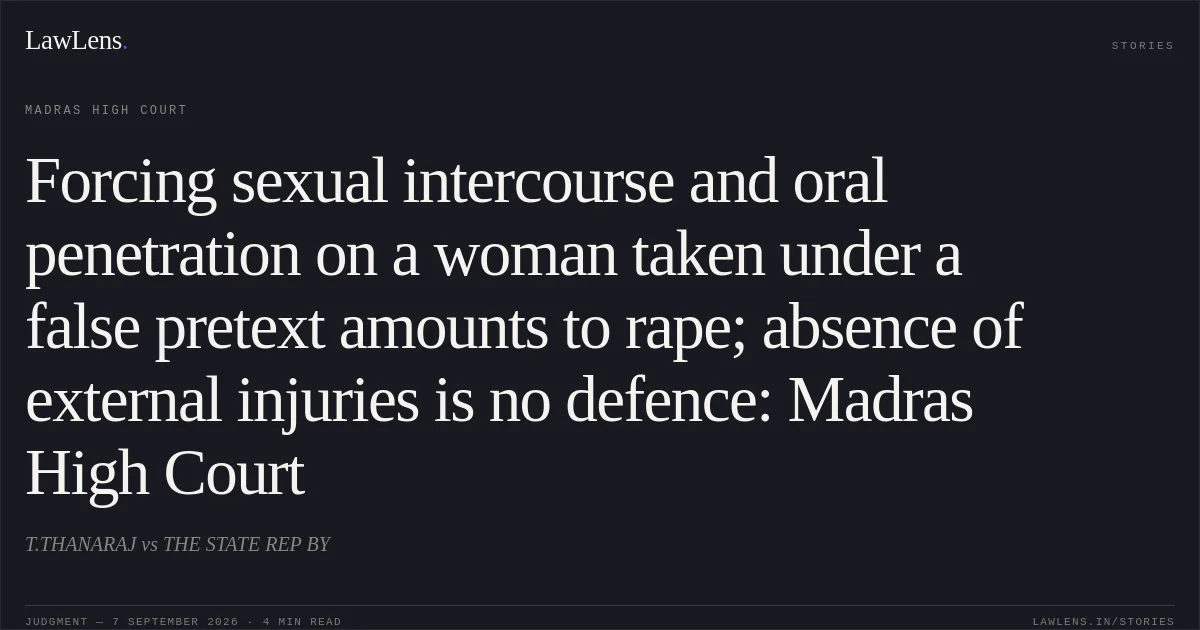
The appellant, a relative of P.W.1, accompanied P.W.1 and her husband, P.W.2, while they were searching for a bride for their son. After visiting P.W.5’s house, the appellant allegedly took P.W.1 on his motorcycle under the pretext of showing her other prospective brides, but instead took her to a forest area and forcibly committed rape, including inserting his penis into her mouth. He thereafter left her at a bus stand, where P.W.2 and an independent witness, P.W.3, found her crying and were informed about the incident
Source reference: p.2–4; paras. 2.1–2.3P.W.1 lodged the complaint on the following day. The medical examination disclosed no external injuries, but the doctor opined that she had been subjected to sexual intercourse. The appellant was medically found to be potent. The Sessions Court convicted him under Sections 366, 376(2)(f), and 354A(2) IPC, sentencing him to ten years’ rigorous imprisonment under Section 366 IPC, life imprisonment under Section 376(2)(f) IPC, and three years’ rigorous imprisonment under Section 354A(2) IPC, with the sentences to run concurrently. The appellant challenged the conviction and sentence under Section 374(2) Cr.P.C.
Source reference: p.1–4; para. 1; para. 2.3Issues
1. Whether the testimony of P.W.1, supported by the surrounding circumstances and corroborative evidence, established that the appellant committed rape despite the absence of external injuries or semen detection?
Source reference: pp.7–10; paras. 10–122. Whether taking P.W.1 on a motorcycle under the false pretext of showing other prospective brides and thereafter taking her to a forest area constituted abduction punishable under Section 366 IPC?
Source reference: p.11; para. 133. Whether the appellant’s relationship with P.W.1 attracted the aggravated form of rape under Section 376(2)(f) IPC, or whether the offence was punishable only under Section 376(1) IPC?
Source reference: pp.11–12; para. 144. Whether the separate conviction and sentence under Section 354A(2) IPC should be sustained in view of the conviction and substantial sentences for rape and abduction?
Source reference: p.12; para. 14Law Applied
The Court applied Section 375 IPC, holding that rape may be established through the credible and reliable testimony of the victim and that penetration is not confined to vaginal penetration; insertion of the penis into the mouth also falls within the statutory concept of rape. The absence of external injuries or semen detection is not, by itself, sufficient to discredit the victim’s testimony.
Source reference: pp.9–10; paras. 11–12Section 366 IPC applies where a woman is taken by deceitful means or without consent with the intention of compelling or facilitating illicit sexual intercourse. Section 376(2)(f) IPC requires the existence of the aggravating circumstance specified in that provision, including a position of trust or authority; absent proof of such circumstance, the offence falls under Section 376(1) IPC. The Court also exercised its appellate jurisdiction under Section 374(2) Cr.P.C. to modify the conviction and sentence.
Source reference: p.1; para. 1; p.11; para. 13; pp.11–12; para. 14Reasoning
The Court found P.W.1’s account consistent with the surrounding circumstances: the appellant had accompanied her to P.W.5’s house, subsequently took her away on the false representation that other brides would be shown, and she was later found crying at the bus stand by P.Ws.2 and 3. P.W.3 was an independent witness with no apparent reason to falsely implicate the appellant, while P.W.4 and the investigating evidence supported the appellant’s apprehension shortly after the incident.
Source reference: pp.7–10; paras. 10–12The Court held that the absence of external injuries was not inconsistent with forcible sexual assault, particularly in view of the circumstances and nature of the place of occurrence. It therefore accepted P.W.1’s testimony as sufficient to establish rape.
Source reference: pp.9–10; paras. 11–12The Court further held that the appellant had taken P.W.1 under a false pretext and diverted her to a forest area with the intention of committing forcible sexual intercourse, thereby satisfying Section 366 IPC.
Source reference: p.11; para. 13However, although the appellant was a relative of P.W.1, the prosecution did not establish that he occupied a position of trust or authority over her. Consequently, the aggravated conviction under Section 376(2)(f) IPC was unsustainable and was altered to Section 376(1) IPC.
Source reference: pp.11–12; para. 14In view of the principal convictions and sentences, the Court considered the separate punishment under Section 354A(2) IPC unwarranted.
Source reference: p.12; para. 14Holding
The appeal was partly allowed. The conviction under Section 366 IPC was confirmed, together with the sentence of ten years’ rigorous imprisonment and a fine of ₹10,000, with one year’s simple imprisonment in default. The conviction under Section 376(2)(f) IPC was altered to Section 376(1) IPC, and the appellant was sentenced to ten years’ rigorous imprisonment and a fine of ₹25,000, with three years’ simple imprisonment in default.
The conviction and sentence under Section 354A(2) IPC were set aside. The sentences under Sections 366 and 376(1) IPC were directed to run concurrently.
Source reference: p.12; para. 14Original Court PDF
T.THANARAJvsTHE STATE REP BY
Click to open original judgment
Original judgment, available to read, download and summarize on LawLens.in