Facts
The petitioner, an Italian national, had previously been granted a multiple-entry Indian e-Visa on 1 August 2024, permitting a continuous stay of up to 180 days without registration. His permitted period was due to expire on 27 January 2025.
Source reference: pp. 2–3Although he had booked a flight from Goa to Doha on 22 January 2025, the airline declined boarding after noticing a handwritten correction in his passport. He obtained a corrected passport from the Italian Consulate on 23 January 2025, but was subsequently informed that, having exceeded the 180-day period, he required an Exit Permit. The Exit Permit was issued on 5 February 2025, and he left India on 8 February 2025.
Source reference: pp. 2–3On returning to India on 10 February 2025, he was stopped at Mopa International Airport and allegedly informed that he had been blacklisted and would not be permitted to re-enter India. No written blacklisting order was furnished to him. His representations to the Ministry of Home Affairs and the Director (Foreigners) elicited no response.
Source reference: pp. 2–3He therefore filed a petition under Article 226 seeking a direction permitting him to enter India on a visa on arrival.
Source reference: p. 3Issues
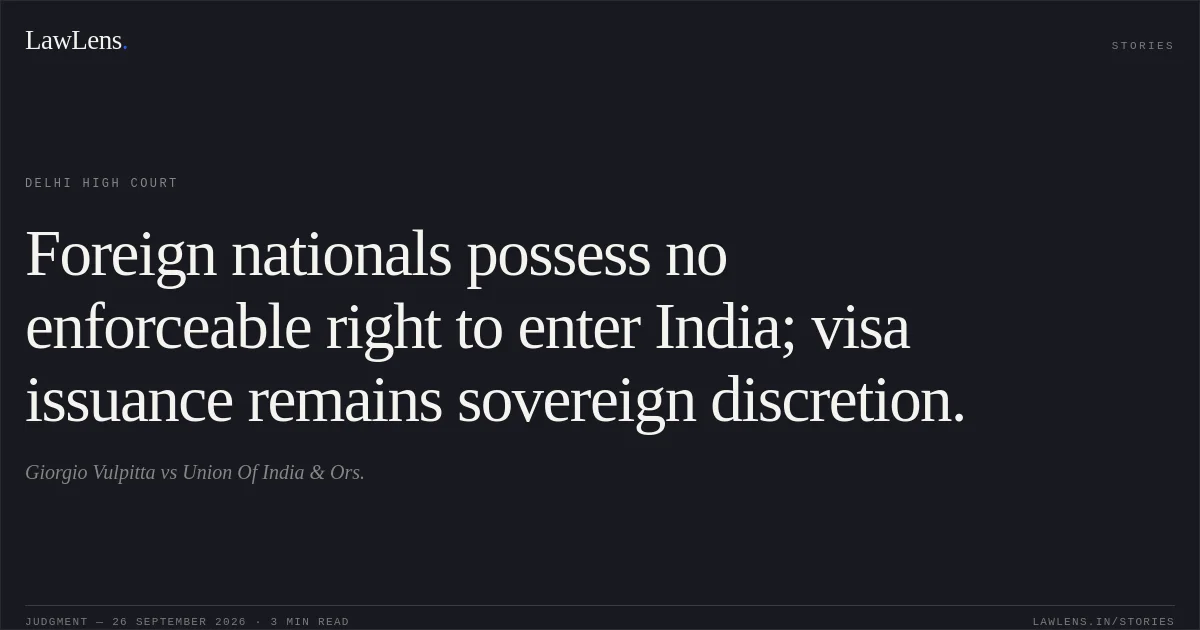
Whether a foreign national has an enforceable legal or fundamental right to enter India and seek issuance of a visa on arrival.
Source reference: pp. 3–4, 6Whether the petitioner’s alleged blacklisting without a written order or prior hearing entitled him to a writ of mandamus directing the respondents to permit his entry into India.
Source reference: pp. 3–6Whether the decision in Mohd. Javed & Anr. v. Union of India & Anr. required the respondents to follow principles of natural justice or grant the petitioner a visa.
Source reference: pp. 4–6Law Applied
The Court applied Section 3 of the Foreigners Act, 1946, and Section 7 of the Immigration and Foreigners Act, 2025, which empower the Central Government to prohibit, regulate or restrict the entry, departure, presence or continued presence of foreigners in India.
Source reference: p. 4Relying on Hans Muller of Nurenburg v. Superintendent, Presidency Jail , 1955 SCR (1) 1284, the Court held that the Government possesses an absolute and unfettered discretion, including the power to expel foreigners.
Source reference: p. 4Under Louis De Raedt v. Union of India , 1991 (3) SCC 544, a foreigner’s protection under Article 21 is confined to life and personal liberty and does not include a right to reside or settle in India; the State’s power to expel a foreigner remains unrestricted.
Source reference: pp. 4–5The Court also relied on Randa Chehab v. Union of India & Ors. , 2023:DHC:9126, for the principle that entry into India is a matter of sovereign discretion and not an enforceable right.
Source reference: p. 5A writ under Article 226 may issue only upon establishment of infringement of a legal or constitutional right.
Source reference: p. 6Reasoning
The Court held that the petitioner could not claim mandamus because entry into India and issuance of a visa are matters involving national security, foreign policy and executive discretion, rather than vested rights enforceable against the State.
Source reference: pp. 3–5The petitioner’s alleged blacklisting and refusal of re-entry therefore did not, by themselves, establish infringement of a legally enforceable right.
Source reference: pp. 3–5The Court distinguished Mohd. Javed , where the foreign national was married to an Indian citizen, had two Indian-citizen children, and had resided in India for thirteen years on a valid Long-Term Visa that was revoked without procedure.
Source reference: pp. 5–6In that exceptional factual context, natural justice was required before deprivation of the family’s Article 21 interests.
Source reference: pp. 5–6The present petitioner had no comparable family or continuing-residence circumstances, and the decision did not create a right of entry or require the grant of a visa.
Source reference: pp. 5–6Holding
The Court answered the issues against the petitioner. It held that a foreign national has no inherent or legally enforceable right to enter India or obtain a visa on arrival, and that the petitioner failed to demonstrate infringement of any right warranting intervention under Article 226.
The writ petition was dismissed.
Source reference: p. 6The application for preponement was disposed of, and the previously fixed hearing date of 16 November 2026 was cancelled.
Source reference: pp. 1, 6Acts & Sections Cited
1 provisions across 1 statute referred to in this judgment. Each provision opens on LawLens.
Immigration and Foreigners Act, 20251
Original Court PDF
Giorgio VulpittavsUnion Of India & Ors.
Click to open original judgment
Original judgment, available to read, download and summarize on LawLens.in