01Facts
The complainant (R-2, K.M. Muniraju) claims to have purchased Survey Nos. 100/1 and 100/2 of Kadiganahalli Village, Jala Hobli, under two registered sale deeds dated 03.11.2014 for ₹4 crore from K.A. Ramakrishna (accused No. 2) and Bhagyamma.
¶ 5.2, 5.4The sale deeds were not fully released because the revenue sketch was not finalized.
¶ 5.4, 28Accused No. 3 and 4 (B. Ravikumar Reddy and P. Jagannath Reddy) filed O.S. No. 881/2015 and 882/2015, which were settled on 12.07.2025 in a compromise decree involving accused No. 1 and 2, without disclosing the complainant's claim.
¶ 25, 28The complainant is not a party to those suits.
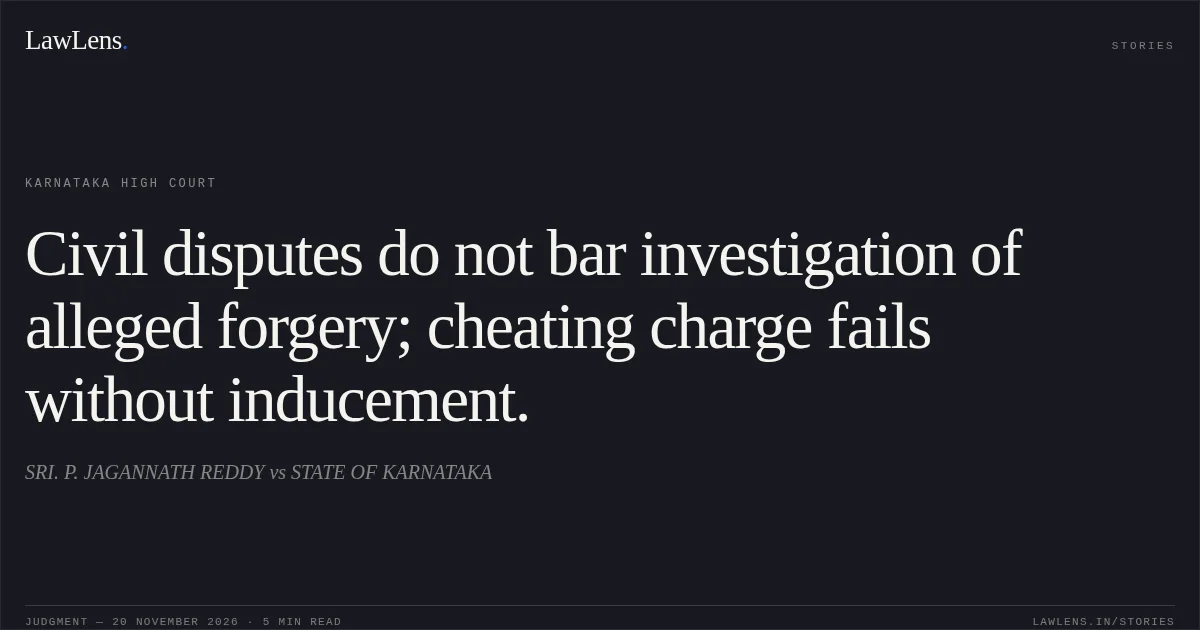
¶ 25The complainant alleges that an unregistered Memorandum of Understanding dated 04.10.2014 was fabricated by forging his signature and was produced before the court as genuine.
¶ 5.6, 21He denies execution of the MoU.
¶ 23The sale deed dated 03.11.2014 does not refer to the MoU, though both documents describe the same properties.
¶ 24Based on a complaint dated 12.03.2026, FIR No. 60/2026 was registered at Hoskote Police Station for offences under Sections 120B, 420, 465, 467, 468 and 471 IPC.
¶ 2, 4Accused No. 1 and 2 (W.P. No. 9012/2026) and accused No. 3 and 4 (Crl.P No. 4473/2026) sought quashing, contending that the dispute is civil in nature.
¶ 6, 1502Issues
i.1. Whether the allegation of forgery of the Memorandum of Understanding dated 04.10.2014 discloses a cognizable offence warranting investigation, such that the FIR cannot be quashed on that score.
¶ 29, 32, 34ii.2. Whether the alleged fraudulent settlement in O.S. Nos. 881/2015 and 882/2015 constitutes an offence of cheating under Section 420 IPC (or Section 318 BNS) and is amenable to criminal investigation.
¶ 35–38, 4403Law Applied
The court exercised its inherent jurisdiction under Articles 226–227 of the Constitution and Section 528 BNSS (corresponding to Section 482 CrPC).
¶ 2At the quashing stage the court need only determine whether the FIR allegations disclose a cognizable offence and must not examine the merits, leaving investigation to the police.
¶ 31–32 (Neeharika Infrastructure (P) Ltd. v. State of Maharashtra (2021) 19 SCC 401)The existence of civil remedies does not by itself bar criminal proceedings where the allegations disclose criminal liability.
¶ 33 (Punit Beriwala v. State of NCT of Delhi, 2025 SCC OnLine SC 983)The test of whether the FIR discloses an offence requires examination of the ingredients of Section 420 IPC.
¶ 36 (State of Haryana v. Bhajanlal, 1992 Supp (1) SCC 335)Section 420 IPC requires deception, dishonest inducement, and delivery of property; the absence of inducement negates the offence.
¶ 36–37Breach of contract is not itself an offence.
¶ 16 (V.Y. Jose v. State of Gujarat (2009) 3 SCC 78)G. Sagar Suri v. State of U.P. (2000) 2 SCC 636 and Paramjeet Batra v. State of Uttarakhand (2013) 11 SCC 673 were quashed on their peculiar facts and are distinguished.
¶ 41–43Provisions in the judgment · 9 · Linked ones open on LawLens
Bharatiya Nagarik Suraksha Sanhita, 2023 Section 528
Code of Criminal Procedure, 1973 Section 482
Indian Penal Code, 1860 Section 420Section 465Section 467Section 468Section 471
Bharatiya Nyaya Sanhita, 2023 Section 318
Negotiable Instruments Act, 1881 Section 138
04Reasoning
The forgery allegation, which the complainant denies and which places the MoU before the court as genuine, discloses prima facie offences under Sections 465, 467, 468 and 471 IPC.
¶ 30The MoU is alleged to have been executed by accused No. 1 and 2, who are parties to it, so investigation is warranted.
¶ 32, 40The pendency of civil suits does not stall this investigation.
¶ 40As to the settlement, the court found no allegation of inducement by which the complainant parted with property. The complainant did not allege that he was induced to deliver anything, and the FIR refers only to the MoU incident of 04.10.2014, not to the compromise.
¶ 37–38The settlement, being a compromise between other parties in suits to which the complainant is not a party, is a civil act whose validity must be tested in the civil forum.
¶ 36, 38–39Unlike Paramjeet Batra, no surrounding peculiar circumstances warrant quashing the forgery limb.
¶ 42–4305Holding
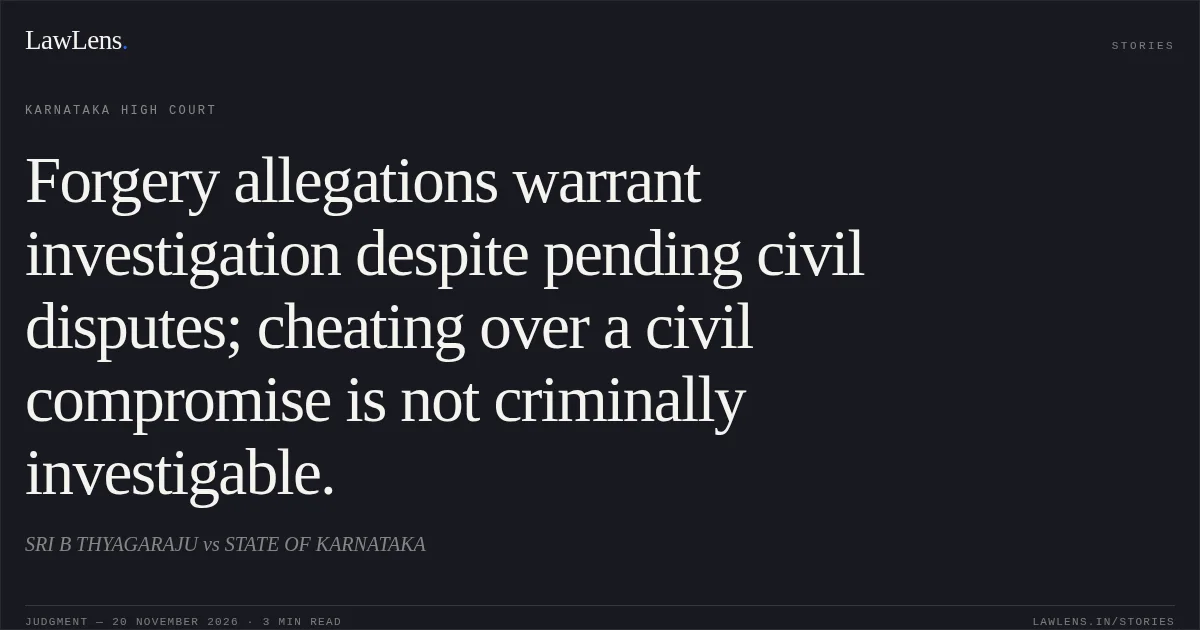
Issue 1 is answered in the affirmative: the forgery allegation regarding the MoU dated 04.10.2014 requires investigation and cannot be quashed.
¶ 34, 44Issue 2 is answered in the negative: the settlement in O.S. Nos. 881/2015 and 882/2015 does not disclose cheating under Section 420 IPC and cannot be the subject of criminal investigation.
¶ 36–39, 44The petitions are allowed in part. The FIR in Crime No. 60/2026 is quashed insofar as it concerns Section 420 IPC. Investigation against the petitioners continues only on the allegation of forgery of the MoU dated 04.10.2014. No investigation may proceed on the alleged fraudulent settlement. The court expresses no opinion on the merits of the forgery allegation or the compromise. Any challenge to the validity of the settlement must be decided by the competent civil forum.
order (ii), order (iii), order (iv), order (v)–(vii)Original Court PDF
SRI B THYAGARAJUvsSTATE OF KARNATAKA
Click to open original judgment
Original judgment, available to read, download and summarize on LawLens.in