Facts
The applicant, a Millwright (Skilled) at the Ordnance Factory, Tiruchirappalli, was issued a Charge Memorandum on 25.05.2015 under Rule 16 of the CCS (CCA) Rules, 1965
Source reference: p. 3-4The charges alleged that on 08.08.2014, he obstructed the movement of a deceased contract labourer’s body from the factory hospital to a government hospital for post-mortem by making unreasonable demands
Source reference: p. 8The Disciplinary Authority (3rd Respondent) imposed a minor penalty of "withholding of one increment for one year without cumulative effect" on 20.07.2015
Source reference: p. 4The applicant appealed to the 2nd Respondent, who issued a show-cause notice for enhancement of penalty
Source reference: p. 4On 24.05.2016, the Appellate Authority enhanced the penalty to "reduction to a lower stage in the time scale of pay by one stage for two years without cumulative effect"
Source reference: p. 4, 7-8The applicant challenged this enhancement on grounds of lack of preliminary inquiry, bias, and violation of natural justice
Source reference: p. 4-5Issues
1. Whether the disciplinary proceedings and subsequent enhancement of penalty under Rule 16 of the CCS (CCA) Rules were vitiated by procedural irregularities or violation of the principles of natural justice
Source reference: p. 4-92. Whether the absence of a formal inquiry and cross-examination invalidated the findings of the Disciplinary and Appellate Authorities
Source reference: p. 10-11Law Applied
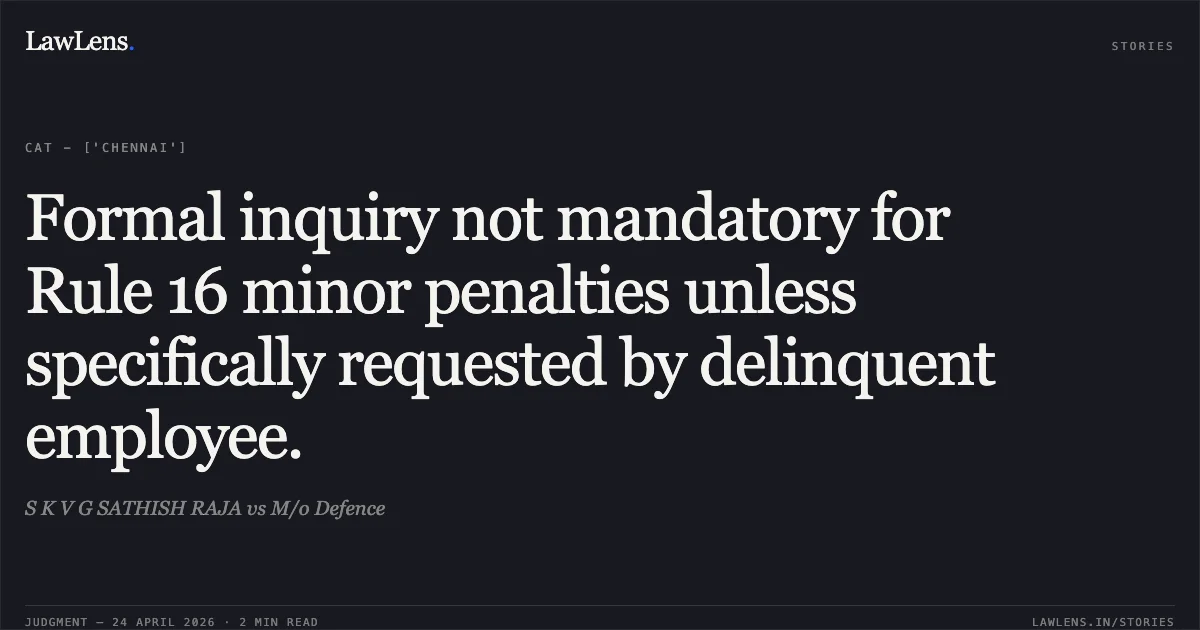
Rule 16 of the CCS (CCA) Rules, 1965, which stipulates that a formal inquiry is not mandatory for minor penalty proceedings unless specifically requested by the delinquent employee or deemed necessary by the authority
Source reference: p. 9Principle from K.L. Tripathi vs. State Bank of India Others (1984), establishing that cross-examination is not an absolute right and is only necessary when facts are disputed or credibility is in doubt
Source reference: p. 10-11Standard from M.V. Bijlani vs. Union of India (2006), which mandates that disciplinary findings must be based on a "preponderance of probability" through relevant evidence and proper appreciation of material
Source reference: p. 11-12Reasoning
The Tribunal found that the applicant never requested a formal inquiry during the Rule 16 proceedings, and therefore, the Disciplinary Authority was not legally bound to conduct one
Source reference: p. 7, 9The evidence on record clearly established the applicant’s active role in obstructing the movement of the deceased's body
Source reference: p. 8Regarding the enhancement of penalty, the Tribunal noted that the Appellate Authority followed the requisite procedure by issuing a show-cause notice before passing a reasoned "speaking order"
Source reference: p. 9-10Applying the K.L. Tripathi precedent, the Tribunal ruled that no prejudice was caused to the applicant by the absence of cross-examination since the facts were substantiated by the record
Source reference: p. 10-11The Tribunal concluded that the judicial review scope is limited to procedural fairness and, as the authorities’ findings were supported by evidence and not founded on conjectures, interference was not warranted
Source reference: p. 12Holding
The Tribunal answered the issues in the negative, holding that there were no procedural lapses or violations of natural justice in the proceedings
It held that the misconduct was serious enough to justify the enhanced minor penalty imposed by the Appellate Authority
Source reference: p. 12Consequently, the Original Application was dismissed as being devoid of merit, and no order as to costs was passed
Source reference: p. 13Acts & Sections Cited
1 provisions across 1 statute referred to in this judgment. Linked provisions open on LawLens.
Central Civil Services (Classification, Control & Appeal) Rules, 19651
Original Court PDF
S K V G SATHISH RAJAvsM/o Defence
Click to open original judgment
Original judgment, available to read, download and summarize on LawLens.in