Facts
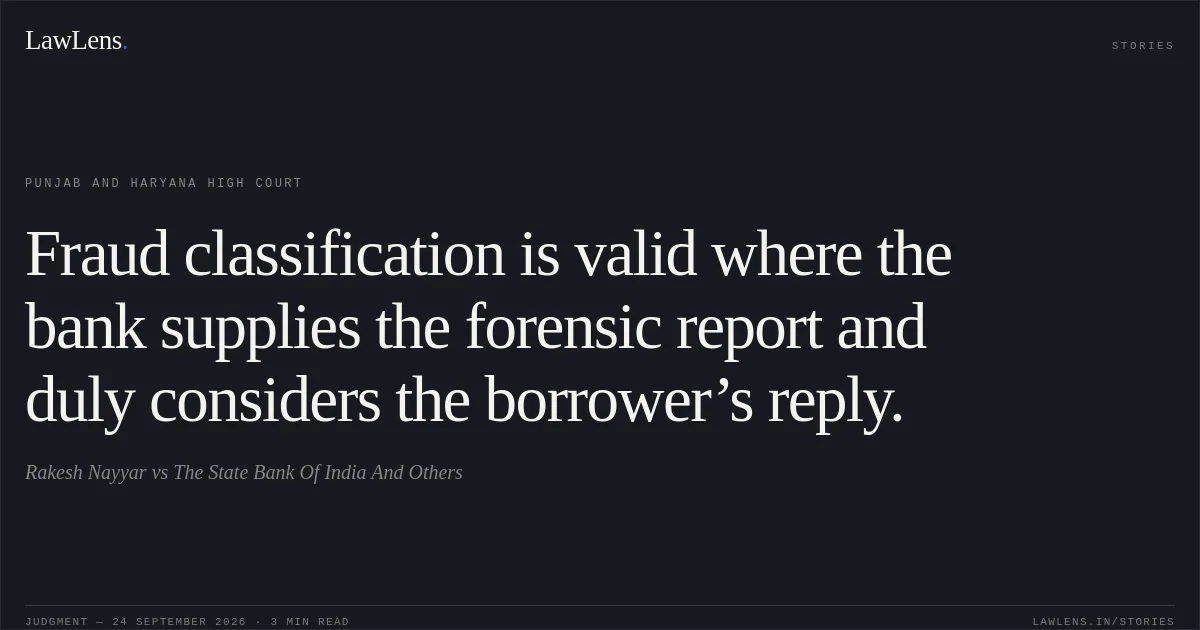
The petitioner, a former Director of Woolways India Limited, challenged the State Bank of India’s orders dated 21.02.2026 and 11.03.2026, whereby the company’s loan account was classified as “fraud” and the company and its Directors were reported to the Reserve Bank of India.
Source reference: paras. 1–2.3The company had entered Corporate Insolvency Resolution Process under the Insolvency and Bankruptcy Code, 2016, pursuant to an NCLT order dated 10.05.2018, following which its management, assets and records came under the control of the Interim Resolution Professional/Liquidator.
Source reference: para. 2SBI issued a show-cause notice dated 02.12.2025 based on a forensic audit report dated 25.03.2019, alleging five instances of financial irregularity and fraud.
Source reference: paras. 2.1–2.2The petitioner submitted a reply dated 18.12.2025, contending, inter alia, that the relevant corporate records were in the custody of the Liquidator and that he had not been afforded a proper opportunity to defend himself.
Source reference: paras. 2.1–2.2, 4.3The petitioner relied on a repayment/settlement plan approved on 10.11.2025 and contended that the adverse action violated natural justice.
Source reference: paras. 4.2–4.5SBI argued that the show-cause notice was accompanied by the complete 157-page forensic audit report, the petitioner had filed a detailed reply, and the Review Committee had considered the reply and dropped one of the five allegations before classifying the account as fraud.
Source reference: paras. 5–5.1, 10Issues
Whether the classification of Woolways India Limited’s loan account as “fraud” and the reporting of the petitioner’s name to the RBI were vitiated for failure to comply with the principles of natural justice?
Source reference: paras. 1, 2.4, 7–8Whether SBI had complied with the requirements laid down in State Bank of India v. Rajesh Aggarwal by furnishing the forensic audit report, providing an opportunity to respond, and passing a reasoned order before classifying the account as fraud?
Source reference: paras. 7, 11–11.1Whether the insolvency proceedings and subsequent repayment/settlement plan prevented SBI from initiating or completing fraud-classification proceedings based on past transactions?
Source reference: paras. 4.2, 4.5, 5Law Applied
The Court applied Clauses 8.9.4 and 8.9.5 of the RBI’s Master Directions on Frauds/earlier Fraud Classification and Reporting Directions, 2016, read with the constitutional principles of natural justice and audi alteram partem.
Source reference: para. 7Relying on State Bank of India v. Rajesh Aggarwal, 2023 (6) SCC 1, the Court held that before classifying a borrower’s account as fraud, the lender must furnish the forensic audit report, provide a reasonable opportunity to submit a representation, consider the objections, and pass a reasoned order; such procedural safeguards are required because fraud classification carries serious civil and penal consequences, including debarment from institutional finance.
Source reference: para. 7The Court also applied the principle that the completion of insolvency or settlement proceedings does not, by itself, eliminate the Bank’s independent obligation to examine and report suspected fraud.
Source reference: paras. 5, 12Reasoning
The Court found that SBI had issued a comprehensive show-cause notice identifying the alleged fraud-related irregularities and had supplied the complete forensic audit report along with it.
Source reference: para. 8The petitioner submitted a point-by-point reply, which was considered by the Review Committee.
Source reference: para. 9The Committee did not mechanically accept the audit findings: it dropped one of the five allegations concerning the alleged operation of multiple cash-credit facilities and addressed the remaining allegations and the petitioner’s objections in its proceedings dated 21.02.2026.
Source reference: paras. 10–11.1The Court rejected the petitioner’s contention that custody of the company’s records with the Liquidator established denial of natural justice, noting that there was no specific material showing that the petitioner had sought particular records or that his contentions had been ignored.
Source reference: para. 10Since the forensic report had been furnished, an opportunity to respond had been granted, the reply had been considered, and a reasoned decision had been made, the requirements stated in Rajesh Aggarwal were held to be satisfied.
Source reference: paras. 7, 11–11.1The insolvency process and settlement plan did not invalidate the Bank’s independent fraud-classification exercise.
Source reference: paras. 5, 12Holding
The Court held that SBI had complied with the principles of audi alteram partem and the procedural requirements governing fraud classification.
The orders dated 21.02.2026 and 11.03.2026 classifying the company’s loan account as “fraud” and reporting the company and its Directors to the RBI were upheld.
Source reference: paras. 12–14The writ petition was dismissed for lack of merit, and any pending miscellaneous application was also disposed of.
Source reference: paras. 12–14Acts & Sections Cited
1 provisions across 1 statute referred to in this judgment. Each provision opens on LawLens.
Insolvency and Bankruptcy Code, 2016.1
Original Court PDF
Rakesh NayyarvsThe State Bank Of India And Others
Click to open original judgment
Original judgment, available to read, download and summarize on LawLens.in