Facts
The respondent-insured filed a claim for Rs. 28,20,65,797/- following a fire at its godown on 25.03.2011, which it attributed to a short circuit
Source reference: para. 3, 10Notably, the respondent had significantly enhanced its insurance coverage shortly before the incident—increasing one policy to Rs. 19 Crores on 07.03.2011 and obtaining another for Rs. 17 Crores in November 2010
Source reference: para. 4While the appellant-insurer repudiated the claim as fraudulent, the National Consumer Disputes Redressal Commission (NCDRC), by order dated 04.12.2023, partly allowed the complaint and directed the appellant to pay Rs. 3,33,63,642/- with interest, based on the surveyor's assessment of physical damage
Source reference: para. 2, 9Investigations by the surveyor and an independent expert (Truth Labs) revealed the presence of kerosene (a fire accelerant) at the seat of the fire and confirmed that the alleged suppliers of the damaged stock were either non-existent or had not engaged in the claimed transactions
Source reference: para. 14, 16Issues
1. Whether the fire incident was an accidental event or a deliberate act of arson intended to defraud the insurance company
Source reference: para. 8, 182. Whether a claim founded on fraud can be partially sustained on the basis of actual physical loss
Source reference: para. 19, 21Law Applied
The court applied the fundamental legal principle that fraud vitiates all solemn acts, rendering any judgment or benefit obtained through it a nullity.
Source reference: para. 20It relied on S.P. Chengalvaraya Naidu v. Jagannath (1994) 1 SCC 1, which established that no person can be permitted to take advantage of their own wrong
Source reference: para. 20The court further cited A.V. Papayya Sastry v. Government of Andhra Pradesh (2007) 4 SCC 221, reiterating that fraud vitiates all judicial acts
Source reference: para. 20Additionally, the court emphasized that an insurance contract is a contract of indemnity and cannot be used as an instrument of unjust enrichment
Source reference: para. 22Reasoning
The Court observed that the proximity between the enhancement of insurance coverage and the fire incident raised serious doubts regarding the bona fides of the claim
Source reference: para. 13Forensic evidence from Truth Labs, specifically GC-MS analysis, proved the presence of kerosene residues at the fire’s origin while ruling out electrical short circuits due to the absence of overheating or bead formation in the wiring
Source reference: para. 14The Court noted the respondent's conduct, including the submission of fabricated invoices from non-existent suppliers and manipulated accounts intended to inflate the claim
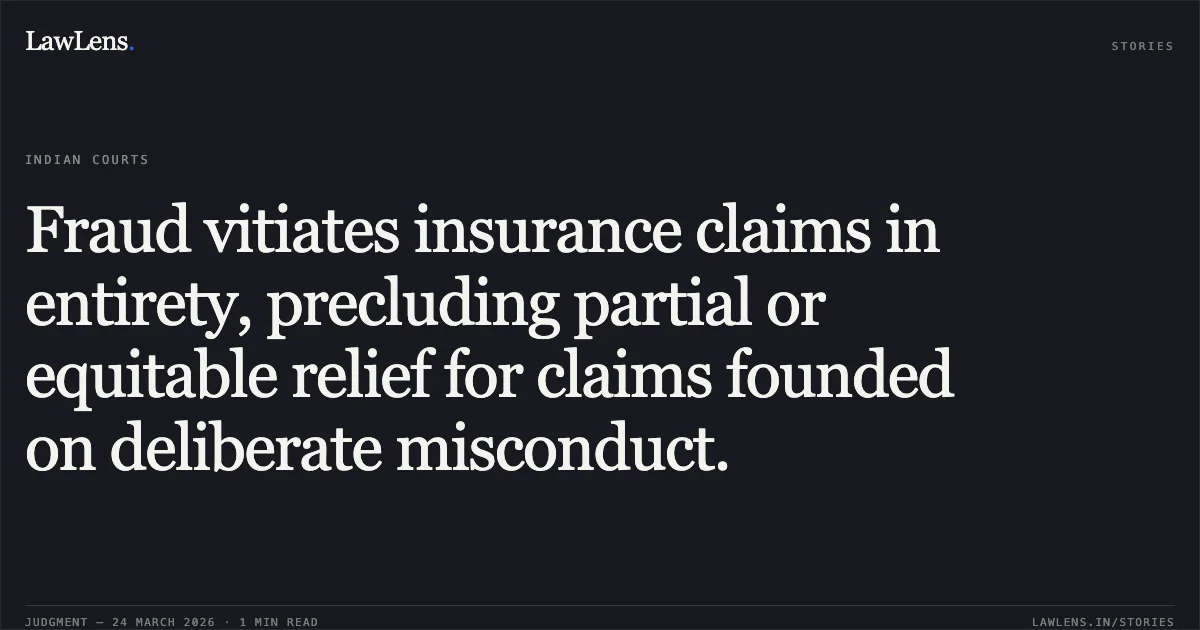
Source reference: para. 15-17The Court critiqued the NCDRC's approach, stating that the Commission erred by awarding partial compensation merely because a fire occurred, thereby ignoring the overwhelming evidence of arson
Source reference: para. 19It reasoned that once the foundational requirement of a genuine claim is absent due to fraud, the entire claim must collapse, irrespective of the physical damage quantified by a surveyor
Source reference: para. 21-22Holding
The Supreme Court allowed the appeal and set aside the NCDRC order, holding that the respondent is not entitled to any amount as the claim was founded on a deliberate act of arson and fraud
The Court directed the refund of the deposited amount to the appellant
Source reference: para. 24Furthermore, citing the serious ramifications of staged insurance claims, the Court directed the Commissioner of Police, Ahmedabad, to constitute a Special Investigation Team (SIT) to conduct a comprehensive criminal investigation into the fraud and submit a report within three months
Source reference: para. 26The cross-appeal filed by the respondent was dismissed
Source reference: Civil Appeal No. 10019/2024Original Court PDF
United India Insurance Co.Ltd.vsSayona Colors Pvt. Ltd.
Click to open original judgment
Original judgment, available to read, download and summarize on LawLens.in