Facts
The claimant sought compensation under Section 166 of the Motor Vehicles Act, 1988, alleging that a motorcycle struck the motorcycle on which he was travelling as a pillion rider, causing fractures and other injuries.
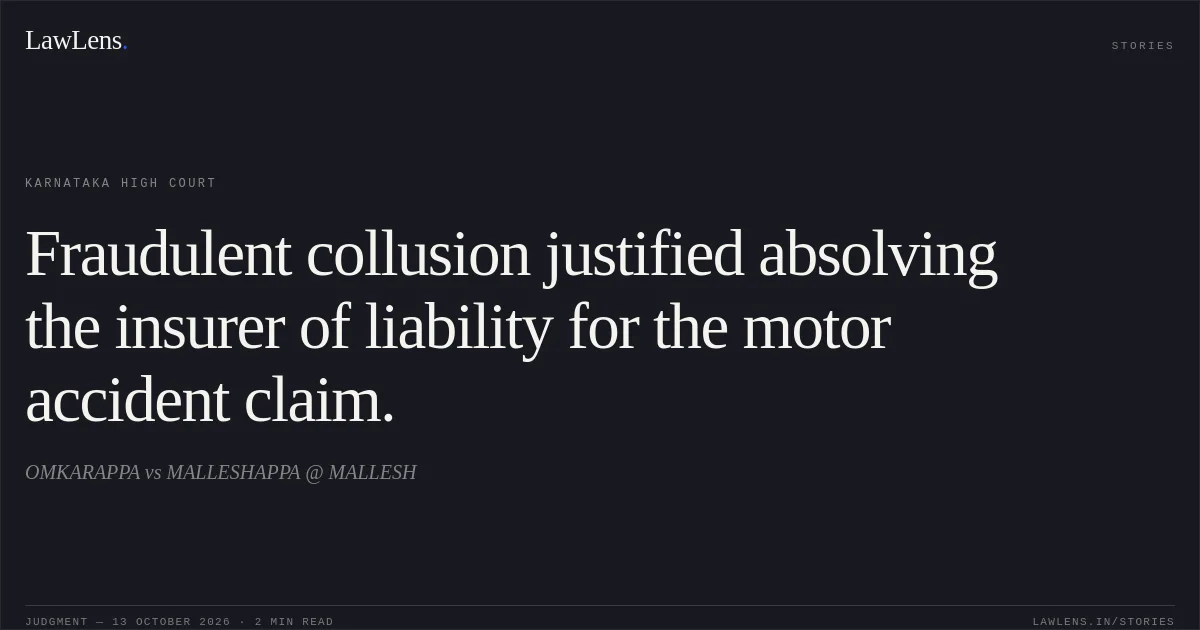
Source reference: pp. 2–4The Tribunal found negligence and assessed compensation at ₹2,32,917, but dismissed the claim against the insurer after concluding that the claim involved collusion and fraud; it held the vehicle owner liable.
Source reference: pp. 2–4The claimant appealed, challenging the finding absolving the insurer and seeking enhancement of compensation.
Source reference: pp. 4–7Issues
Whether the Tribunal was justified in dismissing the claim petition against the insurer.
Source reference: p. 8, para. 13Whether the claimant was entitled to enhancement of compensation.
Source reference: p. 8, para. 13Law Applied
The claim was brought under Section 166 of the Motor Vehicles Act, 1988, and the appeal under Section 173(1) of that Act.
Source reference: pp. 2–3The Court referred to Dalip Singh v. State of Uttar Pradesh, (2010) 2 SCC 144, for the principle that a party who practises fraud on the court cannot ordinarily claim the court’s assistance.
Source reference: p. 10, para. 16The claimant relied on New India Assurance Co. Ltd. v. Yallavva, ILR 2020 KAR 2239, for the proposition that an insurer may be required to pay a third-party claimant and recover from the insured where a policy breach is established; the Court noted that submission but did not apply it to displace the Tribunal’s finding of fraud.
Source reference: p. 5, para. 8For quantum, the Court reassessed compensation using the 2015 notional monthly income of ₹9,000, an 8% loss of earning capacity and multiplier of 11, while considering the injuries and treatment period.
Source reference: pp. 11–13, paras. 17–18Reasoning
On the insurer issue, the Court considered the delayed complaint naming Malleshappa as the rider alongside hospital records that identified Malleshappa as the pillion rider and his son Parashuram as the rider. It also noted the absence of an adequate explanation for the delay and the claimant’s unexplained status between the accident and his examination at hospital. Viewed cumulatively, these circumstances supported the Tribunal’s finding of collusion and fraud; the Court therefore declined to disturb the dismissal against the insurer.
Source reference: pp. 9–11, paras. 14–16On quantum, it adopted the 2015 notional income of ₹9,000 per month and retained the Tribunal’s 8% assessment of loss of earning capacity, but enhanced certain heads to reflect the fractures, recovery period and future medical expenses.
Source reference: pp. 11–13, paras. 17–18Holding
The dismissal of the claim against the insurer was sustained.
The appeal was allowed in part. The owner was directed to deposit the reassessed compensation of ₹3,09,597, with interest at 8% per annum from the date of the claim petition until deposit, within eight weeks. The amount, with accrued interest, was ordered to be released to the claimant.
Source reference: pp. 13–14, para. 19Acts & Sections Cited
2 provisions across 1 statute referred to in this judgment. Each provision opens on LawLens.
Motor Vehicles Act, 19882
Original Court PDF
OMKARAPPAvsMALLESHAPPA @ MALLESH
Click to open original judgment
Original judgment, available to read, download and summarize on LawLens.in