Facts
The plaintiff (Deena Nath Baruah) agreed to sell 12 Bighas of land to defendant Nos. 1 and 2 at a rate of ₹8,000 per Bigha, receiving an advance of ₹55,000
Source reference: p. 5While the plaintiff intended to execute Sale Deeds upon payment of the balance amount, the defendants allegedly prepared three Gift Deeds (Nos. 419/99, 420/99, 421/99) instead
Source reference: p. 6The plaintiff, an elderly man, signed these documents under the impression they were Sale Deeds without being allowed to read them
Source reference: p. 6, 17Upon discovering the fraud, the plaintiff filed a suit for declaration of title and cancellation of the Gift Deeds
Source reference: p. 7Both the Trial Court and First Appellate Court decreed in favor of the plaintiff, holding the deeds fraudulent
Source reference: p. 9The defendants appealed to the High Court under Section 100 CPC
Source reference: p. 9Issues
1. Whether the Court was justified in cancelling the deeds on grounds of fraud and undue influence despite the recitals stating the plaintiff was of sound mind and in the absence of specific pleadings
Source reference: p. 10 / para 52. Whether the Court wrongly shifted the burden of proof to the defendants to prove the transaction was not induced by fraud or undue influence
Source reference: p. 10 / para 53. Whether the Court was justified in declaring the deeds invalid without specific findings on the defendants' position to dominate the plaintiff's will under Sections 16 and 17 of the Contract Act
Source reference: p. 10 / para 5Law Applied
The Court applied Section 101 of the Evidence Act, which places the initial burden of proof on the party asserting a fact (the plaintiff), and Section 102, which mandates that the onus shifts once the initial burden is discharged
Source reference: p. 15-16It relied on Anil Rishi v. Gurbaksh Singh regarding the distinction between the "burden of proof" and "onus of proof"
Source reference: p. 15The Court referred to Section 34 of the Specific Relief Act, 1963, regarding the requirement for consequential relief in declaratory suits
Source reference: p. 11, 21It further applied Section 122 of the Transfer of Property Act, 1882, which defines a gift as a voluntary transfer without consideration
Source reference: p. 19Section 100 of the CPC, which restricts interference with concurrent findings of fact unless they are perverse
Source reference: p. 19-21Reasoning
The Court found that the plaintiff had specifically pleaded fraud in paragraphs 6 and 8 of the plaint, refuting the defendants' claim of inadequate pleading
Source reference: p. 14On the burden of proof, the Court reasoned that while the plaintiff bore the initial burden, he successfully discharged it by proving he was elderly, was misled into signing documents he could not peruse, and that no consideration was paid for what the defendants termed a "gift" despite an initial sale agreement
Source reference: p. 17-18Consequently, the onus shifted to the defendants to prove the transaction was voluntary, which they failed to do
Source reference: p. 18Regarding maintainability, the Court rejected the argument that the suit was barred by Section 34 of the Specific Relief Act for lack of seeking "possession"; evidence showed the plaintiff remained in possession, making a prayer for permanent injunction sufficient consequential relief
Source reference: p. 22The Court concluded the "Gift Deeds" were a sham because the parties' original intention was a sale (not a gift), and the lack of consideration or voluntary intent invalidated the instruments
Source reference: p. 19, 24Holding
The High Court dismissed the appeal and affirmed the lower courts' judgments
It held that the substantial questions of law were not attracted as the findings were based on concurrent factual evidence of fraud
Source reference: p. 14, 18, 25The Court declared Gift Deed Nos. 419/99, 420/99, and 421/99 invalid and non-enforceable, confirming the plaintiff's right, title, and interest over the "Ka" schedule land
Source reference: p. 9, 25No order was made for the return of the advance money as the defendants filed no counter-claim
Source reference: p. 9, 13Acts & Sections Cited
7 provisions across 5 statutes referred to in this judgment. Each provision opens on LawLens.
Code of Civil Procedure, 19081
Code of Criminal Procedure, 19731
Indian Contract Act, 18722
Specific Relief Act, 19631
Transfer of Property Act, 18822
Original Court PDF
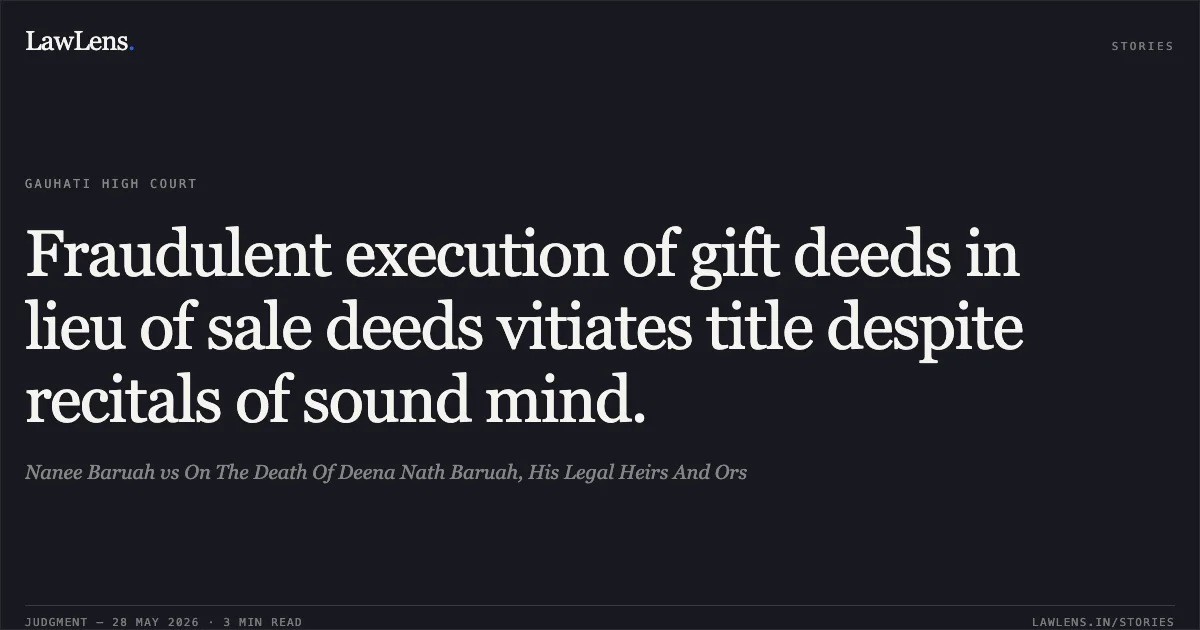
Nanee BaruahvsOn The Death Of Deena Nath Baruah, His Legal Heirs And Ors
Click to open original judgment
Original judgment, available to read, download and summarize on LawLens.in


