Facts
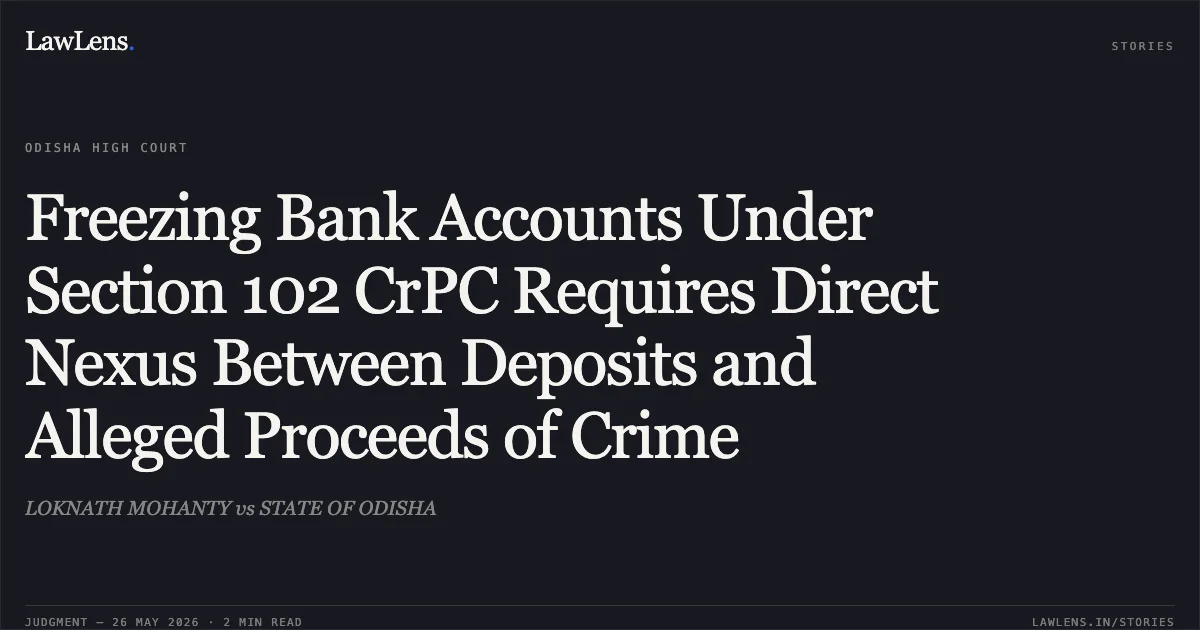
The Petitioner, a transport business owner, was accused of extorting money from a supervisor (Opposite Party No. 2) under Sections 341/294/386/506 of the IPC.
Source reference: p.2During the investigation, the Investigating Officer (I.O.) froze the Petitioner’s HDFC Bank account under Section 102 Cr.P.C., asserting that a deposit of ₹1,90,000 made between January and October 2023 "might have been" extorted funds.
Source reference: p.3-4Lower courts (JMFC and Sessions Judge) rejected the Petitioner’s applications to de-freeze the account, citing the Petitioner’s criminal antecedents (10 prior cases) and the need to protect the victim's interest.
Source reference: p.6, 9The Petitioner challenged these orders, arguing that there was no nexus between the alleged crime and the bank account since the prosecution admitted all alleged extortion payments were made in cash, not through bank transfers.
Source reference: p.5, 8Issues
1. Whether the freezing of a bank account under Section 102 Cr.P.C. (Section 106 BNSS) requires a demonstrable nexus between the property and the alleged offence.
Source reference: para. 172. Whether the freezing of an entire account based on "speculative suspicion" and criminal antecedents, despite the absence of digital transaction trails, is legally sustainable.
Source reference: para. 18-22Law Applied
The Court applied Section 102 of the Cr.P.C. (corresponding to Section 106 of the BNSS), which allows the seizure of property "suspected to have been stolen" or "found under circumstances creating suspicion of commission of an offence".
Source reference: para. 17Precedents such as State of Maharashtra v. Tapas D. Neogy, which includes bank accounts within the definition of "property" under Section 102.
Source reference: para. 14, 17Teesta Atul Setalvad v. State of Gujarat regarding the scope of investigative seizure.
Source reference: para. 14The court emphasized that such power must satisfy the constitutional requirements of proportionality under Articles 14, 21, and 300-A.
Source reference: para. 17, 21Reasoning
The Court reasoned that while Section 102 Cr.P.C. is an investigatory tool, it is not punitive and must not be exercised mechanically.
Source reference: para. 17In this case, the prosecution's admission that the alleged extortion money was paid in cash—and the total lack of evidence showing any NEFT, UPI, or RTGS transfers from the informant to the Petitioner—severed the "live link" or nexus required for seizure.
Source reference: para. 19-20The Court found the I.O.’s action was based on mere "conjectural inference" that deposits from the Petitioner's transport business were proceeds of crime.
Source reference: para. 19Furthermore, while the State highlighted 10 criminal antecedents, the Court held that prior cases cannot substitute for specific proof of a link between the current offence and the current property.
Source reference: para. 22Because the investigation was complete (charge-sheet filed) and the freezing paralyzed the Petitioner’s travel agency operations, the court found the measure disproportionate and a violation of the right to property under Article 300-A.
Source reference: para. 21, 23-24Holding
In the absence of a demonstrable nexus between the bank deposits and the alleged extortion, the indefinite freezing of the account constituted an excessive exercise of statutory power.
The Court allowed the CRLMC, quashed the orders of the lower courts, and ordered the de-freezing of the Petitioner’s HDFC Bank account, concluding that suspicion, however grave, cannot replace the legal requirement for objective material evidence in seizure proceedings.
Source reference: para. 25-26Acts & Sections Cited
31 provisions across 6 statutes referred to in this judgment. Each provision opens on LawLens.
Code of Criminal Procedure, 19736
Bharatiya Nagarik Suraksha Sanhita, 20233
Indian Penal Code, 1860
Negotiable Instruments Act, 18811
Arms Act, 19592
Information Technology Act, 20001
Original Court PDF
LOKNATH MOHANTYvsSTATE OF ODISHA
Click to open original judgment
Original judgment, available to read, download and summarize on LawLens.in