01Facts
The petitioner, a registered firm, approached the High Court under Article 226 of the Constitution concerning a dispute relating to possession and demarcation of land bearing Khasra Nos. 327/5 and 327/7, situated at P.H. No. 30/23, Bijor, District Bilaspur.
¶ 2The petitioner sought directions to the Collector to consider its complaint, representation and objections before conducting demarcation, supervise a fresh demarcation, and reconstitute the demarcation team by excluding Respondent No. 7.
¶ 2The petitioner contended that an earlier demarcation had not resolved the dispute and that the presence of certain persons in the demarcation team would render the process doubtful.
¶ 3, 6The respondents submitted that the Collector had already considered the petitioner’s request and directed the concerned Tehsildar to reconstitute the demarcation team, excluding Respondent No. 7.
¶ 4The Court noted that the dispute required a fresh and fair demarcation.
¶ 602Issues
i.1. Whether the concerned revenue authorities were required to conduct a fresh and fair demarcation of the disputed land after considering the petitioner’s objections and affording the parties an opportunity of hearing.
¶ 6–7ii.2. Whether the demarcation was required to be conducted in accordance with Section 129 of the Chhattisgarh Land Revenue Code and the Rules framed thereunder.
¶ 7iii.3. Whether the High Court should direct the constitution of a fresh demarcation team excluding Respondent No. 7, in light of the Collector’s directions.
¶ 2, 4 and 803Law Applied
The Court exercised its jurisdiction under Article 226 of the Constitution to ensure that the statutory demarcation process was conducted fairly and according to law.
¶ 2It primarily applied Section 129 of the Chhattisgarh Land Revenue Code and the Rules appended thereto, which govern the lawful demarcation of land boundaries.
¶ 7The Court further applied the principles of procedural fairness and natural justice, requiring prior notice, consideration of objections, and a proper opportunity of hearing to affected parties before demarcation.
¶ 7 and 9The Court also recognised that a revenue demarcation would not necessarily finally adjudicate disputed rights or possession, and that dissatisfied parties could pursue remedies before higher authorities.
¶ 7Provisions in the judgment · 1
Chhattisgarh Land Revenue Code, 1959 Section 129
04Reasoning
The Court found that the earlier demarcation had not resolved the parties’ competing claims and that the dispute concerning possession made a fresh demarcation necessary.
¶ 6Since the Collector had already directed the constitution of a demarcation team after considering the petitioner’s objections, the Court declined to undertake any merits-based adjudication or issue an independent direction contrary to that administrative process.
¶ 4, 6 and 8Instead, it directed the concerned Tehsildar to conduct the demarcation in accordance with Section 129 and the applicable Rules, after considering the objections of the petitioner and other parties and providing them a proper opportunity of hearing.
¶ 7To promote transparency and minimise further disputes, the Court also required the demarcation proceedings to be videographed.
¶ 905Holding
The writ petition was disposed of.
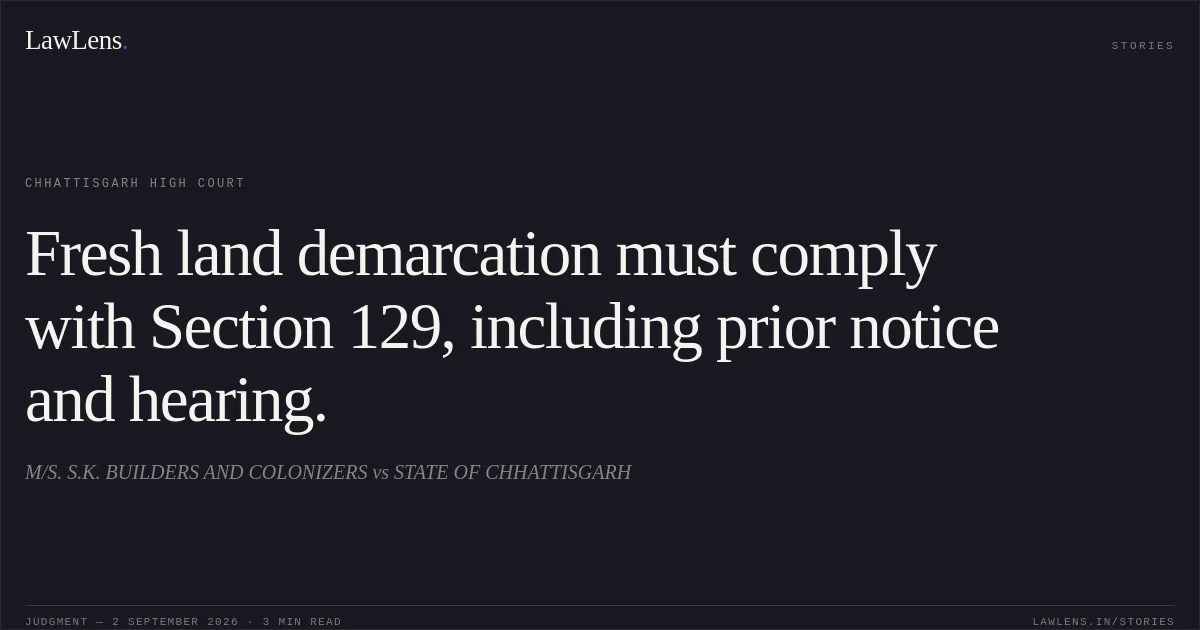
¶ 7–8The concerned Tehsildar was directed to conduct a fair and fresh demarcation in accordance with Section 129 of the Chhattisgarh Land Revenue Code and the applicable Rules, following the demarcation team constituted pursuant to the Collector’s order.
¶ 7–8The parties were to receive prior notice and an opportunity of hearing, and the process was to be completed within 30 days from receipt of the Court’s order.
¶ 9The demarcation was also directed to be videographed.
¶ 9The Court expressly clarified that it had not adjudicated the merits of the parties’ claims and that they remained free to approach higher authorities if dissatisfied with the demarcation.
¶ 7 and 9–10Original Court PDF
M/S. S.K. BUILDERS AND COLONIZERSvsSTATE OF CHHATTISGARH
Click to open original judgment
Original judgment, available to read, download and summarize on LawLens.in