Facts
The appellant (complainant) alleged that on January 3, 2007, he provided a "friendly loan" of ₹2,00,000 to the accused (Respondent Nos. 2 & 3) for business purposes.
Source reference: para. 4Security for this loan was provided via two post-dated cheques for ₹1,50,000 and ₹50,000.
Source reference: para. 4Both cheques were dishonored due to "insufficient funds" in April 2007.
Source reference: para. 4Following a legal notice and a reply from the accused alleging one cheque was lost, the complainant filed a case under Section 138 of the Negotiable Instruments (N.I.) Act.
Source reference: para. 4During the trial, inconsistencies arose in the complainant’s testimony regarding the dates and mode of payment.
Source reference: para. 8The trial court acquitted the respondents on July 28, 2008, leading to this appeal.
Source reference: paras. 2, 5Issues
1. Whether the statutory presumption under the N.I. Act is applicable when the transaction is characterized as a "friendly loan" without commercial consideration.
Source reference: para. 132. Whether the acquittal by the trial court was justified based on the material evidence and the nature of the debt as a "legally enforceable debt".
Source reference: para. 15-16Law Applied
The court applied Section 138 of the Negotiable Instruments Act, 1881, which requires that a cheque must be issued for the discharge of a "legally enforceable debt or other liability".
Source reference: para. 12The court relied on the Supreme Court precedent in Rajesh Jain v. Ajay Singh (2023), which clarifies that the presumption under Section 139 is rebuttable by a "preponderance of probabilities".
Source reference: para. 14The court referred to the Indian Contract Act, 1872, stating that for a debt to be legally enforceable, there must be a contract supported by consideration; the court noted that "friendship cannot be a consideration to form a contract".
Source reference: para. 15Reasoning
The court reasoned that while Section 139 of the N.I. Act creates a presumption in favor of the holder, this presumption "disappears" once the accused produces evidence or circumstances suggesting the non-existence of a legally enforceable debt.
Source reference: para. 14In this case, the complainant admitted the transaction was a "friendly loan".
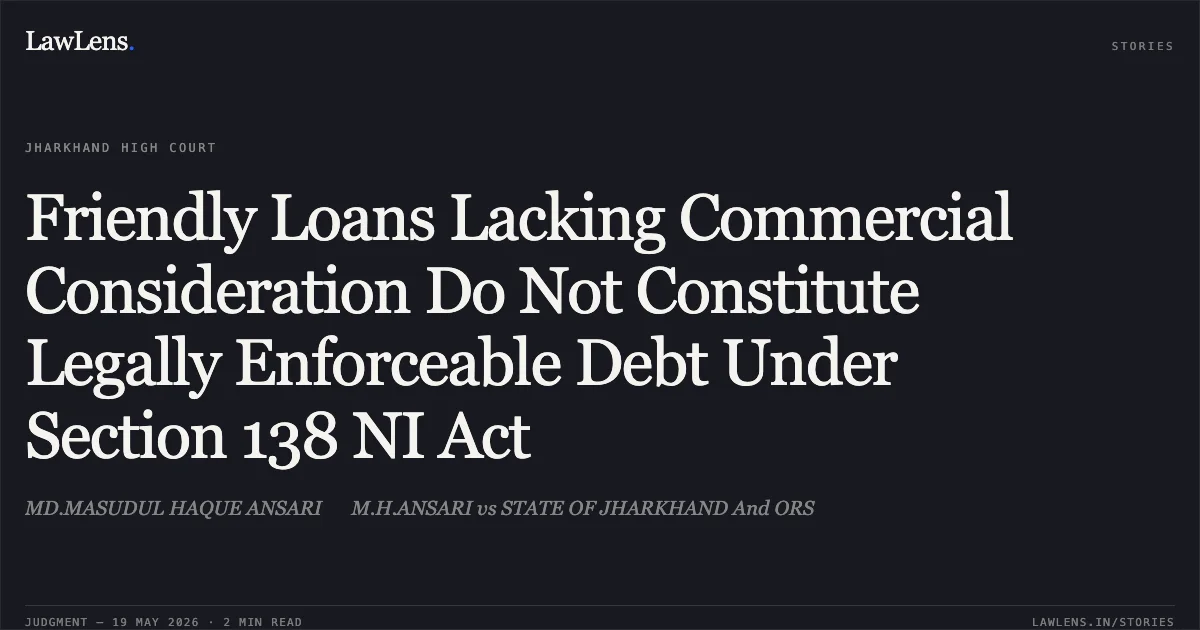
Source reference: para. 8The court observed that Section 138 was designed for commercial transactions; since "friendship" does not constitute valid commercial consideration under the Indian Contract Act, the transaction did not result in a legally enforceable debt.
Source reference: para. 15Additionally, the court noted discrepancies in the complainant’s testimony (C.W.-1) regarding the loan amounts and dates between his examination-in-chief and cross-examination.
Source reference: para. 8Consequently, the complainant failed to prove the existence of a liability that the law is bound to enforce.
Source reference: para. 15Holding
The High Court answered that the transaction was not a legally enforceable debt under the N.I. Act.
The court held that there was no merit to interfere with the trial court's decision, dismissed the acquittal appeal, and upheld the lower court's judgment dated July 28, 2008.
Source reference: paras. 16-17The Trial Court Records were ordered to be returned.
Source reference: para. 18Acts & Sections Cited
2 provisions across 1 statute referred to in this judgment. Each provision opens on LawLens.
Negotiable Instruments Act, 18812
Original Court PDF
MD.MASUDUL HAQUE ANSARI M.H.ANSARIvsSTATE OF JHARKHAND And ORS
Click to open original judgment
Original judgment, available to read, download and summarize on LawLens.in


![Subsequent exoneration does not retrospectively invalidate a finalized promotion select list.. UNNIKRISHNAN M vs M/o Environment And Forests. CAT - ['Ernakulam']. LawLens](/stories/thumbnails/subsequent-exoneration-does-not-retrospectively-invalidate-a-finalized-promotion-select-li-ce80a0e84f2f4887857271e8b4341c42.webp)