Facts
The petitioner, a proprietary concern, filed a writ petition under Article 226 of the Constitution of India seeking a direction to IndusInd Bank (Respondent No. 1) to defreeze its bank account (No. 259827025257).
Source reference: para 1The petitioner’s account had been frozen following intimations from cyber cells regarding alleged involvement in cyber fraud.
Source reference: para 3The petitioner relied on a precedent set by the same Court in Malcolm Murayis & Ors. v. State Bank of India and Others (W.P. No. 1100 of 2024), wherein accounts were frozen without proper notice or strict adherence to investigative procedures.
Source reference: paras 2-3Issues
Whether the petitioner is entitled to the defreezing of its bank account and under what conditions the disputed amounts allegedly linked to cybercrime should be maintained.
Source reference: para 5Law Applied
The Court primarily applied the principles of Article 226 of the Constitution of India regarding writ jurisdiction.
Source reference: paras 3, 5It relied heavily on the precedent of Malcolm Murayis & Ors. v. State Bank of India and Others, which interpreted the procedural requirements of Section 102 of the Cr.P.C. (now relevant provisions of the Bharatiya Nagarik Suraksha Sanhita [BNSS]).
Source reference: paras 3, 5The core legal principle dictates that while investigative agencies have the power to freeze accounts, they must comply with statutory mandates, such as informing the Magistrate and acting within a reasonable timeframe, to prevent the indefinite deprivation of a petitioner’s right to operate their account.
Source reference: para 3Reasoning
The Court determined that the petitioner’s case was "squarely covered" by the decision in Malcolm Murayis and that the same logic should apply mutatis mutandis.
Source reference: paras 2, 4In the referenced precedent, the Court had criticized the "poor functioning and irresponsible approach" of cyber crime cells that freeze accounts without responding to subsequent inquiries or providing clean chits.
Source reference: para 3The Court reasoned that a balance must be struck between the needs of a criminal investigation and the petitioner’s business interests. Consequently, it found that the entire account need not remain frozen if the specific disputed amount—the sum allegedly linked to the fraud—is secured in a fixed deposit.
Source reference: para 5Holding
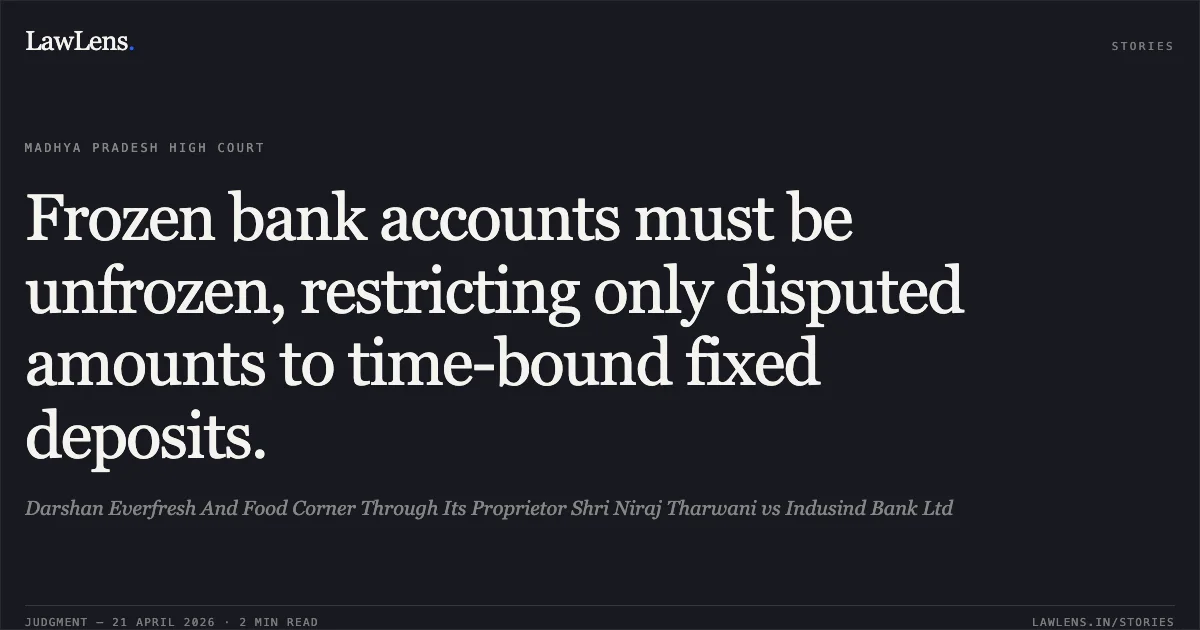
The High Court disposed of the petition with a direction to Respondent No. 1 to unfreeze the petitioner’s bank account.
The bank was ordered to keep only the specific "disputed amount" (as identified by the crime agencies) in a fixed deposit (FD).
Source reference: para 5This FD is to remain frozen and may only be liquidated upon orders from a competent Judicial Magistrate within a three-month period.
Source reference: para 5Should the police agency fail to proceed in accordance with the BNSS or relevant law within those three months, the petitioner is permitted to withdraw the FD amount under intimation to the agency.
Source reference: para 5Acts & Sections Cited
1 provisions across 1 statute referred to in this judgment. Each provision opens on LawLens.
Code of Criminal Procedure, 19731
Original Court PDF
Darshan Everfresh And Food Corner Through Its Proprietor Shri Niraj TharwanivsIndusind Bank Ltd
Click to open original judgment
Original judgment, available to read, download and summarize on LawLens.in