Facts
The Appellant Insurance Company challenged a Motor Accidents Claims Tribunal (MACT) award dated August 2, 2024, which granted ₹45,24,155/- with 8% interest to Respondent No. 1.
Source reference: p. 1Respondent No. 1, a TSR driver, suffered a 36% permanent disability (complete vision loss in the left eye) following an accident on July 29, 2018.
Source reference: p. 1-2The Tribunal assessed his functional disability at 100%.
Source reference: p. 3The Appellant contended that since the Respondent successfully renewed his driving license in 2021—which required a medical certificate for applicants over 40—he was still capable of driving, and thus the 100% disability assessment was unsustainable.
Source reference: p. 2-3During the proceedings, the Respondent's license was suspended at his own request in November 2023.
Source reference: p. 2Issues
1. Whether the assessment of 100% functional disability by the MACT was appropriate given the renewal of the claimant's driving license post-accident.
Source reference: p. 32. Whether the non-pecuniary damages (pain, suffering, and loss of amenities) awarded by the Tribunal required enhancement.
Source reference: p. 5Law Applied
The Court applied the principles governing the assessment of future loss of earnings as established by the Supreme Court in Rajkumar v. Ajay Kumar (2011) 1 SCC 343.
Source reference: p. 3This precedent mandates a distinction between medical permanent disability and "functional disability," requiring a threefold test: (i) identifying activities the claimant can no longer perform, (ii) assessing the pre-accident profession and age, and (iii) determining if the claimant is totally or partially restricted from earning a livelihood.
Source reference: p. 3-4Section 15 of the Motor Vehicles Act, 1988, regarding the requirement of a medical certificate for license renewal for those above age 40.
Source reference: p. 2Reasoning
The Court observed that as a commercial TSR driver, the complete loss of sight in one eye made it "virtually impossible" for the Respondent to drive safely on the road.
Source reference: p. 4The High Court disagreed with the Tribunal’s 100% functional disability assessment. It reasoned that while the Respondent could no longer drive commercial vehicles, he was not "totally disabled from earning any kind of livelihood" and could potentially pursue self-employment or vocations with lesser strain on eyesight.
Source reference: p. 4Regarding the license renewal, the Court noted that such renewals are often sought for identity purposes or desperate attempts to sustain income, and the validity of the underlying medical certificate did not override the clinical reality of vision loss.
Source reference: p. 4The Court found the non-pecuniary awards for pain and suffering and loss of amenities too low given the substantive nature of the injury and enhanced them to ₹1,00,000/- each.
Source reference: p. 5Holding
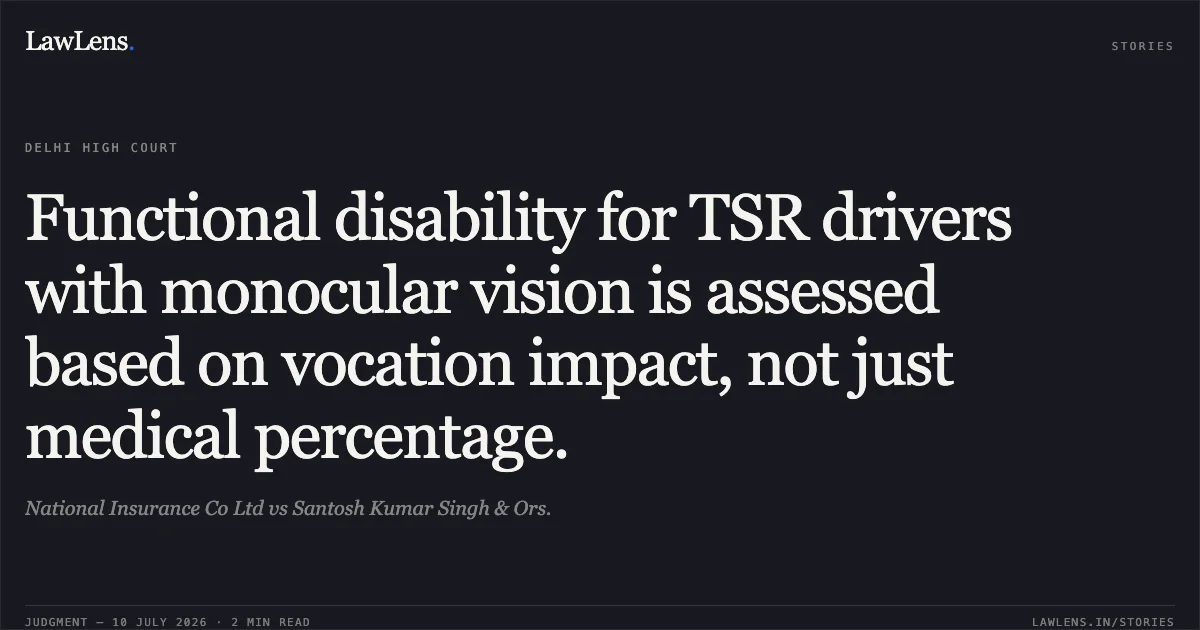
The Court held that functional disability should be assessed at 72% rather than 100%.
The Court partly allowed the appeal, reducing the total compensation from ₹45,24,155/- to ₹34,49,655/-.
Source reference: p. 5It directed that the excess amount deposited by the Insurance Company be refunded with interest, while the Respondent is entitled to the balance of the revised amount.
Source reference: p. 6Acts & Sections Cited
1 provisions across 1 statute referred to in this judgment. Each provision opens on LawLens.
Motor Vehicles Act, 19881
Original Court PDF
National Insurance Co LtdvsSantosh Kumar Singh & Ors.
Click to open original judgment
Original judgment, available to read, download and summarize on LawLens.in


![Subsequent exoneration does not retrospectively invalidate a finalized promotion select list.. UNNIKRISHNAN M vs M/o Environment And Forests. CAT - ['Ernakulam']. LawLens](/stories/thumbnails/subsequent-exoneration-does-not-retrospectively-invalidate-a-finalized-promotion-select-li-ce80a0e84f2f4887857271e8b4341c42.webp)