Facts
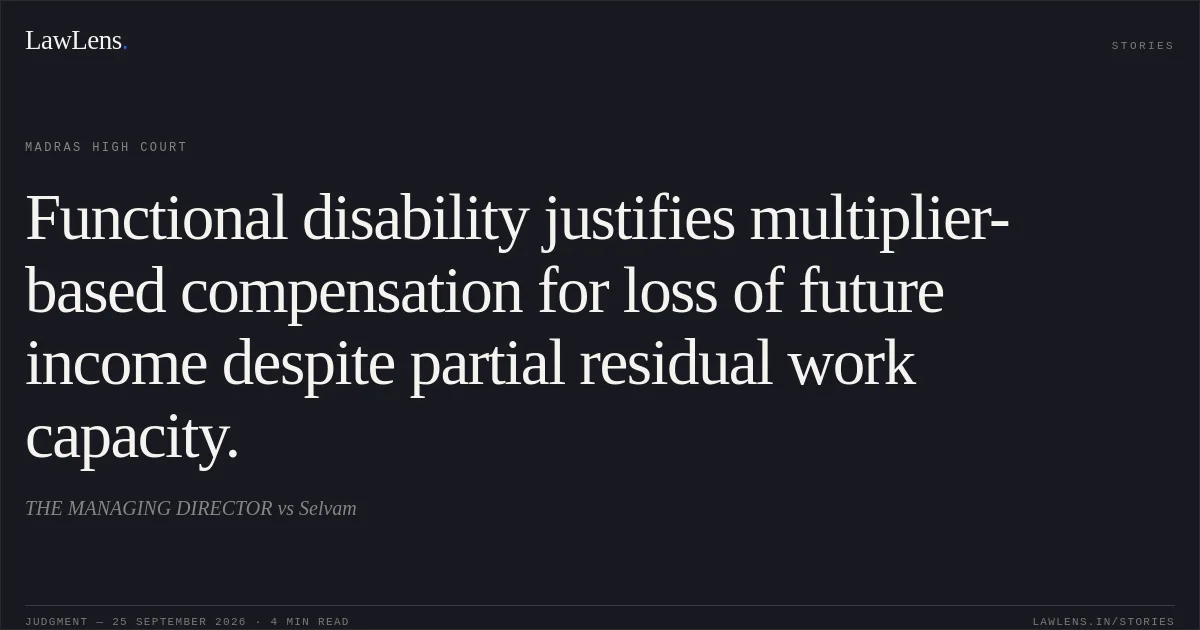
On 21 December 2019, Selvam was travelling in a Tamil Nadu State Transport Corporation bus near Rayarpalayam Bus Stop, Palladam–Tiruppur Road, when the bus allegedly was driven rashly and negligently, causing him to sustain multiple injuries, including a burst compression fracture of the D12 vertebra. He claimed to be a professional driver earning ₹25,000 per month and sought compensation of ₹40,00,000 under the Motor Vehicles Act, 1988.
Source reference: p.2, para. 2The Transport Corporation denied negligence, asserting that the claimant fell inside the bus while it was crossing a speed breaker and that he was standing without holding the iron bar.
Source reference: p.2, para. 3Before the Tribunal, the claimant examined himself and another witness. The Corporation examined the bus conductor but not the driver. The Tribunal relied on the FIR, the claimant’s evidence, and the conductor’s admission that he had not directly witnessed the accident, and held the bus driver negligent.
Source reference: p.3, para. 4; p.6, para. 9The Tribunal assessed the claimant’s functional disability at 30%, fixed his monthly income at ₹14,000, applied a multiplier of 11, added 10% towards future prospects, and awarded ₹8,73,795 in total compensation, including ₹6,09,840 for loss of future income.
Source reference: p.4, para. 5The Transport Corporation filed the present appeal under Section 173 of the Motor Vehicles Act, challenging the finding of negligence and the quantum of compensation.
Source reference: pp.1, 5, paras. 1, 6Issues
Whether the Tribunal was justified in fixing negligence on the bus driver despite the Corporation’s denial of liability and the non-examination of the driver?
Source reference: pp.5–6, paras. 6, 9Whether the Tribunal was justified in adopting the multiplier method and awarding ₹6,09,840 towards loss of future income on the basis of 30% functional disability, a monthly income of ₹14,000, multiplier 11, and 10% future prospects?
Source reference: pp.6–7, para. 10Whether the compensation awarded under the remaining heads was excessive or otherwise liable to be interfered with in appeal?
Source reference: p.7, para. 10Law Applied
The Court exercised appellate jurisdiction under Section 173 of the Motor Vehicles Act, 1988.
Source reference: p.1In a motor accident claim, negligence may be determined on the basis of the overall evidence, including the injured claimant’s testimony, the FIR, and the failure of the party possessing the best evidence—such as the bus driver—to examine that witness.
Source reference: pp.3, 6, paras. 5, 9For assessing loss of future earning capacity, the Court applied the principle that functional disability, rather than merely the medical percentage of disability, must be evaluated in relation to the claimant’s occupation.
Source reference: pp.4, 7, para. 10It relied on Sarla Verma v. Delhi Transport Corporation, 2009 AIR (SC) 3104, for selection of the multiplier, and National Insurance Co. Ltd. v. Pranay Sethi, 2017 (2) TNMAC 609 (SC), for addition of future prospects.
Source reference: pp.4, 7, para. 10Reasoning
The Court upheld the finding of negligence because the claimant’s evidence supported the pleaded manner of accident and the FIR had been registered against the bus driver.
Source reference: p.6, para. 9The Corporation’s conductor admitted that he had not witnessed the occurrence directly, while the driver—the material witness capable of explaining how the accident occurred—was not examined. Accordingly, the Tribunal was justified in accepting the claimant’s version and fixing negligence on the bus driver.
Source reference: p.6, para. 9On quantum, the Court noted that the claimant’s driving licence established that he was qualified to drive transport vehicles and supported his case that he was a professional driver.
Source reference: pp.3–4, para. 5Although the Medical Board assessed physical disability at 45%, the Tribunal reasonably assessed functional disability at 30%, finding that the spinal injuries would make it difficult for him to continue driving as before but did not completely disable his driving career.
Source reference: p.7, para. 10The income of ₹14,000 per month was considered reasonable in the absence of documentary proof of the claimed ₹25,000 income. Applying multiplier 11 and adding 10% future prospects in accordance with Sarla Verma and Pranay Sethi, the award of ₹6,09,840 for loss of future income was held justified.
Source reference: pp.4, 7, para. 10The amounts awarded for pain and suffering, loss of amenities, medical expenses, transportation, nourishment, attendant charges, and damage to clothing were also found reasonable considering the spinal fracture, surgery, and period of hospitalisation.
Source reference: p.7, para. 10Holding
The appeal was dismissed, and the Tribunal’s award of ₹8,73,795, together with proportionate interest and costs, was confirmed.
The Transport Corporation was directed to deposit the awarded amount, after deducting any amount already deposited, within six weeks from receipt of the order.
Source reference: p.8, para. 11The claimant was permitted to withdraw the amount, subject to deduction of any sum already withdrawn and upon filing the appropriate application before the Tribunal.
Source reference: p.8, para. 11The connected miscellaneous petition was closed, with no order as to costs.
Source reference: p.8, para. 11Acts & Sections Cited
1 provisions across 1 statute referred to in this judgment. Each provision opens on LawLens.
Motor Vehicles Act, 19881
Original Court PDF
THE MANAGING DIRECTORvsSelvam
Click to open original judgment
Original judgment, available to read, download and summarize on LawLens.in