Facts
On 16 February 2020, the appellant was riding his motorcycle when a Bolero vehicle bearing registration No. CG-11-AR-3169, driven allegedly rashly and negligently by Respondent No. 1, collided with him. The appellant sustained severe injuries, resulting in amputation of his right leg, and was treated at hospitals in Bilaspur and Raipur. An FIR was registered under Sections 279, 337 and 338 of the IPC, followed by submission of a charge-sheet.
Source reference: para. 2The appellant instituted a claim under Sections 166 and 140 of the Motor Vehicles Act, 1988, seeking compensation of ₹66,00,000. The Motor Accident Claims Tribunal awarded ₹27,51,100 with interest at 9% per annum from 18 March 2020. Dissatisfied with the assessment of disability, income and medical expenses, the appellant preferred the present appeal seeking enhancement.
Source reference: para. 3The Tribunal had assessed the appellant’s functional disability at 60%, monthly income at ₹12,000, and awarded compensation towards loss of earning capacity, medical expenses, artificial limb and pain and suffering.
Source reference: paras. 9, 14–16Issues
Whether the Tribunal was justified in assessing the appellant’s functional disability at 60%, or whether it should be enhanced having regard to the impact of the amputation on his occupation as a shopkeeper?
Source reference: para. 8Whether the appellant was entitled to enhanced compensation for medical expenses, including future repair and replacement of the artificial limb?
Source reference: paras. 8, 13–14Whether the compensation was required to be reassessed on the basis of a higher income, a higher percentage of functional disability, or a higher rate of interest?
Source reference: paras. 4, 8, 15–17Law Applied
The Court applied Sections 166 and 173 of the Motor Vehicles Act, 1988, governing claims for compensation and appeals against awards of the Claims Tribunal.
Source reference: paras. 1, 3It distinguished between medical/physical disability and functional disability, holding that compensation must reflect the actual effect of the injury on the claimant’s earning capacity and occupation.
Source reference: paras. 12–14Relying on Shankar Dutt v. United India Insurance Co. Ltd. & Others, 2026 SCC OnLine 1193, and the principles in Mohd. Sabeer @ Shabir Hussain v. Regional Manager, U.P. State Road Transport Corporation, (2023) 20 SCC 774, Anant v. Pratap, (2018) 9 SCC 450, and R.D. Hattangadi v. Pest Control (India) Pvt. Ltd., (1995) 1 SCC 551, the Court held that just compensation includes pecuniary and non-pecuniary losses, future loss of income and future prospects, pain and suffering, loss of amenities, and the continuing cost of maintaining, repairing or replacing a prosthetic limb.
Source reference: paras. 12–14The Court also accepted the multiplier method and future-prospect assessment applied by the Tribunal, while retaining interest at 9% per annum.
Source reference: paras. 15–17Reasoning
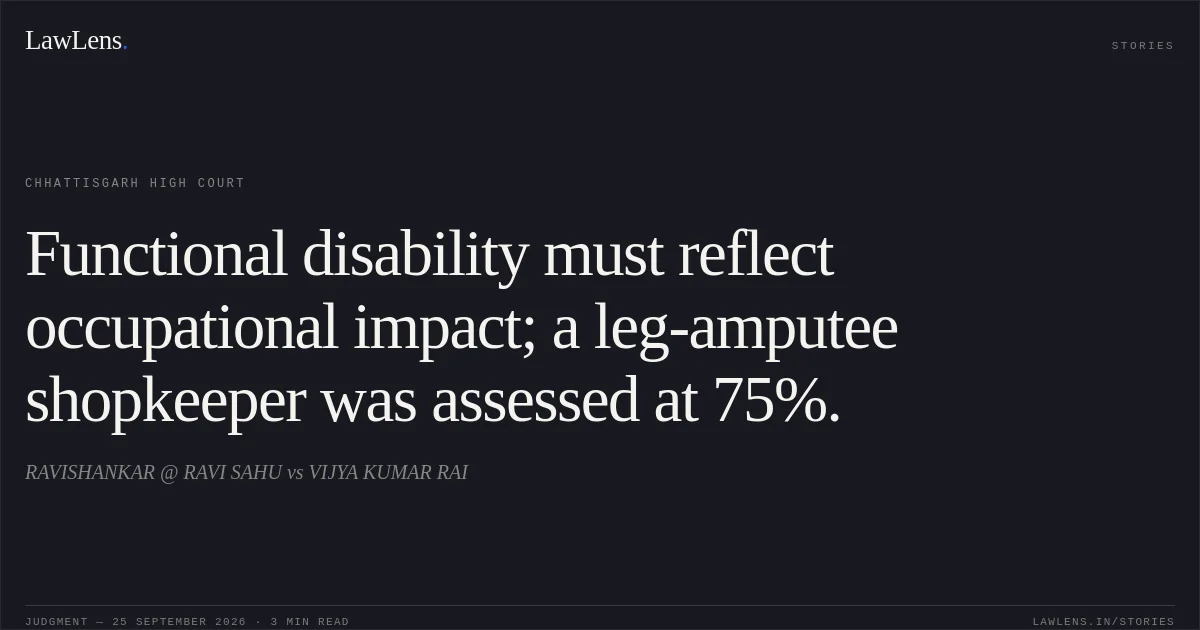
The Court found that although the medical evidence quantified the appellant’s permanent disability at 60%, the relevant inquiry was his functional disability in the context of his occupation. As a shopkeeper, the appellant was required to move around the shop and attend to customers; after amputation, he would require assistance and would be dependent upon another person for the smooth functioning of the business. Accordingly, the Court enhanced the functional disability from 60% to 75%, while rejecting the claim for assessment at 100%.
Source reference: paras. 9–12The Court further held that the Tribunal had properly assessed the appellant’s age, monthly income of ₹12,000, 40% future prospects, multiplier of 18, and compensation for pain, shock and suffering.
Source reference: paras. 13–16However, because a prosthetic limb requires periodic repair, maintenance and replacement, the amount towards the artificial limb was enhanced from ₹1,91,835 to ₹3,41,835, resulting in an additional award of ₹1,50,000 under that head.
Source reference: paras. 13–16The revised calculation produced total compensation of ₹34,45,420.
Source reference: para. 16The Court declined to enhance the interest rate beyond 9% per annum.
Source reference: para. 17Holding
The appeal was partly allowed. The Court enhanced the appellant’s functional disability from 60% to 75% and recalculated the total compensation at ₹34,45,420, as against the Tribunal’s award of ₹27,51,100.
The enhanced compensation was directed to carry interest at 9% per annum from the date of filing of the claim petition until payment.
Source reference: para. 17Respondent No. 2, the Oriental Insurance Company Ltd., was directed to deposit the balance additional amount of ₹6,94,319 with interest within six weeks, for disbursement to the appellant after due verification.
Source reference: para. 19Acts & Sections Cited
6 provisions across 2 statutes referred to in this judgment. Each provision opens on LawLens.
Motor Vehicles Act, 19883
Indian Penal Code, 18603
Original Court PDF
RAVISHANKAR @ RAVI SAHUvsVIJYA KUMAR RAI
Click to open original judgment
Original judgment, available to read, download and summarize on LawLens.in