Facts
The respondent-claimant, aged 28 years, sustained grievous injuries, including amputation of his right hand, when the bus bearing registration No. AS-01-GC-0266, insured by the appellant, collided with another vehicle while travelling on a National Highway under Samaguri Police Station, Nagaon District.
Source reference: p. 8; para. 14The claimant filed a petition under Section 166 of the Motor Vehicles Act, 1988. The Motor Accident Claims Tribunal, Tinsukia, awarded him ₹39,74,381 with interest at 8% per annum from the date of filing of the claim petition until realization.
Source reference: p. 2; para. 1The insurer challenged the award, contending that negligence of the bus driver was not proved, the claimant was contributorily negligent because he had kept his right hand outside the bus window, the unidentified truck was the immediate cause of the accident, the claim ought to have been pursued under Section 163 of the Act, and the Tribunal had erroneously applied a multiplier of 37.
Source reference: pp. 3–6; paras. 4–8Issues
1. Whether the claim petition under Section 166 of the Motor Vehicles Act was maintainable and whether the accident resulted from rash and negligent driving of the insured bus?
Source reference: pp. 5, 7–8; paras. 4, 14–152. Whether the claimant was guilty of contributory negligence because he allegedly kept his hand outside the bus window?
Source reference: pp. 3–4, 7–8; paras. 4(ii), 143. Whether the Tribunal had correctly assessed the claimant’s loss of future earning capacity, particularly by applying a multiplier of 37 and treating 80% physical disability as equivalent to 80% loss of earning capacity?
Source reference: pp. 4, 8–9; paras. 4(iv), 16–184. Whether the compensation awarded by the Tribunal required modification to ensure “just compensation” under Section 168 of the Motor Vehicles Act?
Source reference: pp. 4–5, 8–10; paras. 4(v), 16–19Law Applied
The Court applied Sections 166 and 168 of the Motor Vehicles Act, 1988: a claim under Section 166 requires proof of negligence on the touchstone of preponderance of probabilities, while Section 168 requires the Tribunal to award just, fair and reasonable compensation.
Source reference: no citationThe Court referred to Oriental Insurance Co. Ltd. v. Meena Variyal, (2007) 5 SCC 428, regarding the necessity of proving negligence in a Section 166 claim.
Source reference: p. 5; para. 4The Court referred to T.O. Antony v. Karvarnan, (2008) 3 SCC 748, on contributory negligence.
Source reference: p. 4; para. 4(ii)The Court referred to Sarla Verma v. Delhi Transport Corporation, (2009) 6 SCC 121, for the applicable multiplier based on the claimant’s age.
Source reference: pp. 4, 8; paras. 4(iv), 16The Court referred to Reshma Kumari v. Madan Mohan, (2013) 9 SCC 65, on the requirement that compensation be neither excessive nor inadequate.
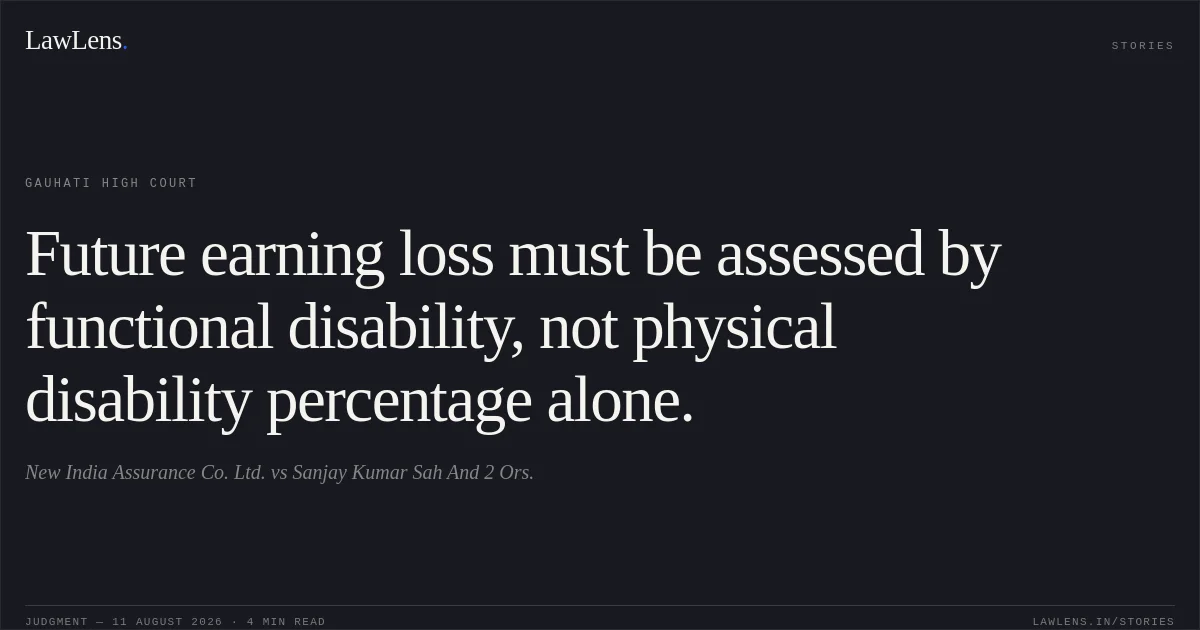
Source reference: p. 5; para. 4(v)The Court referred to Raj Kumar v. Ajay Kumar, (2011) 1 SCC 343, which requires loss of future earning capacity to be assessed with reference to functional disability and its impact on the claimant’s actual earning capacity, rather than merely relying on the percentage of physical disability.
Source reference: p. 9; para. 18Reasoning
The Court found that the accident and involvement of the insured bus were not seriously disputed. The evidence of the claimant and the co-passenger, together with the FIR, established that the bus collided with another vehicle and that the claimant suffered the amputation injury in the accident, thereby satisfying the requirement of negligence for maintaining a Section 166 claim.
Source reference: pp. 7–8; paras. 13–15The allegation of contributory negligence was rejected because the evidence did not establish that the claimant had acted negligently or failed to exercise due care; the mere assertion that his hand was outside the window was insufficient to reduce liability.
Source reference: p. 8; para. 14The Court, however, held that the Tribunal had committed a patent error by applying a multiplier of 37 to a claimant aged 28 years. Under Sarla Verma, the proper multiplier was 17.
Source reference: p. 8; para. 16Further, although the disability certificate recorded 80% physical disability, the Tribunal had not assessed the claimant’s functional disability or its effect on his occupation as a commission agent.
Source reference: p. 9; paras. 17–18Applying Raj Kumar, the Court considered 60% to be the appropriate loss of earning capacity, rather than equating the 80% physical disability with 80% economic loss.
Source reference: p. 9; paras. 17–18The compensation was consequently recalculated on the basis of annual income of ₹78,000, 60% loss of earning capacity and multiplier 17.
Source reference: p. 10; para. 19Holding
The appeal was partly allowed. The Court upheld the maintainability of the Section 166 claim and rejected the insurer’s plea of contributory negligence and its contention that liability could not be fastened on the insured bus.
However, it modified the Tribunal’s award by applying multiplier 17 and assessing loss of future earning capacity at 60%. The compensation was reduced to ₹24,61,181, comprising ₹7,95,600 for loss of future earning capacity, ₹10,00,000 for future medical expenses, loss of amenities and conveyance, ₹1,65,581 for medical expenses, and ₹5,00,000 for pain and suffering.
Source reference: p. 10; para. 19The insurer was directed to deposit the balance amount, after adjustment of the ₹7,00,000 already withdrawn by the claimant, before the Tribunal within six weeks, together with interest at 8% per annum from the date of filing of the claim petition until realization.
Source reference: p. 10; para. 21The statutory deposit was directed to be refunded to the insurer, and the appeal was disposed of accordingly.
Source reference: p. 11; paras. 20–22Acts & Sections Cited
5 provisions across 1 statute referred to in this judgment. Each provision opens on LawLens.
Motor Vehicles Act, 19885
Original Court PDF
New India Assurance Co. Ltd.vsSanjay Kumar Sah And 2 Ors.
Click to open original judgment
Original judgment, available to read, download and summarize on LawLens.in