Facts
On 17 March 2012, the appellant, aged approximately 18 years and studying in the 10th standard, was riding his motorcycle from Vapi to Surat when a Maruti car, allegedly driven rashly and negligently, collided with him.
Source reference: paras. 1–2, pp. 1–3He suffered serious injuries, including a head injury, fractures, neurological impairment, and orthopaedic disability.
Source reference: paras. 1–2, pp. 1–3The Motor Accident Claims Tribunal partly allowed his claim petition and awarded ₹7,03,200 with interest at 9% per annum from the date of filing until realization.
Source reference: paras. 1–2, pp. 1–3The claimant challenged the award seeking enhancement on the grounds of inadequate assessment of income, functional disability, actual loss of income, pain and suffering, loss of studies, and loss of amenities.
Source reference: paras. 1–2, pp. 1–3The insurer opposed the enhancement and supported the Tribunal’s assessment.
Source reference: paras. 10–11, pp. 6–7Issues
1. Whether the compensation awarded by the Tribunal required enhancement, particularly in relation to the claimant’s notional income and future prospects.
Source reference: paras. 4, 10, 12–14, pp. 4–72. Whether the claimant’s functional disability ought to be reassessed in light of the neurological and orthopaedic medical evidence.
Source reference: paras. 5, 11, 15–17, pp. 4–6, 8–103. Whether the claimant was entitled to enhanced compensation for actual loss of income, pain and suffering, special diet, attendant charges, transportation, loss of one academic year, and loss of amenities.
Source reference: paras. 6–9, 19–22, pp. 5, 10–124. What amount of enhanced compensation and interest should be awarded.
Source reference: paras. 23–25, pp. 12–13Law Applied
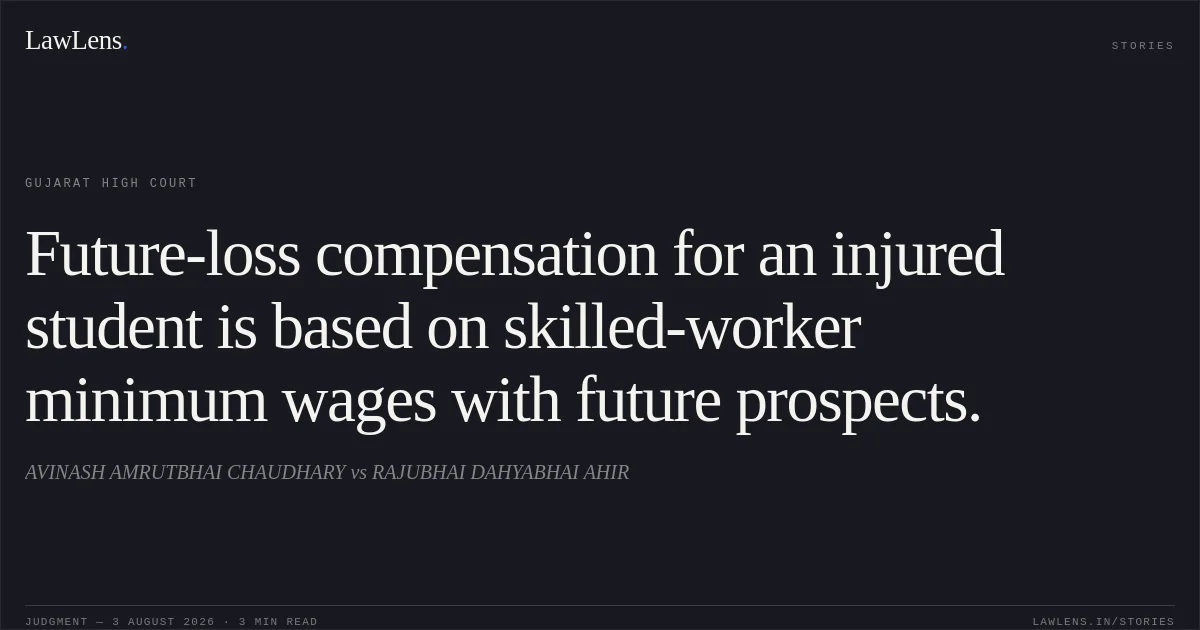
The Court applied the principle that compensation under the Motor Vehicles Act must be “just compensation” and must reflect the claimant’s actual and prospective loss arising from the accident.
Source reference: no citationIn assessing the future loss of income of a young claimant without established earnings, the Court adopted the minimum wages applicable to a skilled worker at the time of the accident, namely ₹4,710 per month.
Source reference: para. 13, p. 7It added 40% towards future prospects in accordance with National Insurance Co. Ltd. v. Pranay Sethi, (2017) 16 SCC 680.
Source reference: para. 14, p. 7Permanent physical or medical disability is not automatically equivalent to functional disability; functional disability must be assessed by considering the nature of the injuries and their impact on the claimant’s earning capacity and daily life.
Source reference: paras. 15–17, pp. 8–10For an 18-year-old claimant, the Court applied a multiplier of 18 in computing future loss of income.
Source reference: para. 17, p. 10Reasoning
The Court held that the Tribunal had undervalued the claimant’s income by fixing it at ₹3,000 per month.
Source reference: paras. 13–14, p. 7Since the claimant was a student and had no proved actual income, the Court adopted the prevailing minimum wage for a skilled worker, ₹4,710 per month, and increased it by 40% for future prospects, resulting in a monthly figure of ₹6,594.
Source reference: paras. 13–14, p. 7The medical evidence established permanent neurological disability of 38.44% and orthopaedic disability of 45%, with right-sided hemiparesis, difficulty in walking, limping, impaired dexterity, speech difficulties, headaches, vertigo, and memory loss.
Source reference: paras. 15–17, pp. 8–10Considering the combined effect of these injuries on his functional capacity and everyday life, the Court increased functional disability from 35% to 40%.
Source reference: paras. 15–17, pp. 8–10Applying the multiplier of 18, it calculated future loss of income at ₹5,69,808.
Source reference: paras. 19–22, pp. 10–12The Court further awarded nine months’ actual loss of income, enhanced compensation for pain and suffering and for special diet, attendant charges and transportation, and granted separate amounts for loss of one academic year and loss of amenities.
Source reference: paras. 19–22, pp. 10–12Holding
The appeal was partly allowed.
The total compensation was enhanced from ₹7,03,200 to ₹11,67,198, comprising ₹5,69,808 for future loss of income, ₹3,05,000 for medical expenses, ₹42,390 for actual loss of income, ₹1,00,000 for pain, shock and suffering, ₹25,000 for special diet, attendant charges and transportation, ₹25,000 for loss of study, and ₹1,00,000 for loss of amenities.
Source reference: para. 23, p. 12The appellant was accordingly awarded additional compensation of ₹4,63,998, together with interest at 9% per annum from the date of filing of the claim petition until realization.
Source reference: para. 24, p. 13The Insurance Company was directed to deposit the additional amount with interest before the Tribunal within six weeks, after which the Tribunal was to disburse the awarded amount to the appellant following due verification.
Source reference: para. 25, p. 13Original Court PDF
AVINASH AMRUTBHAI CHAUDHARYvsRAJUBHAI DAHYABHAI AHIR
Click to open original judgment
Original judgment, available to read, download and summarize on LawLens.in