Facts
The appellant sustained a crush injury to his right leg in a motor-vehicle accident on 20 June 2013 and claimed compensation of ₹20,00,000.
Source reference: p.3The Motor Accidents Claims Tribunal awarded ₹8,45,000 with interest at 6% per annum, holding the vehicle’s owner liable because the driver had no driving licence.
Source reference: p.3The claimant appealed under Section 173(1) of the Motor Vehicles Act, 1988, seeking enhancement.
Source reference: p.3He relied on evidence that he worked as a restaurant manager and earned ₹40,000 per month; the Tribunal had assessed his monthly income at ₹10,000.
Source reference: pp.3–7The doctor assessed disability of the right lower limb at 70% and whole-body disability at 24%, and stated that further surgery might be required.
Source reference: pp.7–8Issues
1. Whether the Tribunal’s assessment of the claimant’s income and functional disability resulted in an inadequate award for loss of future earning capacity.
Source reference: pp.7–92. Whether the compensation awarded under the other heads, including future medical expenses, required enhancement.
Source reference: pp.8–103. Whether the insurer was liable to pay the compensation, given the finding that the driver had no driving licence and the owner’s appeal seeking pay-and-recovery had been dismissed.
Source reference: pp.3–5, 10Law Applied
Section 173(1) of the Motor Vehicles Act, 1988, provides for an appeal against an award of the Claims Tribunal.
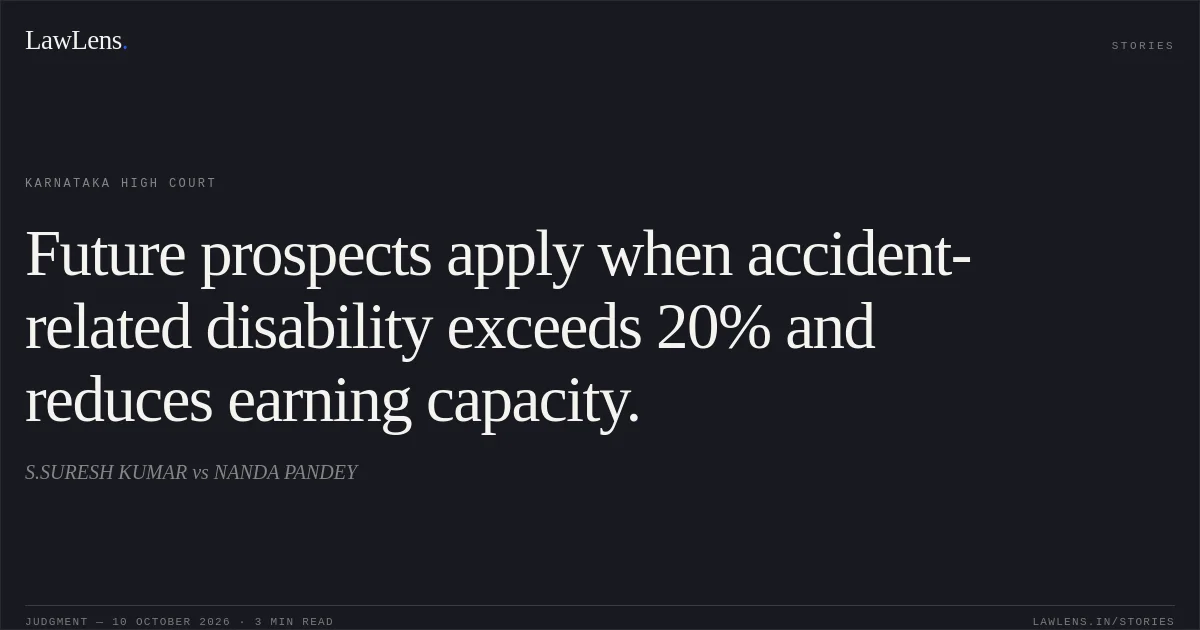
Source reference: p.2In assessing future loss of earning capacity, the Court applied the multiplier method and relied on National Insurance Company Limited v. Pranay Sethi, (2017) 16 SCC 680, for future prospects; it also relied on New India Assurance Company Limited v. Abdul, son of Mehaboob Tahasildar and Others, MFA No.103807/2016 c/w MFA No.103835/2016, decided 27 May 2022, in considering future prospects where disability exceeded 20%.
Source reference: p.8The Court treated the relevant multiplier for a claimant aged 31 as 16 and added 40% to the assessed income for future prospects.
Source reference: p.8It further assessed disability and the remaining heads of compensation on the medical and other evidence in the record.
Source reference: pp.7–10Reasoning
The Court found the Tribunal’s monthly income assessment of ₹10,000 too low, but did not accept the claimed ₹40,000 as established: although the employer’s evidence and salary certificate supported earnings of ₹35,000, there were no bank statements or income-tax returns, and the evidence differed on the claimant’s job title.
Source reference: p.7It therefore assessed monthly income at ₹20,000.
Source reference: p.7Given the medical evidence of 70% right-limb disability, it assessed whole-body disability at 23%.
Source reference: p.8Applying 40% future prospects and a multiplier of 16, it calculated future loss of earning capacity at ₹12,36,480.
Source reference: pp.8–9It enhanced compensation for pain and suffering, loss of amenities, transport, nourishment and attendant charges, laid-up-period income, and future medical expenses, while retaining the Tribunal’s medical-expense award.
Source reference: pp.9–10The Court did not impose liability on the insurer: the Tribunal had found that the driver lacked a licence, and the owner’s appeal seeking pay-and-recovery had been dismissed.
Source reference: pp.3–5, 10Holding
The appeal was allowed in part.
The total compensation was enhanced from ₹8,45,000 to ₹18,26,480, an increase of ₹9,81,480, with interest at 6% per annum on the enhanced amount.
Source reference: p.10The owner was directed to deposit the enhanced compensation within one month; the claimant was permitted to withdraw the deposited amount with accrued interest.
Source reference: p.10The insurer was held not liable to pay the compensation.
Source reference: p.10Acts & Sections Cited
1 provisions across 1 statute referred to in this judgment. Each provision opens on LawLens.
Motor Vehicles Act, 19881
Original Court PDF
S.SURESH KUMARvsNANDA PANDEY
Click to open original judgment
Original judgment, available to read, download and summarize on LawLens.in