01Facts
On 09.12.2012 at about 10:45 am, the claimant was riding motorcycle KA-06-EC-9779 on the Tumkur–Koratagere road when Car AP-09-AH-1999 collided with it.
¶ 3The claimant alleged rash and negligent driving by the car driver.
¶ 3He sustained grievous injuries, did not fully recover, and lost earning capacity.
¶ 3He filed a claim under Section 166 of the Motor Vehicles Act, 1988 against the owner and insurer.
¶ 3The claim was contested.
¶ 3The claimant examined three witnesses (PWs 1–3, including treating doctor Dr. Lokesh) and marked Exhibits P1–P14.
¶ 4–5The respondents led no evidence.
¶ 4–5The Tribunal held the accident was caused by the car driver's rash and negligent driving and awarded ₹7,35,000 with 6% interest against the insurer (R2).
¶ 6The claimant appealed for enhancement only.
¶ 2, 11He pleaded that his monthly income was ₹10,000 as a coolie, that the Tribunal wrongly assessed it at ₹6,000, and that the 15% functional disability award was inadequate given 63% disability to the right upper limb and 56% to the right lower limb.
¶ 7–8The insurer contended that the Tribunal's assessment was proper and that disability may reduce after removal of implants.
¶ 902Issues
i.1. Whether the claimant is entitled to enhancement of compensation.
¶ 1103Law Applied
The Court applied Section 166 of the Motor Vehicles Act, 1988, under which the claim was filed, and Section 173(1), under which the appeal was filed.
¶ 1, 3On income, it accepted that where the claimant's income is not substantiated, the Tribunal may assess it notionally, and that the notional figure must reflect the prevailing rate for the relevant year (₹7,000 for 2012).
¶ 12On future prospects, it relied on Erudhaya Priya v. State Express Transport Corporation Ltd., AIR 2020 SC 4284, which holds that future prospects are payable in personal injury claims even where the claimant is self-employed.
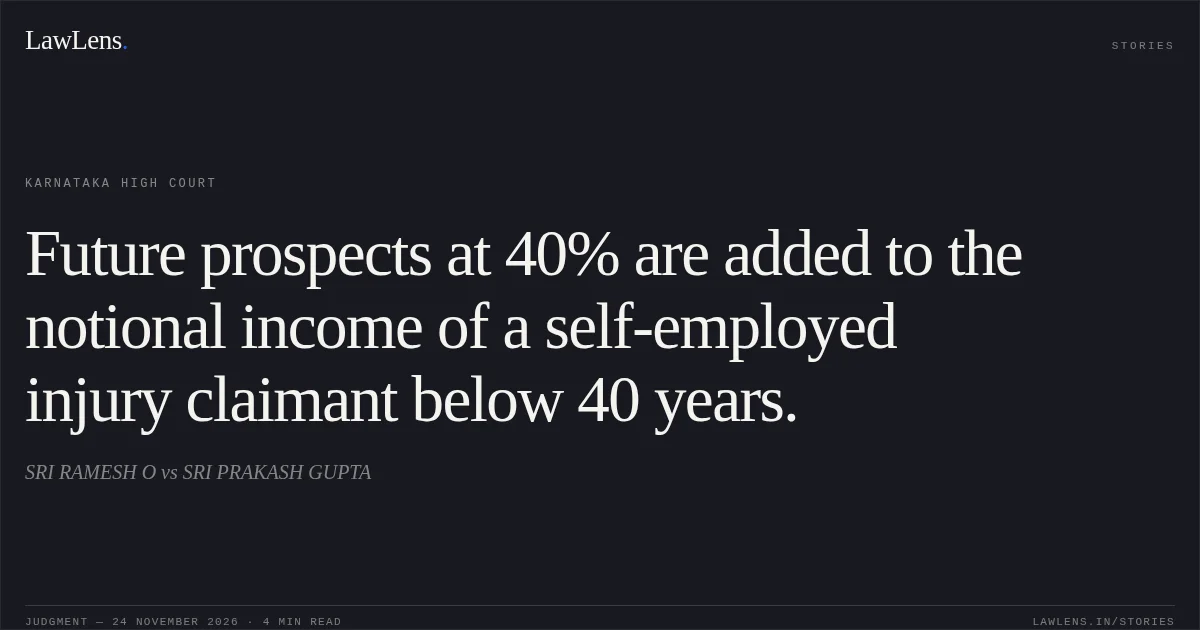
¶ 12The Court applied 40% future prospects for a self-employed claimant below 40 years and a multiplier of 17.
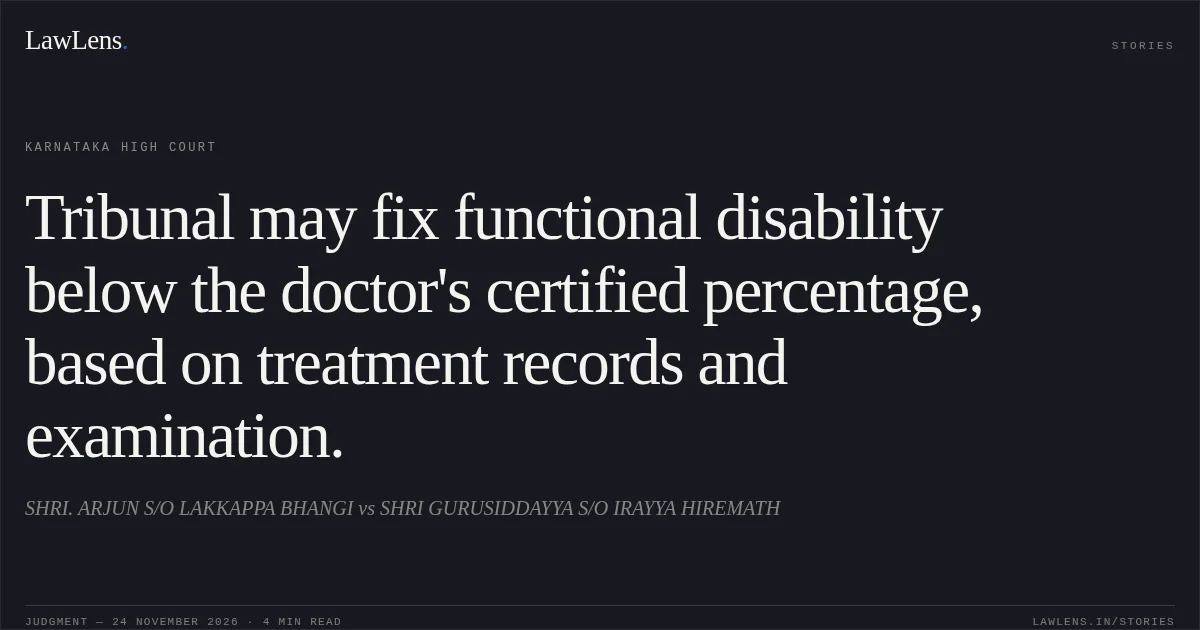
¶ 12On functional disability, the Court treated the treating doctor's assessment of physical disability, based on restricted range of movement, as the operative evidence where it is not discredited in cross-examination, and applied it to the claimant's occupation as a coolie.
¶ 12On general damages, the Court assessed pain and suffering, loss of amenities, and layoff compensation against the severity of injuries and the revised income.
¶ 13–14Provisions in the judgment · 2 · Linked ones open on LawLens
Motor Vehicles Act, 1988 Section 173Section 166
04Reasoning
The Court found the Tribunal's notional income of ₹6,000 incorrect because the Tribunal had not applied the year-appropriate notional figure. It adopted ₹7,000 for 2012.
¶ 12Because the claimant was self-employed and under 40, future prospects of 40% were added to the income.
¶ 12On disability, the Court rejected the Tribunal's 15% finding. PW2's uncontroverted evidence assessed 63% disability to the right upper limb and 56% to the right lower limb, and nothing material was elicited in cross-examination to discredit it.
¶ 12Given the claimant's occupation as a coolie, the Court held that the restriction would cause substantial difficulty and loss of earning capacity. It fixed functional disability at 40%, yielding future loss of income of ₹7,99,680.
¶ 12The Court enhanced pain and suffering from ₹50,000 to ₹75,000 because of multiple fractures, a crush injury and a head/bronchial plexus injury, with 38 days of inpatient treatment.
¶ 13It enhanced loss of amenities from ₹30,000 to ₹1,00,000 given the high disability at a young age.
¶ 13It scaled layoff compensation to ₹28,000 on the revised income.
¶ 13It upheld the incidental expenses (₹15,000), attendant charges (₹15,000), medical expenses (₹3,97,000) and future medical expenses (₹20,000), finding them adequate and supported by the record.
¶ 13The insurer's argument that disability may reduce after implant removal was recorded but not accepted; the Court did not rely on it.
¶ 9, 1205Holding
The appeal is allowed in part. The claimant is entitled to enhancement of compensation to a total of ₹14,49,680.
¶ 12–14The Court held that the enhancement rested on the notional income of ₹7,000, 40% future prospects, a multiplier of 17, 40% functional disability, and enhanced awards for pain and suffering, loss of amenities and layoff.
¶ 12–13The Tribunal's judgment and award dated 03.03.2014 in MVC No. 7558/2012 is modified accordingly.
¶ 14(ii)–(iii)The insurer must deposit the enhanced compensation with 6% interest from the date of claim until deposit, within six weeks before the Tribunal.
¶ 14(iii)–(iv)On deposit, 50% of the enhanced compensation with interest is to be kept in a fixed deposit for three years. Early release is permitted for treatment or other just cause.
¶ 14(v)Original Court PDF
SRI RAMESH OvsSRI PRAKASH GUPTA
Click to open original judgment
Original judgment, available to read, download and summarize on LawLens.in