01Facts
On 28.03.2013 at about 7:30 p.m., the claimant, riding motorcycle KA-06/E-5454 on the Tumkur–Bellavi road, collided with Tractor-Trailer KA-06/T-2024-2025, which had been parked on the left side of the road without signal and was loaded with Nilgiri poles.
¶ 2The claimant alleged that the darkness prevented him from seeing the parked vehicle.
¶ 3He underwent treatment at Government Hospital, Tumkur, NIMHANS, Bangalore, and again at Government Hospital, Tumkur, but did not recover fully and claimed loss of earning capacity.
¶ 3He filed MVC No. 977/2014 under Section 166 of the Motor Vehicles Act, 1988 against the owner (R-1) and insurer (R-2).
¶ 3The respondents contested the claim on grounds of commercial use in breach of policy terms, lack of a valid driving licence, and contributory negligence.
¶ 4The Tribunal framed three issues on rash and negligent driving, entitlement to compensation, and final order.
¶ 5The claimant examined himself and a doctor (PWs 1–2); the insurer examined one official (RW-1).
¶ 6The Tribunal answered issues 1 and 2 in the affirmative and awarded ₹1,65,800 with 8% interest, holding R-1 and R-2 jointly and severally liable.
¶ 7The claimant appealed for enhancement, and the insurer cross-objected on liability and quantum.
¶ 2, 7The cross-objection's cause title refers to the award as dated 06.01.2014, whereas the body of the judgment and the MFA refer to 06.01.2016.
¶ 1 · cross-objection cause title02Issues
i.1. Whether the Tribunal was justified in holding the insurer liable to pay compensation.
¶ 13ii.2. Whether the assessment of compensation by the Tribunal calls for modification.
¶ 1303Law Applied
The Court relied on the terms of the insurance policy, specifically Ex. R1, which indicated that a commercial third-party liability policy had been issued, so the insurer could not avoid liability on the ground of commercial use of a vehicle covered by a miscellaneous policy.
¶ 14The insurer's liability is limited to cases where the insured was rash or negligent, and the insurer's contention on the driver's improper parking did not displace this standard.
¶ 14The contention on the absence of a transport endorsement was governed by Mukund Dewangan v. Oriental Insurance Co. Ltd., (2017) 14 SCC 663, which the Court treated as dispositive.
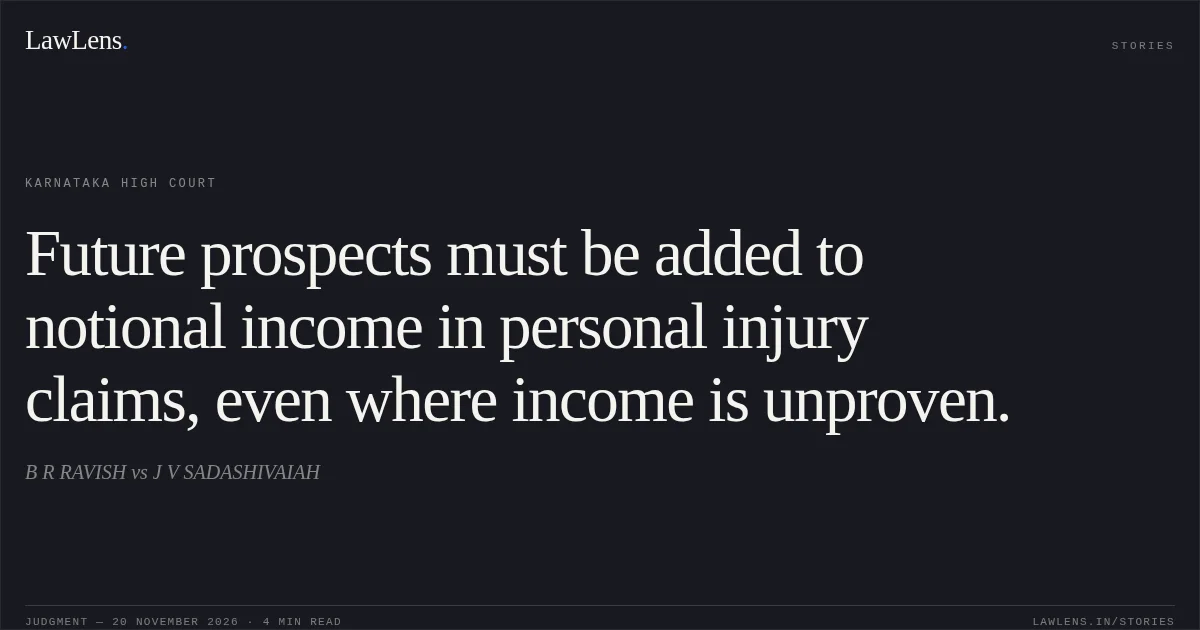
¶ 11, 14On quantum, the Court applied Erudhaya Priya v. State Express Transport Corporation Ltd., 2020 SCC OnLine SC 601, which holds that future prospects must be added to income even in personal injury claims, and that the multiplier for the claimant's age applies (here, 16).
¶ 17Compensation for loss of earning capacity, pain and suffering, loss of amenities, and laid-up period were assessed on the basis of the claimant's injuries and the duration of treatment.
¶ 15–18Provisions in the judgment · 2 · Linked ones open on LawLens
Motor Vehicles Act, 1988 Section 173Section 166
04Reasoning
The policy issued (Ex. R1) covered commercial use, so the insurer's defence based on commercial use failed.
¶ 14The alleged negligence in parking the tractor did not relieve the insurer, because the insurer's liability depended on the insured's rashness or negligence, which the Tribunal had found.
¶ 14 · see para. 7The transport-endorsement objection was rejected under Mukund Dewangan.
¶ 14The claimant's pleaded income of ₹8,000 per month was unproven, but the notional income for 2013 was ₹8,000, which was adopted in place of the Tribunal's ₹4,500.
¶ 16The Tribunal had erred by awarding ₹50,000 as lump-sum future medical expenses instead of computing future loss of income.
¶ 16The PW-2 deposition assessed 30% whole-body disability from loss of vision in the right eye. The Court held that the claimant could still perform some functions with one eye and fixed loss of earning capacity at 15%.
¶ 16Applying Erudhaya Priya, the Court computed future loss of income as (₹8,000 + 40%) × 15% × 12 × 16 = ₹3,22,560.
¶ 17The Court enhanced pain and suffering to ₹75,000 because of the temporal bone and maxillary fractures in addition to the eye injury.
¶ 18Conveyance, food and nourishment (₹10,000 each) were held adequate for a seven-day inpatient period, and medical expenses were reimbursed at ₹7,800 on bills totalling ₹7,791.
¶ 18Loss of income during a four-month laid-up period was enhanced to ₹32,000, and loss of amenities was enhanced from ₹20,000 to ₹50,000.
¶ 18The Court did not separately award future medical expenses; the total of ₹5,07,360 reflects the components listed in para. 18 and excludes the ₹50,000 earlier awarded for future medical expenses.
¶ 16, 18On interest, the claimant conceded reduction, and the Court reduced the rate from 8% to 6%.
¶ 11 · ¶ 19(b)–(c)05Holding
The insurer is liable to pay compensation, as the policy covered commercial use and the transport-endorsement objection was foreclosed by Mukund Dewangan.
¶ 14The Tribunal's compensation required modification, and total compensation was enhanced to ₹5,07,360 from ₹1,65,800.
¶ 18, 19(a)The MFA by the claimant was allowed in part; the MFA Cross-Objection by the insurer was allowed in part only as to reduction of interest from 8% to 6%.
¶ 19(a)–(b)The enhanced compensation carries 6% interest from the date of the claim petition until realisation, excluding 204 days of delay in filing the appeal.
¶ 19(c)The amount in deposit is to be transmitted to the Tribunal for payment, the insurer is directed to deposit the balance with interest before the Tribunal within six weeks, and the entire enhanced compensation is to be released in favour of the claimant on deposit.
¶ 19(d)–(f)Original Court PDF
B R RAVISHvsJ V SADASHIVAIAH
Click to open original judgment
Original judgment, available to read, download and summarize on LawLens.in