01Facts
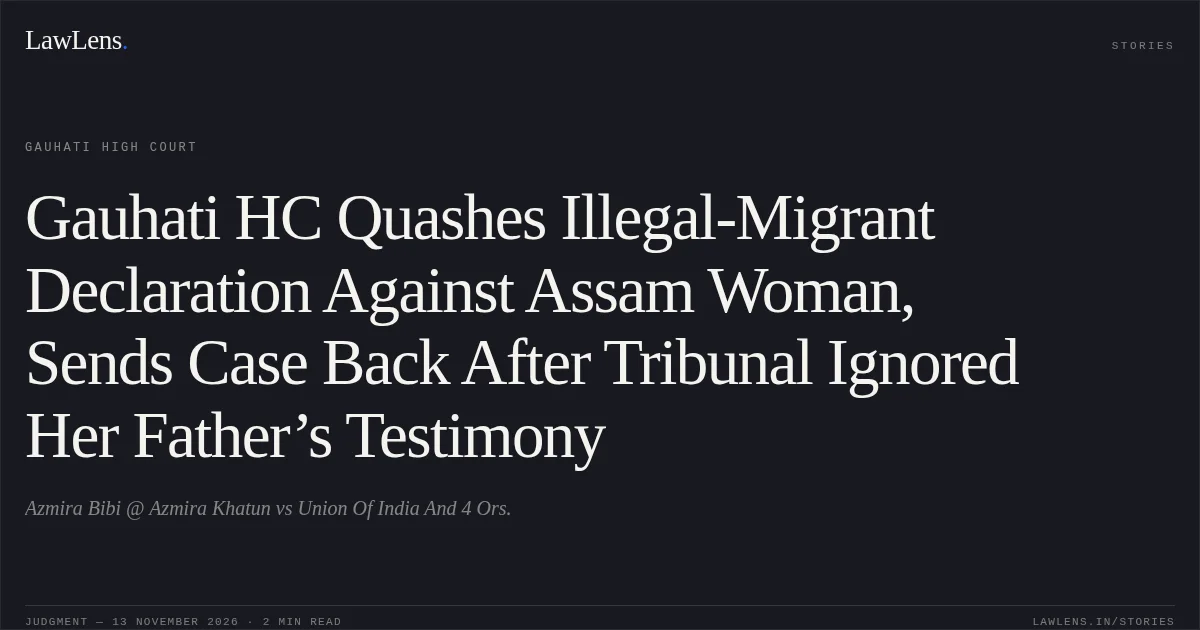
The petitioner challenged a Foreigners Tribunal opinion dated 5 September 2019 declaring her a foreigner who had entered Assam illegally from Bangladesh on or after 25 March 1971.
¶ 3She claimed Indian citizenship through her father, Tasir Ali, and grandfather, Abdul Jabbar, and relied on electoral rolls, jamabandis, and pre-Independence sale deeds, among other documents.
¶ 5, 7The Tribunal found that the evidence established her father’s presence in India before 1971 but held that she had not proved her relationship to him; it rejected, among other evidence, the jamabandis and sale deeds.
¶ 15–18The petitioner sought judicial review under Article 226.
¶ 302Issues
i.Whether the Tribunal’s treatment of the jamabandis and pre-Independence sale deeds involved a legal error warranting interference under Article 226.
¶ 13–21ii.Whether the High Court should substitute its own conclusion on citizenship or remit the matter to the Tribunal for fresh consideration.
¶ 21–2203Law Applied
Under Section 9 of the Foreigners Act, 1946, the person whose citizenship is questioned bears the burden of proving that they are not a foreigner.
¶ 15Section 41(2) of the Assam Land and Revenue Regulation, 1886 provides that entries in a record of rights are presumed correct unless the contrary is proved.
¶ 13Section 90 of the Evidence Act, 1872 permits a presumption as to the authenticity of a document that is at least thirty years old and produced from proper custody; the judgment also refers to Section 92 of the Bharatiya Sakshya Adhiniyam, 2023 as the corresponding provision.
¶ 18Section 65-B(4) of the Evidence Act concerns certification of electronic records, but the Court held that a claimant should not be penalised where a certified land record is issued by the public authority without the required certification.
¶ 13In exercising supervisory jurisdiction, the High Court may correct a jurisdictional error but should not simply substitute its own view for that of the Tribunal.
¶ 21Provisions in the judgment · 2 · Linked ones open on LawLens
Citizenship Act, 1955 Section 3
Bharatiya Sakshya Adhiniyam, 2023 Section 92
04Reasoning
The Tribunal accepted that the evidence showed Tasir Ali’s presence in India before 1971, but rejected the claimed relationship between him and the petitioner.
¶ 13, 16The High Court found that the Tribunal had not properly considered the jamabandi entry showing Tasir Ali’s inheritance-based mutation from Abdul Jabbar, including the statutory presumption applicable to land records.
¶ 13, 16It also held that the original pre-Independence sale deeds were eligible for the presumption concerning old documents and that the petitioner relied on them to establish lineage, not title.
¶ 18The Tribunal’s own findings identified Tasir Ali as the son of both “Aa. Jabbar” and “Abdul Jabbar”; the Court considered the reasonable inference to be that the names referred to the same person, supporting the claimed family link.
¶ 18–20Because these evidentiary and legal errors affected the Tribunal’s assessment, its opinion was vitiated by jurisdictional error; however, the High Court left the ultimate determination to the Tribunal on remand.
¶ 2105Holding
The writ petition was allowed and the Tribunal’s opinion was set aside.
¶ 22The matter was remanded for a fresh hearing and opinion in accordance with law.
¶ 22If the Tribunal considered that Exts. 14–17 required supporting records, the petitioner was to be given an opportunity to seek those records from the relevant authorities.
¶ 24The petitioner was directed to appear before the Tribunal by 15 December 2026; any bail granted on her application was to remain effective for 30 days from the date of the fresh opinion.
¶ 25–26There was no order as to costs.
¶ 23Original Court PDF
Lutfa BegumvsThe Union Of India And 7 Ors
Click to open original judgment
Original judgment, available to read, download and summarize on LawLens.in