Facts
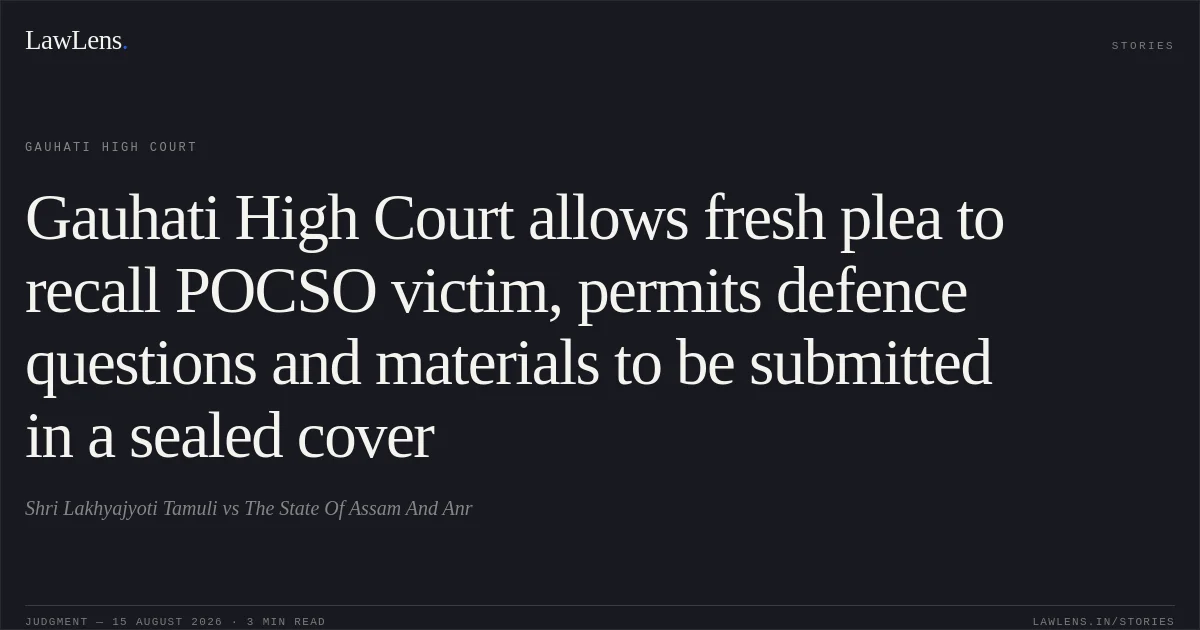
The petitioner/accused, facing trial in Special (POCSO) Case No. 46/2022 before the Special Judge, POCSO, Sonitpur, challenged the order dated 4 August 2025 refusing to recall the victim/PW-1 for further cross-examination under Section 348 of the BNSS, corresponding to Section 311 of the CrPC.
Source reference: p.2, para. 4The victim had been examined and cross-examined at length on 21 February 2023.
Source reference: p.2, para. 4; p.7, para. 8The defence later sought recall on the ground that new evidence and material circumstances had emerged, while undertaking not to repeat previous questions and to limit the examination to relevant ambiguities and contradictions.
Source reference: p.3, para. 5The Trial Court rejected the application because the defence had not identified the specific material allegedly omitted during the earlier cross-examination.
Source reference: p.4, para. 5Issues
Whether the Trial Court was justified in refusing to recall the victim for further cross-examination merely because she had previously been cross-examined at length and the defence had not disclosed the precise material proposed to be put to her?
Source reference: p.7–8, paras. 8–10Whether, in a POCSO trial, the accused should be afforded a liberal opportunity to recall and further cross-examine the victim in view of the statutory presumption under Section 29 of the POCSO Act?
Source reference: p.8–9, paras. 11–12Whether the restriction under Section 33(5) of the POCSO Act against repeatedly calling a child to testify applied where the victim was no longer a child at the time of the impugned order?
Source reference: p.4–5, para. 7Law Applied
The Court considered Section 528 of the BNSS, under which the inherent jurisdiction of the High Court was invoked, and Section 348 of the BNSS, corresponding to Section 311 of the CrPC, which empowers the court to summon, examine, recall, or re-examine a witness where such evidence is essential for a just decision.
Source reference: p.2, para. 2; p.3, para. 4Relying principally on Rajaram Prasad Yadav v. State of Bihar, (2013) 14 SCC 461, the Court reiterated that the power to recall a witness must be exercised judicially, for discovering the truth and securing a just decision, and not arbitrarily or merely to fill a lacuna; however, a court should adopt a fair and liberal approach where additional evidence is necessary to avoid miscarriage of justice.
Source reference: p.5–7, para. 7Section 33(5) of the POCSO Act requires the Special Court to ensure that a child is not repeatedly called to testify, while Section 2(d) defines a child as a person below 18 years of age.
Source reference: p.4, para. 6; p.5, para. 7The Court also considered Section 29 of the POCSO Act, which creates a statutory presumption against the accused, and held that this heightened burden makes it particularly important that the accused receive a meaningful opportunity to establish the defence.
Source reference: p.8–9, para. 11Reasoning
The High Court held that the victim’s earlier lengthy cross-examination did not, by itself, rule out the possibility that genuinely new material had subsequently emerged.
Source reference: p.7, para. 9At the same time, the defence application was deficient because it did not identify the new material or the specific matters requiring further cross-examination.
Source reference: p.7–8, paras. 9–10The Court recognised that requiring full disclosure of the proposed defence could improperly expose the accused’s case; nevertheless, the Trial Court needed some basis to determine whether recall was essential for a just decision.
Source reference: p.8, para. 10In a POCSO prosecution, the statutory presumption under Section 29 places the accused under a significant evidentiary burden, warranting a liberal approach to applications seeking an effective opportunity to cross-examine the prosecution witness.
Source reference: p.8–9, para. 11The Court therefore devised a procedural safeguard: the defence could submit the relevant materials and proposed questions in a sealed cover, enabling the Trial Court to assess their necessity without disclosing the defence strategy.
Source reference: p.9, para. 12Since the victim was no longer below 18 years of age when the impugned order was passed, Section 33(5) was held not necessarily attracted at that stage.
Source reference: p.5, para. 7Holding
The High Court did not directly order the victim’s recall. It remanded the matter to the Trial Court, permitting the defence to file a fresh application, accompanied where necessary by the relevant materials and proposed questions in a sealed cover, within 14 days from the date of the order.
The Trial Court was directed to consider the application in accordance with the High Court’s observations without disclosing the defence case.
Source reference: p.10, para. 13If the application were allowed, the recall and further cross-examination were to be completed within 30 days thereafter.
Source reference: p.10, para. 13The criminal petition was accordingly disposed of.
Source reference: p.10, para. 14Acts & Sections Cited
6 provisions across 3 statutes referred to in this judgment. Each provision opens on LawLens.
Bharatiya Nagarik Suraksha Sanhita, 20232
Code of Criminal Procedure, 19731
Protection of Children from Sexual Offences Act, 20123
Original Court PDF
Shri Lakhyajyoti TamulivsThe State Of Assam And Anr
Click to open original judgment
Original judgment, available to read, download and summarize on LawLens.in