Facts
The complainant alleged that the petitioners subjected her to mental and physical cruelty over non-fulfilment of dowry demands
Source reference: p. 2, para. 4The S.D.J.M., Sherghati, Gaya, took cognizance under Section 498A of the Indian Penal Code in Complaint Case No. 109 of 2017
Source reference: p. 2, para. 2Petitioners 3 and 4 sought quashing, contending that they lived separately, had no involvement in the complainant’s domestic affairs, and faced only general and omnibus allegations
Source reference: pp. 2–3, para. 5The complainant did not appear despite service of notice
Source reference: p. 2, para. 3The judgment describes the challenged cognizance order as dated 15 May 2027, although the judgment itself is dated 5 October 2026
Source reference: pp. 1–2, para. 2; p. 7, para. 10Issues
1. Whether the general and omnibus allegations of cruelty and dowry demand disclosed a prima facie case under Section 498A IPC against petitioners 3 and 4.
Source reference: pp. 2–3, paras. 5, 92. Whether the proceedings against petitioners 3 and 4 should be quashed under the High Court’s inherent jurisdiction where they were stated to live separately and have no connection with the complainant’s daily or domestic affairs.
Source reference: p. 6, para. 9; p. 7, para. 10Law Applied
Section 498A IPC criminalises specified forms of cruelty by a husband or his relatives.
Source reference: pp. 3–6, para. 8The High Court’s inherent power under Section 482 of the Code of Criminal Procedure may be exercised sparingly to prevent abuse of process or secure the ends of justice.
Source reference: pp. 3–6, para. 8Applying State of Haryana v. Bhajan Lal, proceedings may be quashed where the allegations, even taken at face value, do not make out an offence or where the prosecution is manifestly mala fide.
Source reference: pp. 3–6, para. 8The Court also relied on Abhishek v. State of Madhya Pradesh, which discussed the need for caution where matrimonial complaints contain general allegations against relatives, alongside Kahkashan Kausar, Preeti Gupta, and Neelu Chopra on the need for specific allegations and individual roles; and Neeharika Infrastructure on the limits and sparing exercise of quashing power.
Source reference: pp. 3–6, para. 8Reasoning
The Court considered the allegations against petitioners 3 and 4 to be general and omnibus and accepted, for the purpose of the quashing application, that they were living separately and had no connection with the complainant’s daily or domestic affairs.
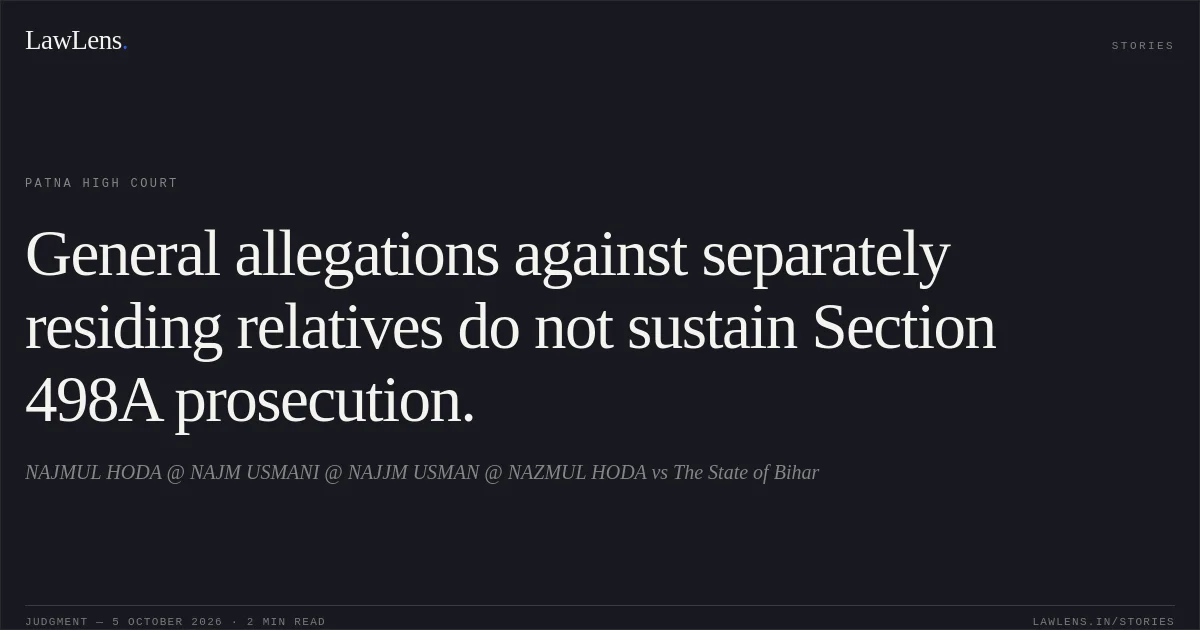
Source reference: p. 6, para. 9Applying the principles concerning vague allegations against relatives in matrimonial cases, the Court concluded that continuing the prosecution against these two petitioners would not be justified.
Source reference: p. 7, para. 10Holding
The application was allowed.
The cognizance order and all consequential proceedings in Complaint Case No. 109 of 2017 were quashed and set aside only as to petitioners 3 and 4; the judgment did not grant that relief to petitioners 1, 2, or 5.
Source reference: p. 7, paras. 10–11Acts & Sections Cited
3 provisions across 1 statute referred to in this judgment. Each provision opens on LawLens.
Code of Criminal Procedure, 19733
Original Court PDF
NAJMUL HODA @ NAJM USMANI @ NAJJM USMAN @ NAZMUL HODAvsThe State of Bihar
Click to open original judgment
Original judgment, available to read, download and summarize on LawLens.in