Facts
Opposite Party No. 2 alleged that she married Petitioner No. 2 on 19 April 2012 and was subjected to dowry-related cruelty, including demands for ₹2 lakhs and a colour television, within two days of marriage. She further alleged that she and her brother were assaulted, her ornaments and other articles were taken, and she was expelled from the matrimonial home. The complaint also alleged that Petitioner No. 2 subsequently married another woman
Source reference: pp. 2–3Upon examination of the complainant and enquiry witnesses, the Sub-Divisional Judicial Magistrate, Patna, took cognizance against Petitioner No. 1, the mother-in-law, and Petitioner No. 2, the husband, for offences under Section 498A of the Indian Penal Code and Section 4 of the Dowry Prohibition Act; the application also challenged cognizance under Section 406 IPC
Source reference: paras. 2, 4; pp. 1, 3The petitioners contended that the allegations were false and retaliatory. They relied on a decree for restitution of conjugal rights obtained by Petitioner No. 2 under Section 9 of the Hindu Marriage Act, followed by an ex parte divorce decree dated 7 February 2015 under Section 13 of that Act. They argued that the complaint, filed in 2016, was an abuse of process and that the allegations against Petitioner No. 1 were general and omnibus
Source reference: pp. 4–6Issues
Whether the continuation of the criminal proceedings and the cognizance order dated 17 November 2017 constituted an abuse of the process of law warranting interference under Section 482 CrPC?
Source reference: paras. 2, 9; pp. 1, 6–7Whether the general and omnibus allegations against the mother-in-law, considered alongside the matrimonial proceedings and decrees in favour of the husband, justified quashing the complaint against both petitioners?
Source reference: para. 9; p. 6Law Applied
The Court exercised its inherent jurisdiction under Section 482 of the Code of Criminal Procedure to prevent abuse of the process of court and secure the ends of justice
Source reference: para. 9; p. 6The alleged offences arose under Sections 406 and 498A IPC and Section 4 of the Dowry Prohibition Act, although the order records cognizance principally under Section 498A IPC and Section 4 of the Dowry Prohibition Act
Source reference: paras. 2, 4; pp. 1, 3The Court also considered the effect of the matrimonial proceedings under Sections 9 and 13 of the Hindu Marriage Act, including the decree for restitution of conjugal rights and the subsequent ex parte divorce decree
Source reference: paras. 5–6; pp. 4–5It relied upon Abhishek v. State of Madhya Pradesh, 2023 SCC OnLine SC 1083, in support of the governing principles concerning quashing of criminal proceedings where continuation would amount to abuse of process
Source reference: para. 7; p. 5Reasoning
The Court noted that the complainant allegedly refused to return to the matrimonial home even after a decree for restitution of conjugal rights was passed in favour of the husband, and that the complaint was filed after the ex parte divorce decree dated 7 February 2015
Source reference: para. 9; p. 6It further found that the allegations against Petitioner No. 1, the mother-in-law, were general and omnibus in nature, without sufficient specific attribution of conduct establishing the alleged offences
Source reference: para. 9; p. 6Considering these circumstances cumulatively, including the prior matrimonial litigation and the timing of the complaint, the Court concluded that continuation of the criminal proceedings would amount to an abuse of the process of law. It therefore invoked Section 482 CrPC to terminate the proceedings against both petitioners
Source reference: para. 9; pp. 6–7Holding
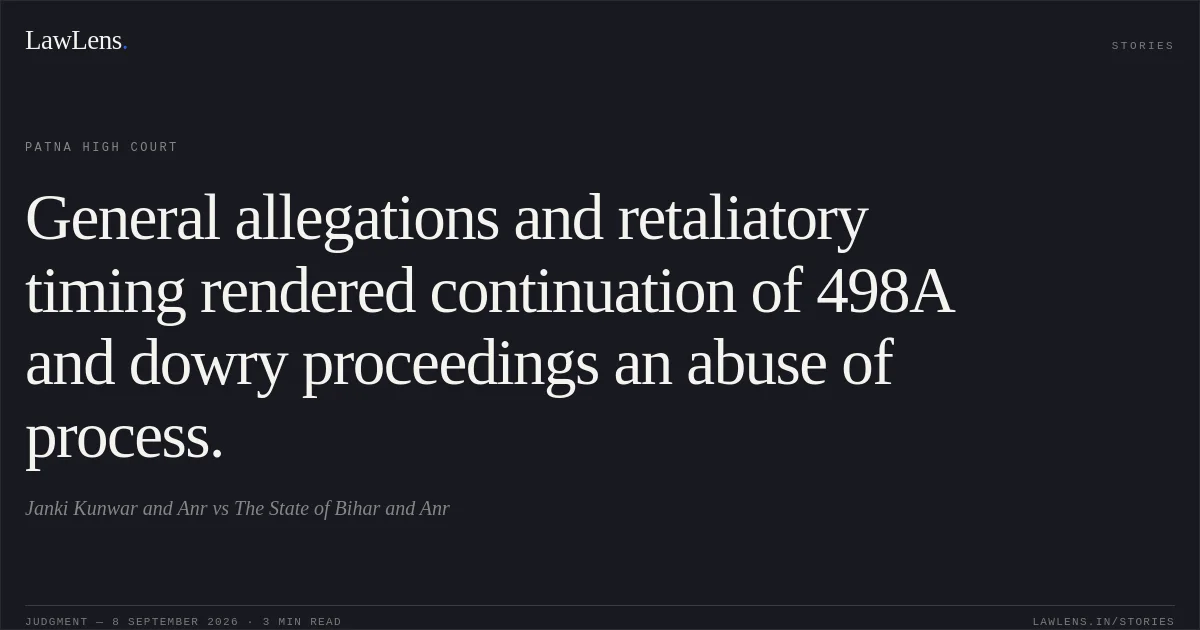
The Patna High Court held that the pending criminal proceedings were an abuse of the process of the court.
It consequently quashed and set aside the cognizance order dated 17 November 2017 passed by the S.D.J.M., Patna, in Complaint Case No. 2221(C) of 2016, insofar as it related to both petitioners, by exercising powers under Section 482 CrPC
Source reference: para. 9; pp. 6–7The criminal miscellaneous petition was accordingly allowed, and the judgment was directed to be communicated to the trial court along with the record, if any
Source reference: paras. 10–11; p. 7Acts & Sections Cited
5 provisions across 4 statutes referred to in this judgment. Each provision opens on LawLens.
Indian Penal Code, 18601
Dowry Prohibition Act, 19611
Hindu Marriage Act, 19552
Code of Criminal Procedure, 19731
Original Court PDF
Janki Kunwar and AnrvsThe State of Bihar and Anr
Click to open original judgment
Original judgment, available to read, download and summarize on LawLens.in