Facts
Darshanaben, married to Accused No. 6 in 2003, died in an unnatural fire-related incident at her matrimonial home on 5 July 2009.
Source reference: pp. 2–4, paras. 1.1–2.5, 7–10Her brother lodged an FIR alleging that her husband, mother-in-law, brothers-in-law and sisters-in-law had subjected her to physical and mental cruelty and harassment, thereby abetting her suicide.
Source reference: pp. 2–4, paras. 1.1–2.5, 7–10The accused were charged under Sections 306, 498-A and 114 of the IPC.
Source reference: pp. 2–4, paras. 1.1–2.5, 7–10The Sessions Court, Surendranagar, acquitted all accused by judgment dated 17 February 2012.
Source reference: pp. 2–4, paras. 1.1–2.5, 7–10The deceased’s brother filed Criminal Appeal No. 552 of 2012 under Section 372 CrPC, and the State filed Criminal Appeal No. 672 of 2012 under Section 378 CrPC against the acquittal.
Source reference: pp. 2–4, paras. 1.1–2.5, 7–10Issues
1. Whether the Trial Court committed an error of law or fact in acquitting the accused of offences under Sections 306, 498-A and 114 IPC?
Source reference: p. 11, para. 62. Whether the prosecution established the ingredients of cruelty under Section 498-A IPC and abetment of suicide under Sections 306 and 107 IPC through cogent and specific evidence?
Source reference: pp. 15–18, paras. 14–183. Whether the statutory presumptions under Sections 113-A and 113-B of the Indian Evidence Act could be invoked against the accused?
Source reference: pp. 5, 20, paras. 4.1, 234. Whether the acquittal suffered from perversity, manifest illegality or any other ground warranting appellate interference?
Source reference: pp. 19–23, paras. 21–28Law Applied
The Court applied Sections 306, 498-A and 114 of the IPC, together with Section 107 IPC, which requires proof of instigation, conspiracy or intentional aid for abetment; mere general allegations of harassment, without specific conduct and a proximate causal link to suicide, are insufficient.
Source reference: pp. 15–18, paras. 14–18The Court considered Sections 113-A and 113-B of the Indian Evidence Act, observing that the statutory presumptions cannot be mechanically invoked without foundational facts or cogent material indicating cruelty, dowry-related conduct or abetment.
Source reference: p. 20, para. 23In an appeal against acquittal, the appellate court may reappreciate the evidence, but must bear in mind the double presumption of innocence; where two reasonable views are possible, the acquittal should not be disturbed unless the Trial Court’s view is perverse or manifestly erroneous.
Source reference: pp. 21–24, paras. 25–28These principles were drawn from Chandrappa v. State of Karnataka, Rajesh Prasad v. State of Bihar, Babu Sahebagouda Rudragoudar v. State of Karnataka and Ramesh v. State of Karnataka.
Source reference: pp. 21–24, paras. 25–28Reasoning
The Court found that the prosecution witnesses, principally the deceased’s relatives, made only general assertions of cruelty and harassment and failed to provide consistent, specific evidence identifying conduct that instigated or intentionally aided the suicide.
Source reference: pp. 15–18, paras. 14–18The allegations were not supported by prior complaints, independent witnesses or evidence of any contemporaneous grievance during the approximately six-year matrimonial relationship.
Source reference: pp. 15–18, paras. 14–18The Court also noted material omissions and embellishments between the FIR, prior statements and trial depositions, including the failure to disclose the deceased’s and her daughter’s medical treatment, despite evidence that some family witnesses knew of it.
Source reference: pp. 16–18, paras. 16–17Although kerosene was allegedly detected on the deceased’s clothing and the prosecution asserted that she had set herself ablaze, those circumstances did not establish that the accused had abetted the suicide or subjected her to legally actionable cruelty.
Source reference: pp. 19–22, paras. 20–27The Trial Court’s consideration of the medical records, defence version and non-examination of independent witnesses was therefore not perverse.
Source reference: pp. 19–22, paras. 20–27Since the prosecution failed to establish the foundational facts, the presumptions under Sections 113-A and 113-B could not be applied.
Source reference: pp. 19–22, paras. 20–27Holding
The High Court answered the issues against the complainant and the State.
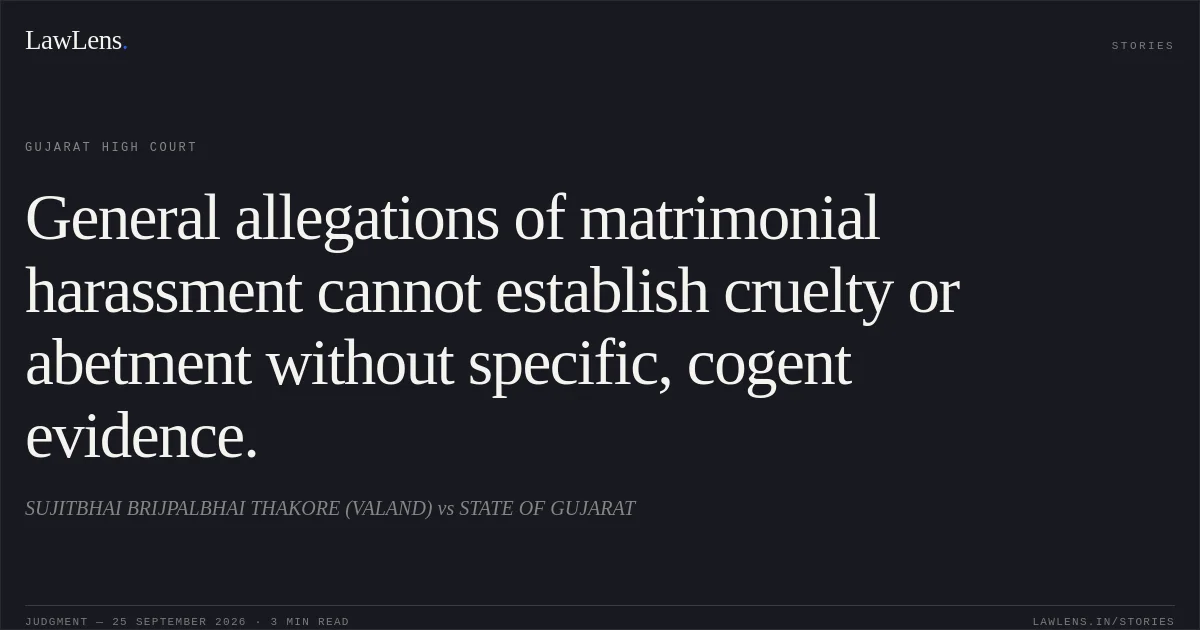
It held that the prosecution failed to prove beyond reasonable doubt the offences under Sections 306, 498-A and 114 IPC, and that the Trial Court’s acquittal was based on a reasonable appreciation of the evidence and did not suffer from illegality or perversity.
Source reference: pp. 24–25, paras. 29–31Both Criminal Appeal No. 552 of 2012 and Criminal Appeal No. 672 of 2012 were dismissed.
Source reference: p. 25, para. 31The order of acquittal dated 17 February 2012 was confirmed, the bail bonds were cancelled, and the record and proceedings were directed to be returned to the Trial Court.
Source reference: p. 25, para. 31Acts & Sections Cited
7 provisions across 2 statutes referred to in this judgment. Each provision opens on LawLens.
Code of Criminal Procedure, 19734
Indian Penal Code, 18603
Original Court PDF
SUJITBHAI BRIJPALBHAI THAKORE (VALAND)vsSTATE OF GUJARAT
Click to open original judgment
Original judgment, available to read, download and summarize on LawLens.in