Facts
The Ministry of New and Renewable Energy (MNRE) introduced a Generation Based Incentive (GBI) scheme in 2009 to incentivize wind power generation by providing ₹0.50 per unit over the tariff approved by State Electricity Regulatory Commissions (SERCs)
Source reference: p. 4-6The Andhra Pradesh Electricity Regulatory Commission (APERC) notified the 2015 Tariff Regulations, where Regulation 20 mandated that the Commission "shall take into consideration" any government incentive or subsidy availed by a generating company (GENCO) while determining tariff
Source reference: p. 8In 2015 and 2016, APERC issued generic preferential tariff orders without factoring in GBI
Source reference: p. 9Upon a petition by distribution companies (DISCOMs), APERC modified these orders in 2018, directing that GBI amounts be deducted from monthly bills to benefit consumers
Source reference: p. 9-11The Appellate Tribunal for Electricity (APTEL) set aside this order, holding that "consideration" did not mandate "deduction" and that determined tariffs should not be lightly amended
Source reference: p. 12-14The DISCOMs appealed to the Supreme Court.
Source reference: no citationIssues
1. Whether the State Electricity Regulatory Commission (SERC) possesses the power and jurisdiction to factor in Generation Based Incentives (GBI) while determining tariff, or if such incentives fall outside its regulatory province
Source reference: p. 142. Whether the regulatory power to determine tariff must be exercised in a manner that accounts for the underlying policy objectives of incentives granted by the Central Government
Source reference: p. 15Law Applied
The Court relied on the Electricity Act, 2003, specifically Section 61 (guiding principles for tariff), Section 62 (determination of tariff), and Section 86 (functions of State Commissions), establishing the SERC as the exclusive authority for tariff fixation
Source reference: p. 19-20It interpreted Regulation 20 of the APERC Tariff Regulations, 2015, which employs the word "shall" regarding the consideration of subsidies
Source reference: p. 21The Court also referenced Articles 112, 114, and 282 of the Constitution of India concerning Parliamentary grants and Appropriation Bills
Source reference: p. 22-23Furthermore, it applied the principle of "Regulation as an Enterprise," requiring regulators to work in coordination with national policy and environmental goals, such as India’s commitments under the Paris Agreement and Nationally Determined Contributions (NDC)
Source reference: p. 28-32Reasoning
The Court held that the Electricity Act is a complete code, leaving no "unallocated regulatory residue" outside the SERC's jurisdiction
Source reference: p. 15, 21While GENCOs argued that GBI is a Parliamentary grant under Article 282 and cannot be diverted by a regulator, the Court clarified that factoring GBI into tariff calculations does not "alter the destination" of the grant; the money still reaches the GENCO, but the tariff paid by the DISCOM is adjusted
Source reference: p. 24-25However, the Court distinguished between the existence of power and its exercise. It adopted the "Regulation as an Enterprise" model, where a regulator must act holistically rather than in a silo
Source reference: p. 31-33Since the GBI was specifically designed as a "generator-focused incentive" to encourage investment in renewable energy and meet international climate obligations, a mechanical deduction of this incentive from the tariff would nullify the policy's intent
Source reference: p. 34-35Therefore, "taking into consideration" under Regulation 20 does not mean an automatic pass-through or deduction if such action subverts the incentive’s purpose of promoting green energy
Source reference: p. 34Holding
SERCs have the plenary power to take government grants/incentives into account during tariff determination
However, this power must be exercised as a "collaborative enterprise" that respects the object of the policy
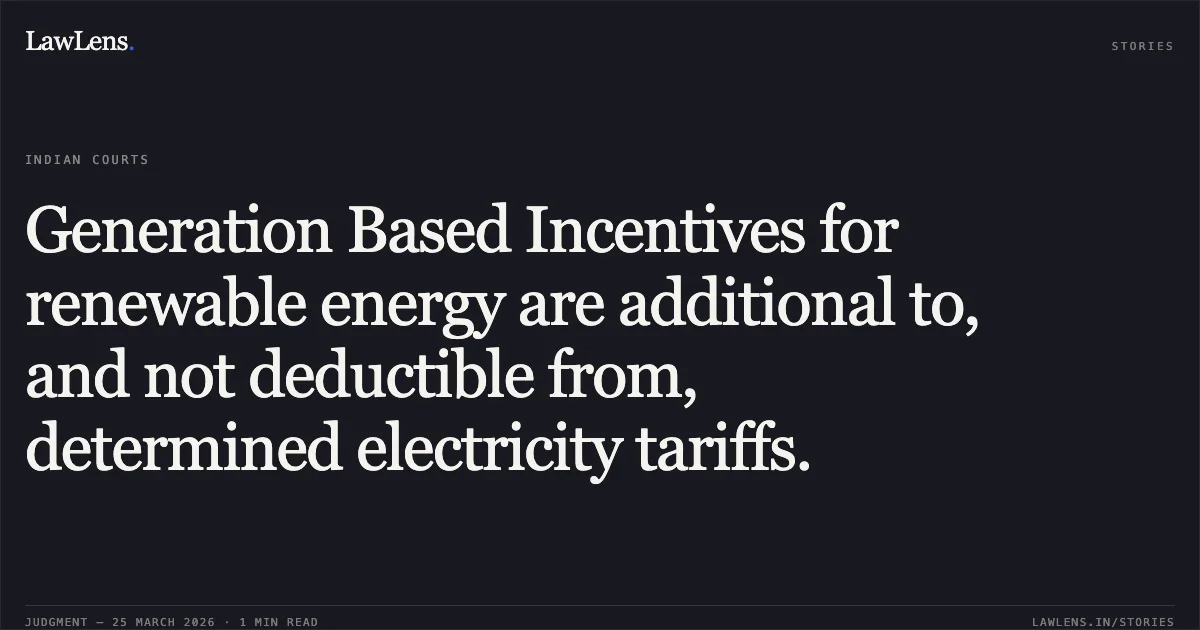
Source reference: p. 35Specifically, the GBI is intended to be a benefit to GENCOs "over and above the tariff" to promote renewable energy security; thus, it cannot be deducted to reduce the tariff for DISCOMs
Source reference: p. 36The DISCOMs were directed to refund any amounts deducted for GBI adjustment.
Source reference: p. 36The Supreme Court dismissed the appeal and upheld the APTEL’s decision, albeit with different reasoning.
Source reference: no citationActs & Sections Cited
9 provisions across 2 statutes referred to in this judgment. Each provision opens on LawLens.
Electricity Act, 20038
General Clauses Act, 18971
Original Court PDF
Southern Power Distribution Company Of Andhra Pradesh LimitedvsGreen Infra Wind Solutions Limited
Click to open original judgment
Original judgment, available to read, download and summarize on LawLens.in