Facts
The Appellant, owner of the second floor of property bearing No. 930, Mukherjee Nagar, Delhi, entered into an Agreement to Sell dated 24.04.2012 with the Respondent for a total consideration of ₹1,56,00,000.
Source reference: paras. 4, 7(b)–(d), 28–30At execution, the Respondent paid ₹12,50,000, described in the agreement and contemporaneous receipt as “Bayana/Earnest Money”; she subsequently paid ₹5,00,000 on 31.05.2012 as part payment towards the sale consideration.
Source reference: paras. 4, 7(b)–(d), 28–30The balance consideration was to be paid by the end of July 2012. The Respondent failed to complete the transaction within the stipulated period, and the Appellant cancelled the agreement by legal notice dated 05.09.2012 and invoked Clause 7 to forfeit the earnest money.
Source reference: para. 7(e)–(f)The Respondent instituted a suit seeking recovery of the amounts paid, contending that only ₹2,50,000 constituted earnest money and that the remaining sums were advance sale consideration.
Source reference: paras. 7(g)–(h), 15–16The Trial Court rejected the alleged conditional-payment arrangement but held that only ₹2,50,000 could be retained as earnest money and reasonable compensation, directing refund of ₹15,00,000 with interest.
Source reference: paras. 7(l)–(m), 35The Appellant preferred the present first appeal under Section 96 read with Order XLI Rule 1 and Section 151 CPC.
Source reference: para. 1Issues
Whether the entire sum of ₹12,50,000 paid at the time of execution of the Agreement to Sell constituted earnest money, or whether only ₹2,50,000 constituted earnest money and the balance represented advance sale consideration?
Source reference: paras. 25–31, 36–47Whether the Appellant was contractually entitled under Clause 7 of the Agreement to Sell to forfeit the ₹12,50,000 earnest money upon the Respondent’s failure to complete the transaction within the stipulated period?
Source reference: paras. 32–34, 48–53Whether proof of actual loss under Section 74 of the Indian Contract Act, 1872 was necessary before the Appellant could forfeit the earnest money?
Source reference: paras. 53–67Whether the subsequent payment of ₹5,00,000, made on 31.05.2012 as part payment of the sale consideration, could also be forfeited?
Source reference: paras. 71–72Law Applied
The Court applied Section 96 CPC and Order XLI Rule 31 CPC, under which a first appellate court must independently reconsider the facts and law and record reasoned findings on the points for determination, while ordinarily giving due weight to supported findings of the Trial Court.
Source reference: paras. 21–24On the character of payments, the Court relied on Shree Hanuman Cotton Mills v. Tata Air Craft Ltd., Satish Batra v. Sudhir Rawal, Central Bank of India v. Shanmugavelu, and K.R. Suresh v. R. Poornima, holding that earnest money is paid at the inception of the contract, operates as security or a guarantee for due performance, forms part of the purchase price if the transaction is completed, and may be forfeited upon the purchaser’s default; nomenclature is relevant but not conclusive.
Source reference: paras. 27, 49–52Under Fateh Chand v. Balkishan Das, Maula Bux v. Union of India, and Kailash Nath Associates v. DDA, Section 74 of the Contract Act applies to penal stipulations and forfeiture clauses, permitting only reasonable compensation; however, the Court distinguished genuine earnest money from mere advance or part-payment, holding that forfeiture of genuine earnest money stands on a distinct footing.
Source reference: paras. 56–67Sections 91 and 92 of the Indian Evidence Act, 1872, corresponding to Sections 94 and 95 of the Bharatiya Sakshya Adhiniyam, 2023, were applied for the principle that the terms of a written contract ordinarily govern the parties’ rights and cannot be varied by unsupported oral assertions.
Source reference: para. 47Reasoning
The Court found that the ₹12,50,000 payment satisfied the legal characteristics of earnest money: it was paid contemporaneously with execution of the agreement, was adjustable against the sale price if the transaction proceeded, and was expressly described as “Bayana/Earnest Money” in the agreement and receipt.
Source reference: paras. 28–31, 41Clause 7 expressly provided for forfeiture of the earnest money upon the purchaser’s default and contained reciprocal consequences for the vendor’s default, demonstrating that the amount was intended to secure performance.
Source reference: paras. 29, 33–34The Respondent produced no documentary or reliable oral evidence establishing that only ₹2,50,000 was earnest money or that her payment obligations were conditional upon the separate transaction with Ms. Renu Kalra; her inability to arrange funds therefore did not alter the written contractual obligation.
Source reference: paras. 37–46Since the Respondent’s breach was admitted and the amount was genuine earnest money, the Court held that the absence of proof of actual loss did not invalidate its forfeiture.
Source reference: paras. 58–62, 66–72However, the later ₹5,00,000 payment was made as part payment of the sale consideration, was not described as earnest money, and was not covered by the forfeiture clause. It therefore could not be retained without a contractual or independent legal basis.
Source reference: paras. 58–62, 66–72Holding
The appeal was partly allowed.
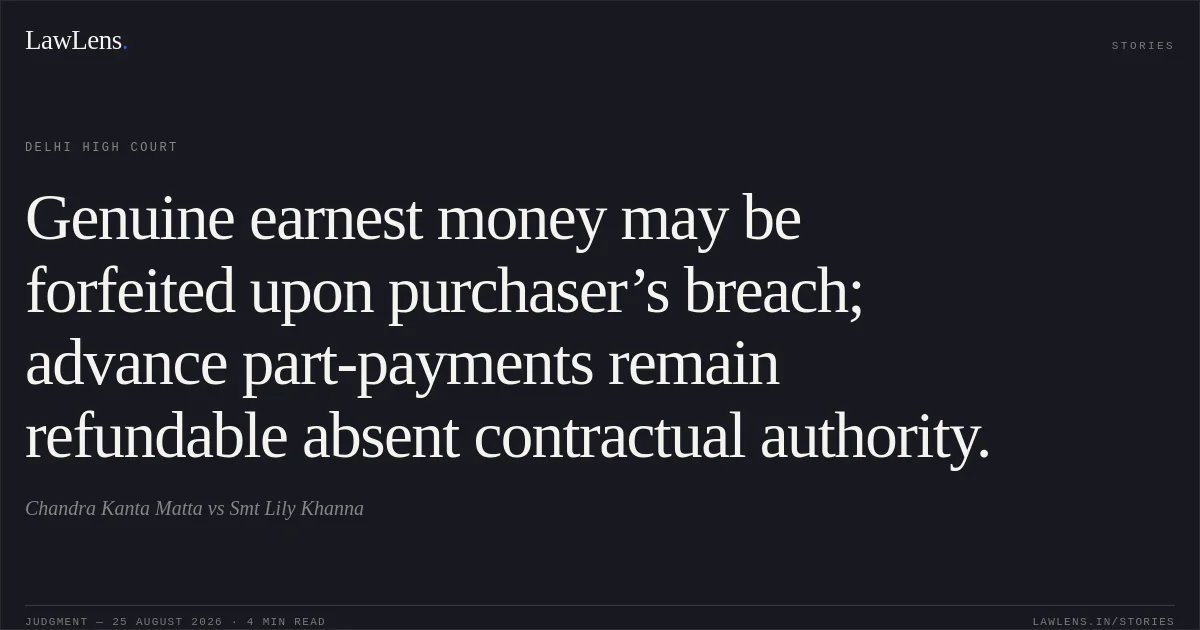
The Court held that ₹12,50,000 constituted genuine earnest money and that the Appellant validly forfeited it under Clause 7 upon the Respondent’s breach.
Source reference: paras. 68–70, 74The subsequent ₹5,00,000 payment was merely part payment of the sale consideration and was refundable.
Source reference: paras. 71–75Accordingly, the Trial Court’s direction to refund ₹15,00,000 was set aside and the Respondent was held entitled to recover only ₹5,00,000 from the Appellant.
Source reference: paras. 73–78The award of interest at 6% per annum was confined to that sum, with the remaining terms of the Trial Court’s order left unaltered; there was no order as to costs.
Source reference: paras. 73–78Acts & Sections Cited
7 provisions across 3 statutes referred to in this judgment. Each provision opens on LawLens.
Code of Civil Procedure, 19083
Indian Contract Act, 18722
Bharatiya Sakshya Adhiniyam, 20232
Original Court PDF
Chandra Kanta MattavsSmt Lily Khanna
Click to open original judgment
Original judgment, available to read, download and summarize on LawLens.in
![Courts will not interfere with transfers absent mala fides or violation of statutory rules.. M Ramya vs EMPLOYEES STATE INSURANCE CORPORATION (ESIC). CAT - ['Chennai']. LawLens](/stories/thumbnails/courts-will-not-interfere-with-transfers-absent-mala-fides-or-violation-of-statutory-rules-a6845e9ca6f548fca284c51c8351957f.webp)
![Courts cannot direct one-time recruitment age relaxation absent authority in the governing rules or advertisement.. UT OF PUDUCHERRY vs M ANDAL. CAT - ['Chennai']. LawLens](/stories/thumbnails/courts-cannot-direct-one-time-recruitment-age-relaxation-absent-authority-in-the-governing-895d78fde47143e2a8ed0207c4b6a44f.webp)
![A review cannot correct an allegedly erroneous decision absent an error apparent on the record.. Ajit Kumar Jha vs RAILWAY BOARD. CAT - ['Delhi']. LawLens](/stories/thumbnails/a-review-cannot-correct-an-allegedly-erroneous-decision-absent-an-error-apparent-on-the-re-8ac952fd4eba470c92f7da20af72a220.webp)