Facts
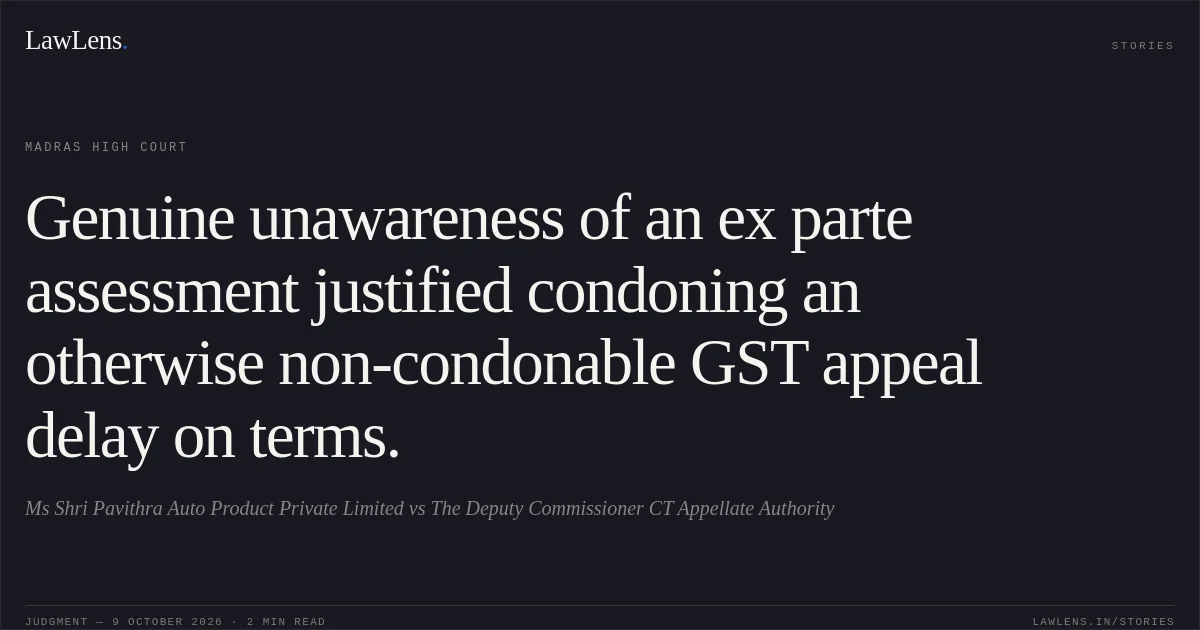
The petitioner challenged the rejection of its GST appeal as time-barred, along with the underlying assessment and related orders and recovery notice.
Source reference: p. 2The assessment was made ex parte on 10 August 2023.
Source reference: p. 2The petitioner said its consultant had not informed it of the order, and that it therefore remained unaware of the assessment.
Source reference: pp. 2–4It filed an appeal on 1 September 2025, which the first respondent rejected on 4 August 2026, recording a delay of 127 days beyond the condonable period.
Source reference: pp. 2–4The petitioner had paid the 10% disputed-tax pre-deposit and agreed to pay an additional 10% to obtain condonation of the delay.
Source reference: p. 3Issues
Whether the 127-day delay in filing the appeal against the ex parte assessment should be condoned despite being beyond the condonable period.
Source reference: pp. 3–4Whether condonation should be granted subject to payment of an additional 10% of the disputed tax and further directions for the appeal’s consideration.
Source reference: pp. 4–5Law Applied
The judgment does not identify or apply a particular GST statutory provision, cite precedent, or set out a general legal test for condoning delay.
Source reference: p. 2It addresses the matter in the exercise of the High Court’s writ jurisdiction under Article 226, as invoked in the petition.
Source reference: p. 2The court’s stated approach was to assess the explanation for delay and, in the circumstances of this case, condone it on terms, including an additional payment and directions for the appeal to be considered on its merits.
Source reference: pp. 4–5Reasoning
The court found the petitioner’s explanation—that it remained unaware of the ex parte assessment because its consultant failed to inform it—appeared genuine.
Source reference: p. 4In view of that explanation, and the petitioner’s undertaking to pay an additional 10% of the disputed tax, the court considered it appropriate to condone the delay on terms rather than leave the rejection in force.
Source reference: pp. 4–5The court did not decide the merits of the underlying assessment; it directed the appellate authority to consider the appeal after providing the petitioner an opportunity to be heard.
Source reference: p. 5Holding
The High Court set aside the appeal-rejection order and condoned the 127-day delay, subject to the petitioner paying an additional 10% of the disputed tax within two weeks of receiving the order; the setting aside takes effect from payment.
If the appeal had been completely rejected, the petitioner was directed to file a fresh appeal with a copy of the order within two weeks of payment.
Source reference: p. 5The appellate authority was then directed to take the appeal on record and decide it on the merits, in accordance with law, after providing sufficient opportunity to the petitioner.
Source reference: p. 5The writ petition was disposed of without costs.
Source reference: p. 6Acts & Sections Cited
1 provisions across 1 statute referred to in this judgment. Each provision opens on LawLens.
Central Goods and Services Tax Act, 20171
Original Court PDF
Ms Shri Pavithra Auto Product Private LimitedvsThe Deputy Commissioner CT Appellate Authority
Click to open original judgment
Original judgment, available to read, download and summarize on LawLens.in