Facts
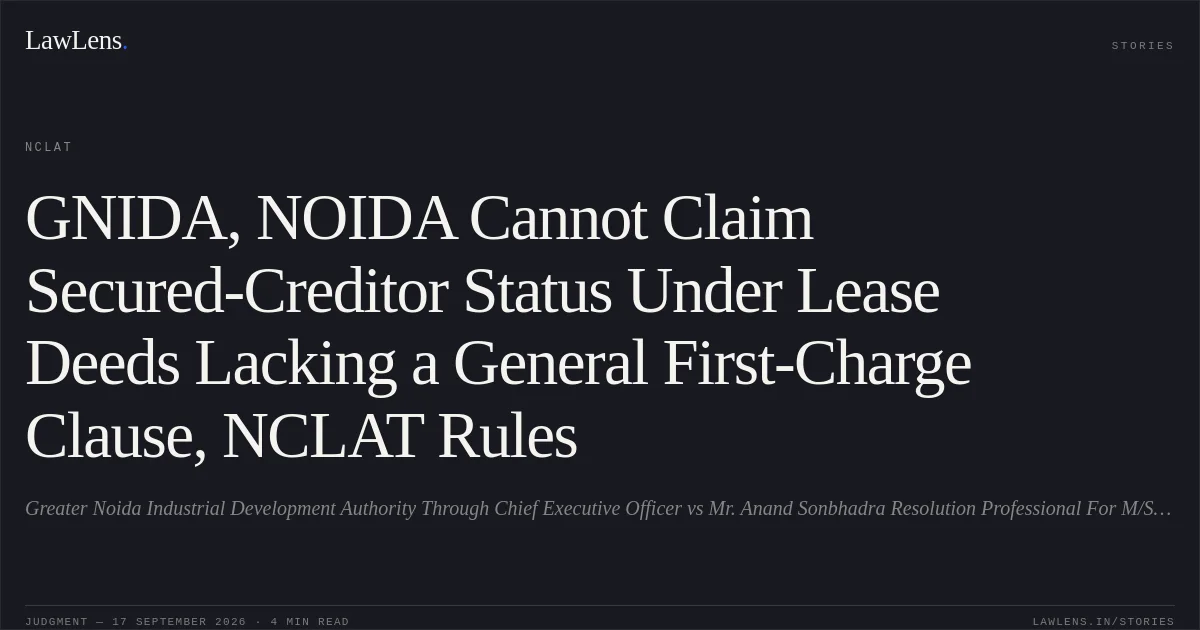
The appeals arose from the CIRP of M/s Shubhkamna Buildtech Pvt. Ltd. and challenged the NCLT’s order dated 12.09.2022 approving the revised resolution plan dated 12.10.2019.
Source reference: paras. 2–8GNIDA had leased Plot No. GH-02/A, Sector-01, Greater Noida, to the Corporate Debtor under a registered lease deed dated 04.04.2011, while NOIDA had leased Plot No. GH-05/B, Sector-137, Noida, under a registered 90-year lease deed dated 30.07.2010.
Source reference: paras. 2–8, 43–44Their claims for lease premium, rent and other statutory dues were treated under the resolution plan as unsecured statutory/government operational dues, with approximately ₹18.5 crore allocated to GNIDA and ₹25 crore allocated to NOIDA.
Source reference: para. 44The Authorities contended that their dues were secured by statutory and contractual charges over the leased plots and that they were entitled to treatment as secured creditors under Sections 30(2)(b) and 53 of the Insolvency and Bankruptcy Code, 2016 (“IBC”).
Source reference: paras. 10–18, 45During the appeals, the parties agreed that the surviving issue was whether GNIDA and NOIDA were secured creditors and what consequential benefits followed from such classification.
Source reference: para. 43Issues
Whether the GNIDA and NOIDA lease deeds created a “security interest” under Section 3(31) of the IBC, entitling the Authorities to classification as secured creditors rather than unsecured statutory/operational creditors.
Source reference: paras. 43, 52Whether the statutory charge or recovery mechanism under Sections 13, 13-A and 14 of the Uttar Pradesh Industrial Area Development Act, 1976 constituted a security interest under the IBC, particularly after the 2026 amendment to Section 3(31).
Source reference: paras. 56–58Whether the decision in Greater Noida Industrial Development Authority v. Prabhjit Singh Soni and the NCLAT decision in Assets Care & Reconstruction Enterprise Ltd. v. Viswanadha Sarma required the resolution plan to treat GNIDA and NOIDA as secured creditors.
Source reference: paras. 46, 59–64Law Applied
The Court applied Sections 3(30), 3(31), 30(2)(b), 31 and 53 of the IBC, together with Regulations 37 and 38 of the CIRP Regulations, 2016.
Source reference: no citationSection 3(31), as amended in 2026, defines “security interest” as a right, title, interest or claim securing payment or performance of an obligation through a transaction or arrangement between parties, while expressly excluding an interest or charge created merely by operation of law.
Source reference: para. 47Under Sections 30(2)(b) and 53, an operational creditor cannot receive less than its liquidation entitlement, but secured-creditor priority depends upon the existence of a legally recognised security interest.
Source reference: no citationThe Court considered State Tax Officer v. Rainbow Papers Ltd., which recognised statutory charges in the context of the then-prevailing law.
Source reference: para. 14Greater Noida Industrial Development Authority v. Prabhjit Singh Soni, which held that a statutory charge under Section 13-A of the 1976 Act required treatment as secured debt.
Source reference: para. 46Assets Care & Reconstruction Enterprise Ltd. v. Viswanadha Sarma, which recognised a contractual first charge expressly created by a registered tripartite sub-lease.
Source reference: paras. 59–64The Court also relied on Avenue Realty v. Assistant Commissioner, Srirangam GST Circle and R. Rajagopal Reddy v. Padmini Chandrasekharan for the principle that a genuinely clarificatory amendment may operate retrospectively.
Source reference: paras. 48, 57Reasoning
The “Mortgage” clause did not create a general charge securing all dues; it only gave the lessor priority for its share of unearned increase in the event of a mortgage foreclosure or sale, and no such event had occurred.
Source reference: paras. 54–55The clause providing that arrears were recoverable as arrears of land revenue was merely a statutory recovery mechanism and did not amount to a consensual charge created by agreement between the parties.
Source reference: para. 56In light of the retrospectively applicable 2026 Explanation to Section 3(31), a charge arising solely by operation of statute could not qualify as a “security interest” under the IBC.
Source reference: paras. 47–48, 57–58The Court distinguished Assets Care because that case involved an express, unconditional and general first charge over the plot for “all dues of Lessor” in a registered tripartite sub-lease, unlike the limited and contingent clauses in the present lease deeds.
Source reference: paras. 61–64Accordingly, the Authorities’ lease deeds did not create a contractual security interest, and the resolution plan’s classification of their claims as unsecured statutory/operational dues was not legally defective.
Source reference: paras. 65–66Holding
The Court held that neither the GNIDA lease deed dated 04.04.2011 nor the NOIDA lease deed dated 30.07.2010 created a general, unconditional contractual charge securing the Authorities’ dues.
The contingent unearned-increase clause and statutory land-revenue recovery mechanism were insufficient to confer secured-creditor status under Section 3(31) of the IBC.
Source reference: paras. 54–58, 65Assets Care was held factually distinguishable, and the statutory-charge reasoning in Prabhjit Singh Soni could not assist the Authorities after the 2026 amendment.
Source reference: paras. 59–64Both appeals were dismissed, the classification and treatment of GNIDA’s and NOIDA’s claims under the approved resolution plan were upheld, all pending interlocutory applications were closed, and there was no order as to costs.
Source reference: para. 66Acts & Sections Cited
8 provisions across 2 statutes referred to in this judgment. Each provision opens on LawLens.
Insolvency and Bankruptcy Code, 2016.6
Original Court PDF
Greater Noida Industrial Development Authority Through Chief Executive OfficervsMr. Anand Sonbhadra Resolution Professional For M/S Subhkamna Buildtech Private Limited & Ors & Ors.
Click to open original judgment
Original judgment, available to read, download and summarize on LawLens.in