Facts
The petitioner entered into an agreement for sale dated 9 November 2015 with LGW Limited, the landowner, and MKHS Realty LLP, the developer, for purchase of Flat No. 7E in the “Pyramid–Energy” project at Rajarhat.
Source reference: para. 4Despite payment of substantial advance amounts, the project was not completed within the agreed period and possession was not delivered.
Source reference: paras. 4, 12–13On 2 August 2021, the petitioner filed a complaint under Sections 420, 406, 120B and 34 IPC against the landowner and developer.
Source reference: para. 2The Magistrate examined the petitioner, took cognizance and issued process.
Source reference: para. 2The opposite party no. 2 thereafter obtained an interim stay in proceedings arising from the petitioner’s complaint and filed the impugned complaint alleging defamation under Sections 500 and 501 IPC.
Source reference: para. 3The Magistrate took cognizance, examined the complainant and a witness under Section 200 CrPC, and issued summons to the petitioner.
Source reference: para. 25The petitioner sought quashing of the defamation proceedings, contending that the statements in his complaint were bona fide accusations made before a court and were intended to protect his interests, and that the defamation case was retaliatory and an abuse of process.
Source reference: paras. 5–6Issues
Whether allegations made by the petitioner in a complaint before a Magistrate, concerning the alleged non-completion of the project and misappropriation or cheating, constituted defamatory imputations under Sections 499–501 IPC?
Source reference: paras. 13, 25–26Whether the allegations were protected by the Eighth and Ninth Exceptions to Section 499 IPC as accusations made in good faith to an authorised person and for protection of the petitioner’s interests?
Source reference: paras. 14–16, 25–28Whether continuation of the defamation proceedings amounted to an abuse of the process of court warranting exercise of the High Court’s quashing jurisdiction?
Source reference: paras. 20, 24, 28–29Law Applied
The Court applied Section 499 IPC, which requires an imputation concerning a person to be made or published with the intention, knowledge or reason to believe that it would harm that person’s reputation; Sections 500 and 501 IPC prescribe punishment for defamation and its publication or printing.
Source reference: paras. 25–26Explanation 2 to Section 499 extends defamation to imputations concerning a company.
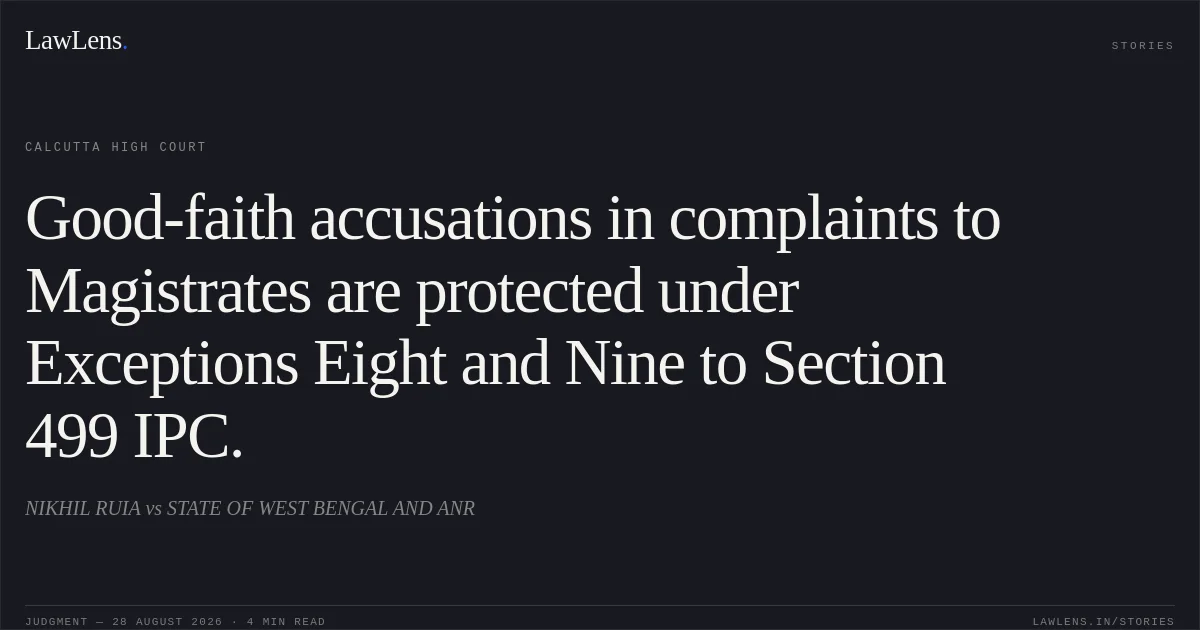
Source reference: paras. 25–26The Court relied particularly on the Eighth Exception, which protects an accusation made in good faith to a person having lawful authority over the subject matter, and the Ninth Exception, which protects imputations made in good faith for safeguarding the maker’s or another person’s interests.
Source reference: paras. 25–27Under Iveco Magirus Brandschutztechnik GMBH v. Nirmal Kishore Bhartiya, the Magistrate, and the High Court while exercising quashing jurisdiction, may consider an exception where the complaint and supporting material disclose a complete defence at the threshold.
Source reference: paras. 14–15The Court also relied on Shahed Kamal v. A. Surti Developers Pvt. Ltd., which recognised that proceedings based on bona fide consumer grievances may be quashed where the allegations fall within an exception to Section 499, and Kishor Balkrishna Nand v. State of Maharashtra, which affirmed that a good-faith accusation made before an authorised authority does not constitute defamation.
Source reference: paras. 14–16, 27The general principles governing quashing to prevent abuse of process, including those in State of Haryana v. Bhajan Lal, were also considered.
Source reference: paras. 20–22Reasoning
The Court found that the petitioner’s statements arose directly from his contractual grievance: he had paid advance consideration, the project remained incomplete, possession was not delivered, and attempts to contact the concerned parties allegedly failed.
Source reference: paras. 12–13, 17–18The complaint was submitted to a Magistrate, a person legally authorised to inquire into the alleged offences, and was not shown to have been circulated on any public platform.
Source reference: para. 19Accordingly, the requirement of publication and the alleged intention to damage the company’s reputation were not sufficiently established.
Source reference: para. 19The statements were treated as part of a bona fide accusation made to protect the petitioner’s financial and legal interests, thereby attracting the Eighth and Ninth Exceptions to Section 499 IPC.
Source reference: paras. 25, 27–28The Court further noted that the opposite party no. 2 had not specifically denied the project’s non-completion or the payment of advances, and that the defamation complaint appeared to have followed the petitioner’s criminal complaint and the stay obtained therein.
Source reference: paras. 10, 18–19The Magistrate had failed to examine whether the basic ingredients of defamation existed or whether the complaint was protected by the statutory exceptions.
Source reference: para. 25Continuation of the prosecution in these circumstances was therefore considered oppressive and an abuse of process.
Source reference: para. 28Holding
The Court held that the petitioner’s allegations, made in a judicial complaint concerning his unpaid investment and the alleged failure to complete the project, were protected by the Eighth and Ninth Exceptions to Section 499 IPC and did not prima facie constitute defamation.
It concluded that continuation of the proceedings under Sections 500 and 501 IPC would amount to an abuse of process.
Source reference: paras. 28–29The criminal revisional application was allowed, and the entire proceeding in Case No. CN/279/2022 pending before the Metropolitan Magistrate, 13th Court, Calcutta, was quashed.
Source reference: paras. 28–29Acts & Sections Cited
17 provisions across 2 statutes referred to in this judgment. Each provision opens on LawLens.
Indian Penal Code, 1860
Code of Criminal Procedure, 19735
Original Court PDF
NIKHIL RUIAvsSTATE OF WEST BENGAL AND ANR
Click to open original judgment
Original judgment, available to read, download and summarize on LawLens.in
![Courts will not interfere with transfers absent mala fides or violation of statutory rules.. M Ramya vs EMPLOYEES STATE INSURANCE CORPORATION (ESIC). CAT - ['Chennai']. LawLens](/stories/thumbnails/courts-will-not-interfere-with-transfers-absent-mala-fides-or-violation-of-statutory-rules-a6845e9ca6f548fca284c51c8351957f.webp)
![Courts cannot direct one-time recruitment age relaxation absent authority in the governing rules or advertisement.. UT OF PUDUCHERRY vs M ANDAL. CAT - ['Chennai']. LawLens](/stories/thumbnails/courts-cannot-direct-one-time-recruitment-age-relaxation-absent-authority-in-the-governing-895d78fde47143e2a8ed0207c4b6a44f.webp)
![A review cannot correct an allegedly erroneous decision absent an error apparent on the record.. Ajit Kumar Jha vs RAILWAY BOARD. CAT - ['Delhi']. LawLens](/stories/thumbnails/a-review-cannot-correct-an-allegedly-erroneous-decision-absent-an-error-apparent-on-the-re-8ac952fd4eba470c92f7da20af72a220.webp)