Facts
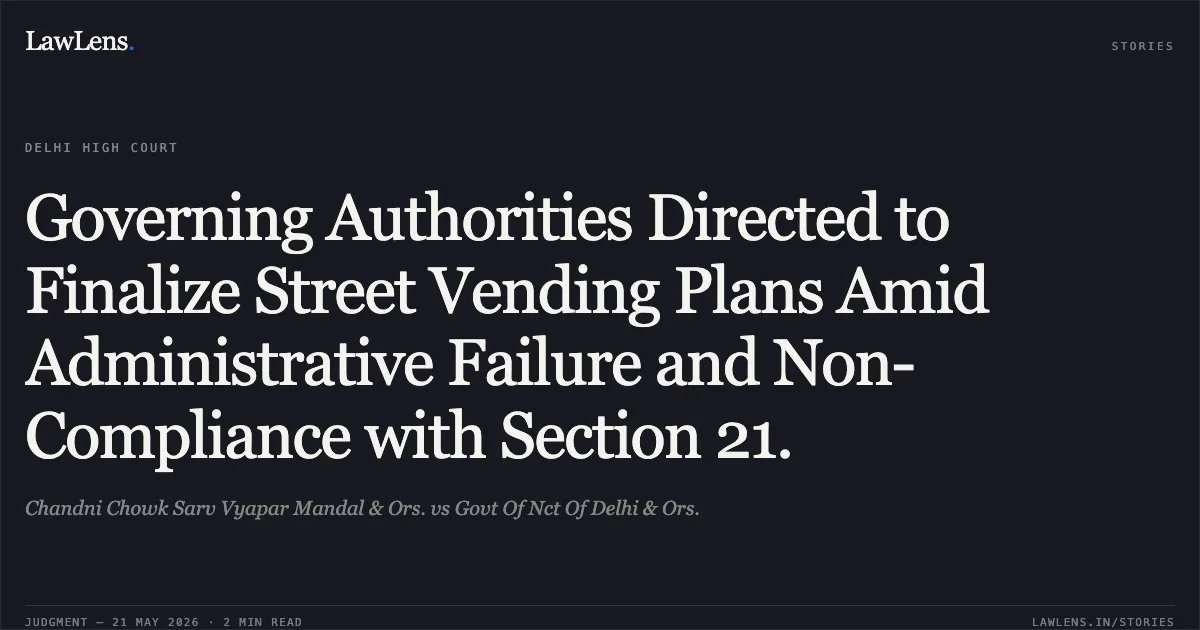
The High Court of Delhi addressed a cluster of petitions from shopkeepers' associations and individuals concerning the unregulated presence of street vendors and tehbazari holders in various zones, including Connaught Place, Palika Bazar (NDMC), and Sarojini Nagar
Source reference: p. 1-3Under the Street Vendors Act, 2014, local bodies like NDMC and MCD are required to survey vendors, identify sites, and submit a vending plan for Government approval
Source reference: p. 3While NDMC submitted a plan on October 9, 2025, subsequent minutes from April 15, 2026, revealed that the plan was incomplete as 200 additional sites were needed
Source reference: p. 3, 7-8Crucially, around 740 squatters/tehbazari holders approved by the Thareja Committee refused to participate in the survey and continue to occupy "no-vending" zones like Connaught Place corridors
Source reference: p. 9-10Meanwhile, the MCD has failed to finalize its plan or conduct elections for Town Vending Committees (TVC-II)
Source reference: p. 11Issues
1. Whether the GNCTD and local municipal bodies have failed in their statutory duty to finalize and implement the Vending Plan under the 2014 Act
Source reference: p. 6, 102. Whether tehbazari holders and squatters can continue to vend in prohibited areas by refusing to participate in the mandatory survey
Source reference: p. 9-103. Whether the current administrative deadlock between NDMC and GNCTD constitutes a failure of decision-making regarding urban planning and pedestrian rights
Source reference: p. 10-11Law Applied
The Court primarily applied the Street Vendors (Protection of Livelihood and Regulation of Street Vending) Act, 2014, specifically Section 21, which mandates the submission of vending plans by local authorities to the Government for approval
Source reference: p. 3-4It further relied on the Supreme Court precedent in Sudhir Madan and Ors. v. MCD and Ors. [2007 SCCOnLine SC 758], which legally established Connaught Place and Rajiv/Indira Chowk as "No-hawking" and "No-vending" zones
Source reference: p. 3-4The court also considered the legal status of tehbazari holders protected under the Thareja Committee guidelines
Source reference: p. 9Reasoning
The Court observed a "complete absence of decision-making" and a lack of coordination between the GNCTD, NDMC, and MCD
Source reference: p. 11It noted that despite the NDMC areas being declared non-vending zones by the Supreme Court, corridors are currently congested due to the refusal of long-standing tehbazari holders to register under the new survey
Source reference: p. 9The GNCTD appeared unaware of the plans already submitted, while the NDMC was found to be shifting positions—submitting a plan in October 2025 but later claiming it required 200 more sites in April 2026 without updating the Government
Source reference: p. 6, 9The Court emphasized that this administrative inertia creates a chaotic environment that infringes upon the rights of three stakeholders: vendors, shopkeepers, and pedestrians
Source reference: p. 11-12Holding
The Court held that the prevailing situation is chaotic and requires immediate high-level intervention.
It directed the Chief Secretary of the GNCTD to take personal charge of the matter
Source reference: p. 11The Court ordered a mandatory joint meeting on June 2, 2026, involving the Chairman of NDMC and Commissioner of MCD to resolve the deadlock
Source reference: p. 12The Chief Secretary is directed to determine the legality of provisional Certificates of Vending (CoVs) and produce a final status report
Source reference: p. 11The Chief Secretary was ordered to join the next hearing virtually on July 27, 2026
Source reference: p. 12Acts & Sections Cited
1 provisions across 1 statute referred to in this judgment. Each provision opens on LawLens.
Street Vendors (Protection of Livelihood and Regulation of Street Vending) Act, 20141
Original Court PDF
Chandni Chowk Sarv Vyapar Mandal & Ors.vsGovt Of Nct Of Delhi & Ors.
Click to open original judgment
Original judgment, available to read, download and summarize on LawLens.in


![Authorities must decide pensionary and retiral-benefit claims through a reasoned order within eight weeks.. Habibullah khan vs HOME DEPARTMENT. CAT - ['Srinagar']. LawLens](/stories/thumbnails/authorities-must-decide-pensionary-and-retiral-benefit-claims-through-a-reasoned-order-wit-d0cbe8a8119c48fbabe7df9f2d353488.webp)