Facts
The applicant, Kovid Khosla, was aggrieved by Government Order No. 175-Rev of 2016 dated December 6, 2016, which rejected his claim for appointment as Naib-Tehsildar.
Source reference: p.3This stemmed from an advertisement notice No. 4 of 2008 for Naib-Tehsildar posts, for which Khosla applied and participated in the written examination on February 22, 2009.
Source reference: p.3During the exam, he found numerous wrong or vague questions.
Source reference: p.4Seven other candidates (proforma respondents), led by Hamidullah Dar, filed SWP No. 487/2009 in the Hon’ble High Court, alleging issues with the question paper.
Source reference: p.4The High Court, on December 31, 2014, allowed the petition, directing the JKSSB to delete 23 questions, re-evaluate the performance of petitioners and selected candidates based on 97 questions, and redraw the merit list.
Source reference: p.12Subsequently, the High Court directed the respondent authorities to issue appointment orders in favor of the petitioners in SWP No. 487/2009 through an order dated August 2, 2016, in contempt petition No. 733/2015.
Source reference: p.5Khosla, considering himself similarly situated, filed SWP No. 96/2016, which was disposed of on February 2, 2016, with a direction to the respondents to consider his case in light of the Hamidullah Dar judgment.
Source reference: p.7However, his claim was ultimately rejected by the impugned Government Order.
Source reference: p.7-8The main contention was that even after re-evaluation, some proforma respondents had very low marks, including Rayees Ahmad Parray with zero marks, yet were appointed, while the applicant was denied.
Source reference: p.6, p.15Issues
Whether the applicant's claim can be denied on the principle of delay and laches, and whether he can be termed a fence-sitter.
Source reference: p.11Whether the rejection order issued by the respondents is reasoned and in consonance with the order dated February 2, 2016, passed in SWP No. 96/2016, and the principles of law, equity, and fair play.
Source reference: p.12Whether the merit of the applicants can be ignored, and their superior merit be treated as a disadvantage for them.
Source reference: p.12Law Applied
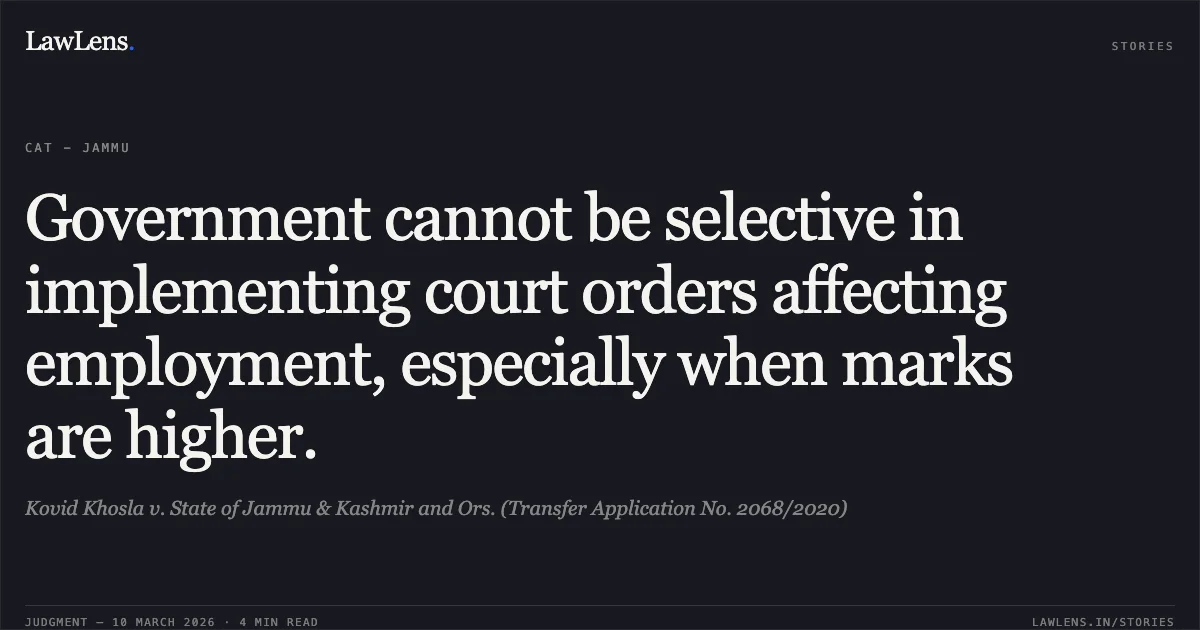
The court primarily applied the principles of equality and non-discrimination enshrined in Articles 14 and 16 of the Constitution of India, emphasizing that similarly situated persons should be treated alike, and selective implementation of court orders is impermissible.
Source reference: p.14-15, p.19It drew support from `State of Karnataka v. C. Lalitha (2006) 2 SCC 747`, which states that all similarly situated persons should be treated similarly, and one person approaching the court does not mean others similarly situated should be treated differently.
Source reference: p.19The court also relied on `State of Uttar Pradesh and Others v. Arvind Kumar Srivastava and Others (2015) 1 SCC 347`, which elaborates on the "normal rule" of extending relief to identically situated persons unless exceptions like laches, delays, or acquiescence apply, and highlights that a "judgment in rem" intends to benefit all similarly situated persons.
Source reference: p.19-20Additionally, the judgment emphasized the requirement for quasi-judicial authorities to record cogent and clear reasons for their decisions, as established in `M/s Kranti Associates Pvt. Ltd. & Anr. Vs. Sh. Masood Ahmed Khan & Others (2010) 3 SCC (Civil) 852`.
Source reference: p.21-22Reasoning
The court found that the official respondents acted selectively and arbitrarily by implementing the High Court's judgment in SWP No. 487/2009 only for its petitioners while denying similar benefits to the applicant, despite the High Court's directive in SWP No. 96/2016 to consider the applicant's case in light of that judgment.
Source reference: p.7-8, p.14The selective approach was highlighted by the fact that some proforma respondents appointed had significantly lower or even zero marks after re-evaluation, whereas the applicant's higher merit was ignored.
Source reference: p.15The court determined that the High Court's directive in SWP No. 487/2009, which involved re-evaluating all candidates' performance and redrawing the merit list, was a "judgment in rem," requiring uniform application to all similarly situated candidates, not just the original petitioners.
Source reference: p.14Therefore, the respondents' argument that the applicant was a fence-sitter or that his claim was delayed was rejected because the discriminatory act was recurring, and he had actively pursued his claim through SWP No. 96/2016.
Source reference: p.15-16The court also noted the respondents' failure to provide evidence that the applicant participated in any further selection process beyond the written test, which was a point of dissimilarity cited in the rejection order.
Source reference: p.16-17Furthermore, the court observed that other similarly situated candidates were appointed as recently as 2023, even with age relaxation, indicating a continuing policy that should extend to the applicant.
Source reference: p.17The court concluded that the rejection order (Government Order No. 175-Rev of 2016) lacked reasoned justification for distinguishing the applicant's case from others who received benefits.
Source reference: p.16Holding
The Tribunal allowed the Transfer Application.
It quashed and set aside Government Order No. 175-Rev of 2016 dated December 6, 2016, which rejected the applicant's claim.
Source reference: p.23The respondents were directed to appoint the applicant as Naib-Tehsildar under the direct recruitment quota and grant all consequential service benefits, including seniority, similar to those granted to the petitioners in SWP No. 487/2009, SWP No. 360/2017, and in alignment with the judgment in TA No. 1101/2020.
Source reference: p.23This exercise is to be completed within four weeks from the date of receipt of a certified copy of the Order.
Source reference: p.23Acts & Sections Cited
1 provisions across 1 statute referred to in this judgment. Each provision opens on LawLens.
Contempt of Courts Act, 19711
Original Court PDF
Kovid Khosla v. State of Jammu & Kashmir and Ors. (Transfer Application No. 2068/2020)
Click to open original judgment
Original judgment, available to read, download and summarize on LawLens.in