Facts
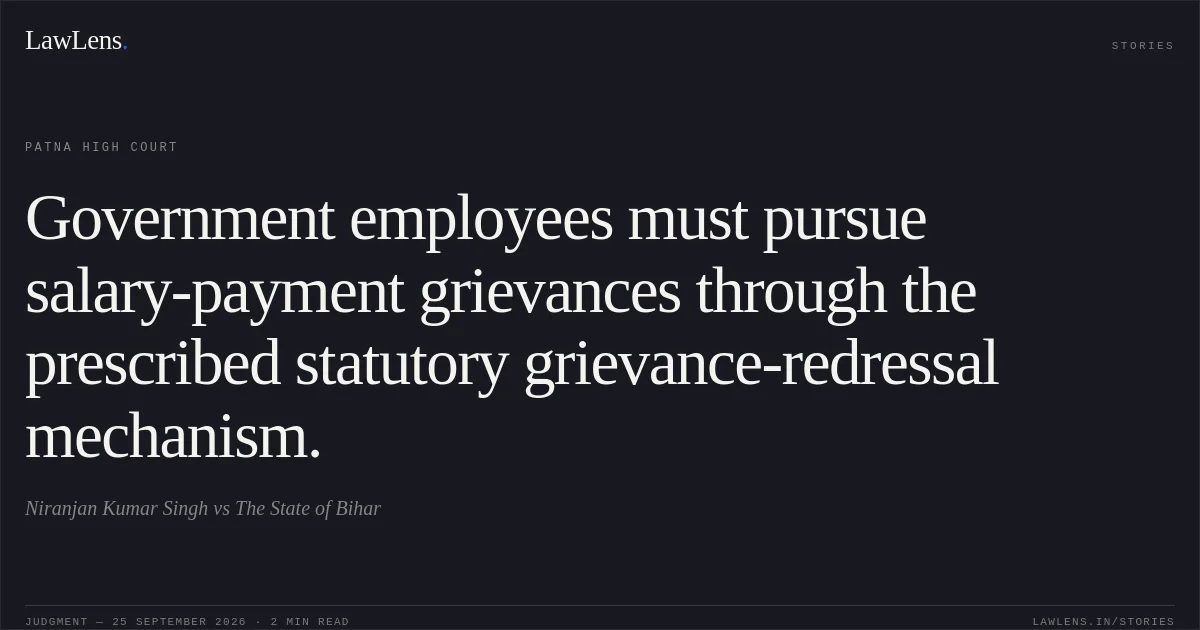
The petitioner, a Government employee, approached the Patna High Court seeking payment of salary and consequential benefits allegedly due for the periods from 1 August 2009 to 8 October 2009 and 9 October 2009 to 14 December 2009.
Source reference: p. 1–2He also sought directions for consideration of his pending representation concerning the same grievance.
Source reference: p. 1–2The State raised a preliminary objection, contending that the petitioner had an alternative remedy under the Bihar Government Servant Grievance Redressal Rules, 2019, which provide a procedure for complaints relating to salary payment and other service benefits.
Source reference: p. 2The Court examined the scope of “complaint” under Rule 2(c) and the filing procedure under Rule 3 of the 2019 Rules.
Source reference: p. 2–5Issues
1. Whether the petitioner’s claim for unpaid salary and consequential service benefits falls within the scope of a “complaint” under Rule 2(c) of the Bihar Government Servant Grievance Redressal Rules, 2019.
Source reference: p. 2–42. Whether the petitioner should be directed to pursue the statutory grievance-redressal mechanism under the 2019 Rules instead of obtaining adjudication of the claim through the writ petition.
Source reference: p. 2, 5Law Applied
The Court applied the Bihar Government Servant Grievance Redressal Rules, 2019. Rule 2(c) defines “complaint” to include matters concerning service benefits of serving and retired State Government personnel, including salary payment, increments, allowances, and retirement benefits, subject to specified exclusions such as matters pending before a court, disciplinary or departmental proceedings, transfer, posting, deputation, and Right to Information Act matters.
Source reference: p. 2–4Rule 3 permits serving or retired State Government employees to file complaints online regarding service matters or retirement benefits and requires a separate application for each distinct subject.
Source reference: p. 4–5The Court consequently recognized the availability of the prescribed alternative administrative remedy for the petitioner’s salary grievance.
Source reference: p. 5Reasoning
The petitioner’s claim related directly to non-payment of salary and consequential service benefits, matters expressly covered by Rule 2(c) of the 2019 Rules.
Source reference: p. 2–4The record did not indicate that the grievance fell within any of the exclusions under the Rules.
Source reference: no citationSince Rule 3 provided a specific mechanism for registering and deciding such service-related complaints, the Court considered it appropriate for the petitioner to first invoke that remedy rather than seek a direct writ direction for payment.
Source reference: p. 4–5The Court therefore disposed of the writ petition without deciding the petitioner’s entitlement to the claimed salary, leaving that issue to be determined by the competent authority in accordance with the 2019 Rules.
Source reference: p. 5Holding
The Court directed the petitioner to file a complaint under the Bihar Government Servant Grievance Redressal Rules, 2019 before the concerned authority within 30 days from the date of judgment.
The concerned authority was directed to decide the complaint strictly within the time frame prescribed under the Rules.
Source reference: p. 5The writ petition was accordingly disposed of, with no final adjudication on the merits of the petitioner’s salary claim.
Source reference: p. 5Original Court PDF
Niranjan Kumar SinghvsThe State of Bihar
Click to open original judgment
Original judgment, available to read, download and summarize on LawLens.in