Facts
The Petitioner-Society claimed title to a larger parcel of land granted by the Collector in 1959.
Source reference: no citationA portion of the adjoining land was Government land reserved for public/open-space purposes.
Source reference: no citationSince the Society’s plot was initially landlocked, the Municipal Corporation permitted it to use a temporary 30-foot access through the Government land, subject to the condition that the access would be discontinued once the sanctioned 44-foot Development Plan road was constructed.
Source reference: paras. 4–6, 36–38The Development Plan road was subsequently constructed and became operational.
Source reference: paras. 39–42The Society nevertheless continued using the Government-land access and installed gates at its entrance, thereby restricting access to the Society’s members and excluding others.
Source reference: paras. 39–42The BMC issued notices in 2025 concerning the Society’s alleged unauthorised use of the garden/open-space property, following which the Society instituted Civil Suit No. 287 of 2025 claiming title by adverse possession and seeking injunctive relief.
Source reference: paras. 7–9, 33Thereafter, the Collector passed an order dated 17 March 2026 directing removal of the gates.
Source reference: paras. 10–16Government officers attempted to remove the gates on 23 March, 27 March and 1 April 2026 without issuing a separate notice or hearing to the Society.
Source reference: paras. 10–16The Society challenged the Collector’s order and consequential action under Articles 226 and 227 of the Constitution, contending that the access strip formed part of its allotted property, was covered by the civil suit injunction, and could not be dealt with without proceedings under Section 53 of the Maharashtra Land Revenue Code, 1966 (“MLRC”).
Source reference: paras. 17–20Issues
Whether the access strip and the gates formed part of the subject matter of Civil Suit No. 287 of 2025, so that the interim injunction passed in that suit applied to the Collector’s action?
Source reference: para. 31(i)Whether the access strip on which the gates were installed formed part of the land allotted to the Society in 1959, and whether the Collector was required to issue notice before directing removal of the gates?
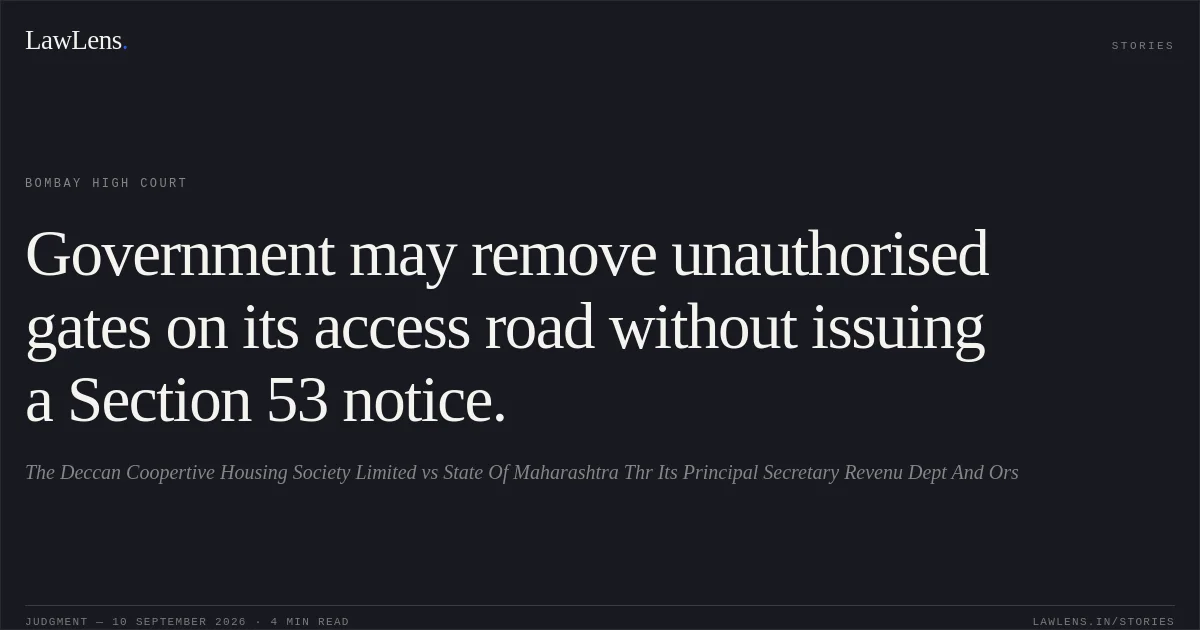
Source reference: para. 31(ii)Whether the Collector had jurisdiction to direct removal of the gates without following the procedure under Section 53 of the MLRC?
Source reference: para. 31(iii)Law Applied
The Court applied the principles governing Government land and unauthorised obstruction of public access under the Maharashtra Land Revenue Code, 1966, particularly Section 53, which ordinarily requires notice, inquiry and a reasonable opportunity of being heard before eviction of a person occupying Government land.
Source reference: para. 43The Court relied on Shakuntalabai w/o Shrinivas Dhoot v. State of Maharashtra, Second Appeal Nos. 118, 119, 120 and 127 of 1999, decided on 8 August 2025, for the principle that occupants of Government land cannot ordinarily be summarily dispossessed without compliance with Section 53.
Source reference: para. 43However, the Court distinguished that principle where the State was not evicting the Society or terminating its access, but was merely removing an unauthorised gate obstructing access over Government land and restoring the land for use by the public.
Source reference: paras. 40–44, 47–48The Court further applied the principle that permission to use Government land as an access does not confer ownership, exclusive possession, or a right to obstruct public access by erecting gates.
Source reference: paras. 40–44, 47–48Reasoning
The Court held that the Society’s own pleadings and the prayer in Civil Suit No. 287 of 2025 showed that the suit concerned the garden/open-space property and did not include the access strip or the gates.
Source reference: paras. 32–34Consequently, the injunction in the civil suit did not restrain action concerning the access strip.
Source reference: paras. 32–34On the title issue, the Court found from the maps and the 1976–1978 Municipal communications that the access ran through Government land and had been granted only as a temporary facility until construction of the eastern Development Plan road.
Source reference: paras. 35–40Since that road had been constructed and was being used, the Society had no basis to claim exclusive possession of the temporary access.
Source reference: paras. 35–40The Court further reasoned that removal of the gates did not dispossess the Society or prevent it from using the access.
Source reference: paras. 41–47Instead, it removed the obstruction and kept the Government land open to the Society and the public.
Source reference: paras. 41–47Therefore, the action was materially different from eviction or takeover of possession requiring prior proceedings under Section 53.
Source reference: paras. 41–47Although the Collector’s observation that the access was being used “unauthorisedly” was incorrect because the access had originally been permitted by the Municipal Corporation, the direction to remove the gates was justified because the Society had converted a permitted access into an exclusive passage.
Source reference: paras. 41–47The Court nevertheless clarified that the State could not stop the Society’s access or grant exclusive use of the road to another party without following due process.
Source reference: para. 48Holding
The Court rejected the Society’s contention that the access strip and gates were covered by the civil suit injunction and held that the strip was Government land, not part of the 1959 allotment.
It upheld the Collector’s direction to remove the gates, holding that Section 53 of the MLRC was not attracted merely because an obstruction on Government land was being removed while the Society’s access continued.
Source reference: paras. 44, 47–48However, the State was directed to keep the access open to the Society as well as to others and was restrained from granting exclusive use of the access to any other party.
Source reference: para. 48The writ petition was accordingly partly allowed, and the Rule was made absolute in those terms.
Source reference: paras. 48–50Acts & Sections Cited
3 provisions across 2 statutes referred to in this judgment. Each provision opens on LawLens.
Maharashtra Land Revenue Code, 19662
Limitation Act, 19631
Original Court PDF
The Deccan Coopertive Housing Society LimitedvsState Of Maharashtra Thr Its Principal Secretary Revenu Dept And Ors
Click to open original judgment
Original judgment, available to read, download and summarize on LawLens.in