Facts
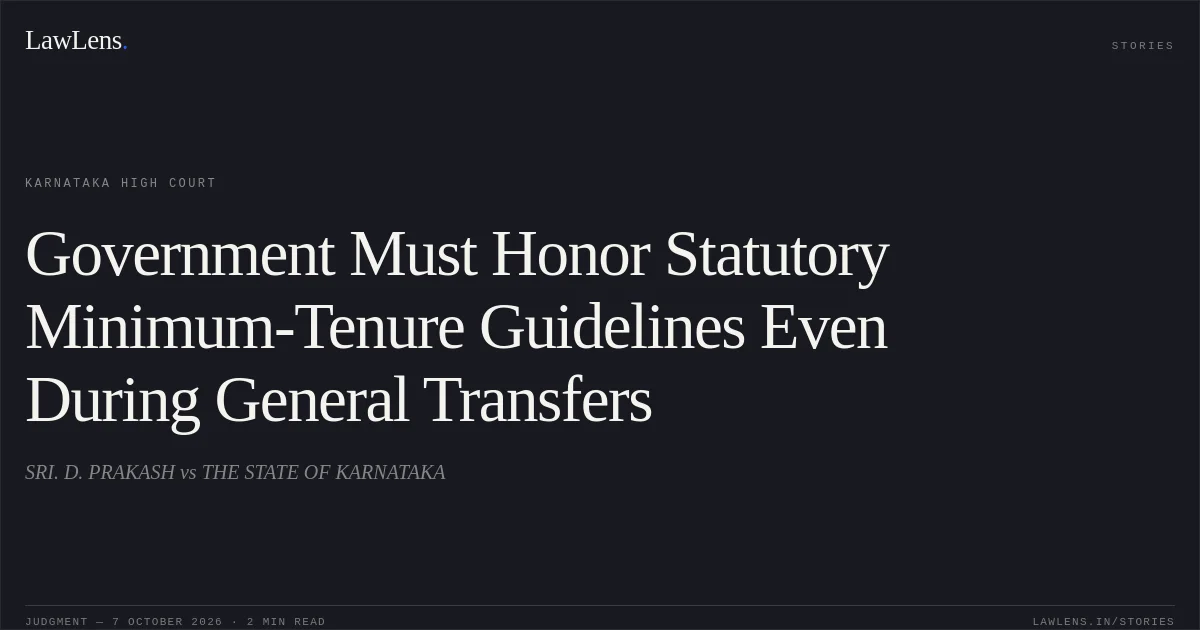
The petitioner, a Group ‘C’ Shirestedar, was posted to Bengaluru East Taluk Office on 23 August 2023.
Source reference: p. 3–4By a transfer order dated 27 May 2026, he was transferred to Doddaballapura before completing the four-year minimum tenure prescribed by the Government’s transfer order dated 13 April 2026; respondent No. 3 was posted in his place.
Source reference: p. 3–4The Karnataka State Administrative Tribunal dismissed the petitioner’s challenge, observing that the transfer had been given effect and had not affected his service conditions.
Source reference: p. 3–4The petitioner challenged the Tribunal’s order and the transfer order under Articles 226 and 227 of the Constitution
Source reference: p. 3–4Issues
1. Whether the Tribunal’s refusal to interfere with the petitioner’s premature transfer warranted interference by the High Court
Source reference: p. 72. Whether the transfer could be sustained because it was made during the general transfer period and had already been given effect
Source reference: p. 5, 9, 12–13Law Applied
The Government order dated 13 April 2026 prescribed a minimum four-year tenure for Group ‘C’ posts.
Source reference: p. 8The Court relied on H.N. Chandru v. State of Karnataka, ILR 2011 KAR 1585, and S.N. Gangadharaiah v. State of Karnataka, AIR 2015 KAR 146, for the proposition that Karnataka’s Government transfer guidelines have statutory force and must be followed
Source reference: p. 8The Court also applied T. Suneel Kumar, IPC v. State of Karnataka, ILR 2013 KAR 4564, which establishes that an order of transfer is not insulated from judicial review merely because the transferred officer has assumed charge
Source reference: p. 12–13While State of U.P. v. Gobardhan Lal, (2004) 11 SCC 402, and Shilpi Bose v. State of Bihar, 1991 Supp (2) SCC 659, recognise that transfer is ordinarily an incidence of service and courts should not lightly interfere, the Court held that authorities must comply with applicable transfer guidelines
Source reference: p. 10–11Reasoning
The petitioner had served at Bengaluru East for less than three years when transferred, despite the applicable four-year minimum tenure.
Source reference: p. 9The State could not identify any provision exempting transfers made during the general transfer period from that requirement; the Court held that the tenure guideline applied during that period as well
Source reference: p. 9The Court distinguished Smt. Ambika v. State of Karnataka, W.P. No. 16507/2026, because that case concerned transfers between offices within the same headquarters, whereas this transfer was between different headquarters
Source reference: p. 10It further held that the Tribunal erred in treating implementation of the transfer as a reason to refuse relief, since assumption of charge does not determine the validity of the transfer order.
Source reference: p. 12–14Holding
The Court answered the issue in the affirmative and allowed the writ petition.
It set aside the Tribunal’s order dated 27 August 2026 and quashed the transfer order dated 27 May 2026 insofar as it concerned the petitioner and respondent No. 3.
Source reference: p. 13–14The State was directed to continue the petitioner as Shirestedar at Bengaluru East until completion of his tenure, with liberty to transfer him earlier if required by the exigencies of service.
Source reference: p. 13–14Original Court PDF
SRI. D. PRAKASHvsTHE STATE OF KARNATAKA
Click to open original judgment
Original judgment, available to read, download and summarize on LawLens.in