Facts
Respondent No. 2 (complainant), claiming to be the General Power of Attorney (GPA) holder of one Fakiri Kisan Gangave (a member of a Scheduled Tribe), filed a private complaint (Criminal M.A. No. 179 of 2024) alleging that the appellants encroached upon and illegally transferred tribal land in Gut No. 311.
Source reference: para. 4The complainant alleged the appellants used fabricated sale deeds to grab land protected under Section 36 of the Maharashtra Land Revenue Code (MLRC).
Source reference: para. 4On 16.05.2025, the Special Court issued process against the appellants for offences under Sections 3(1)(f) and 3(1)(g) of the SC & ST (Prevention of Atrocities) Act.
Source reference: para. 2, 5The appellants challenged this order, arguing the complainant lacked locus standi and that revenue records classified the land as Class-1 (non-tribal).
Source reference: para. 6, 7Issues
1. Whether a General Power of Attorney holder has the locus standi to file a criminal complaint under the SC & ST Act on behalf of a victim without specific authorization or the victim's participation.
Source reference: para. 92. Whether the ingredients of Sections 3(1)(f) and 3(1)(g) of the SC & ST Act are attracted when revenue reports indicate the subject land is classified as "Class-1" and not "tribal land".
Source reference: para. 13Law Applied
Sections 3(1)(f) and 3(1)(g) of the Scheduled Castes and Scheduled Tribes (Prevention of Atrocities) Act, 1989, which penalize the wrongful occupation or transfer of land belonging to a member of a Scheduled Caste or Tribe.
Source reference: para. 12, 13Sections 36 and 36A of the Maharashtra Land Revenue Code (MLRC), which restrict the transfer of occupancies of tribals to non-tribals.
Source reference: para. 13Section 202 of the Cr.P.C. regarding the investigation of complaints before issuing process.
Source reference: para. 7The legal distinction between acting "by" an entity versus "on behalf of" an entity under agency law.
Source reference: para. 10Reasoning
The Court observed that while any person can generally set the criminal law in motion under Section 154 Cr.P.C., the specific nature of the SC & ST Act requires the involvement of the victim.
Source reference: para. 12The Court found that the GPA produced by Respondent No. 2 did not specifically authorize the filing of criminal proceedings on behalf of the victim, Fakiri Kisan Gangave, who was not a party to the complaint.
Source reference: para. 9The Court analyzed the Section 202 Cr.P.C. report submitted by the Investigating Officer, which cited Sub-Registrar records stating that the land in the name of Appellant No. 1 (3 Hectare 22 R) was "Class-1" land and not categorized as tribal land.
Source reference: para. 13Since the complainant failed to produce substantial evidence showing the land was prohibited from transfer under the MLRC, the Court determined that the essential ingredients of the alleged offences were absent.
Source reference: para. 13The trial court was found to have issued process in a "mechanical manner" without addressing these legal and factual discrepancies.
Source reference: para. 7, 13Holding
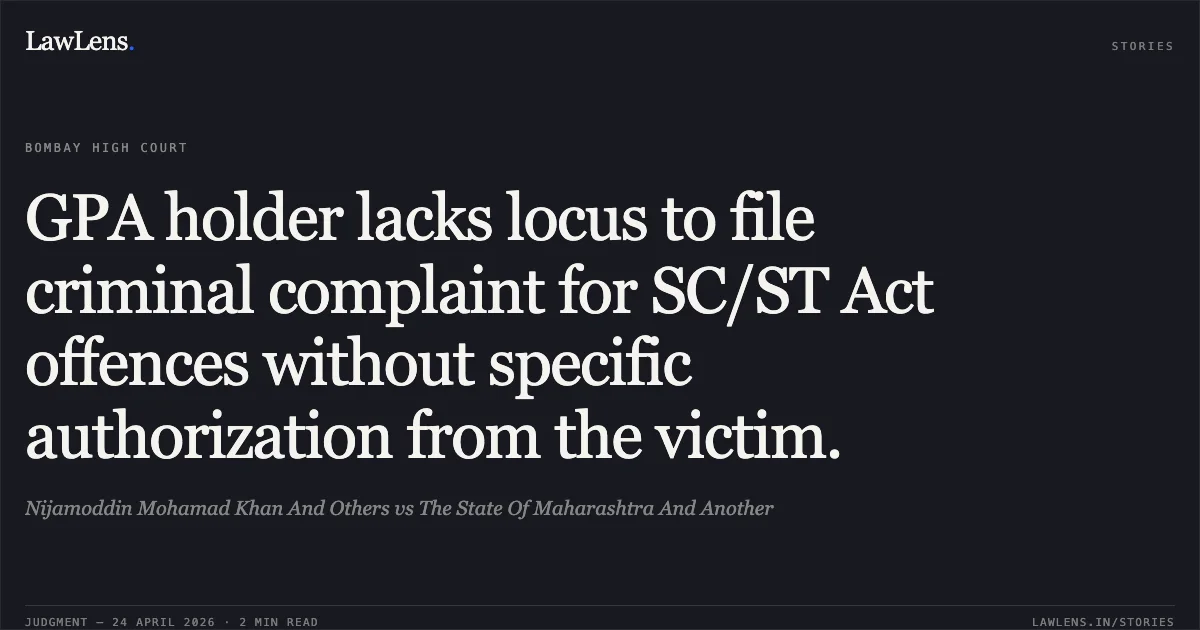
The High Court held that Respondent No. 2 lacked the locus standi to maintain the complaint and that no prima facie case was established under Sections 3(1)(f) or 3(1)(g) of the SC & ST Act.
The High Court allowed the appeal and quashed the impugned order dated 16.05.2025, and Criminal M.A. No. 179 of 2024 was dismissed.
Source reference: para. 14, 14(iii)Acts & Sections Cited
4 provisions across 3 statutes referred to in this judgment. Each provision opens on LawLens.
Scheduled Castes and the Scheduled Tribes (Prevention of Atrocities) Act, 19891
Maharashtra Land Revenue Code, 19661
Code of Criminal Procedure, 19732
Original Court PDF
Nijamoddin Mohamad Khan And OthersvsThe State Of Maharashtra And Another
Click to open original judgment
Original judgment, available to read, download and summarize on LawLens.in


