Facts
The Petitioner was an elected member of the Gram Panchayat, Devegaon, Parbhani
Source reference: para 3.1He concurrently performed duties as a 'Gram Rojgar Sevak' (GRS) under a scheme governed by a Government Resolution (GR) dated 02.05.2011
Source reference: para 3.1Respondent No. 3 filed a complaint seeking the Petitioner’s disqualification under Section 14(1)(f) and (g) of the Maharashtra Village Panchayat Act, 1958, alleging that the GRS post was an "office of profit" and that the Petitioner held an interest in the Panchayat’s works
Source reference: para 3.2, 3.3The District Collector disqualified the Petitioner on 03.01.2024
Source reference: para 3.6a decision subsequently upheld by the Additional Divisional Commissioner on 27.06.2024
Source reference: para 3.7Issues
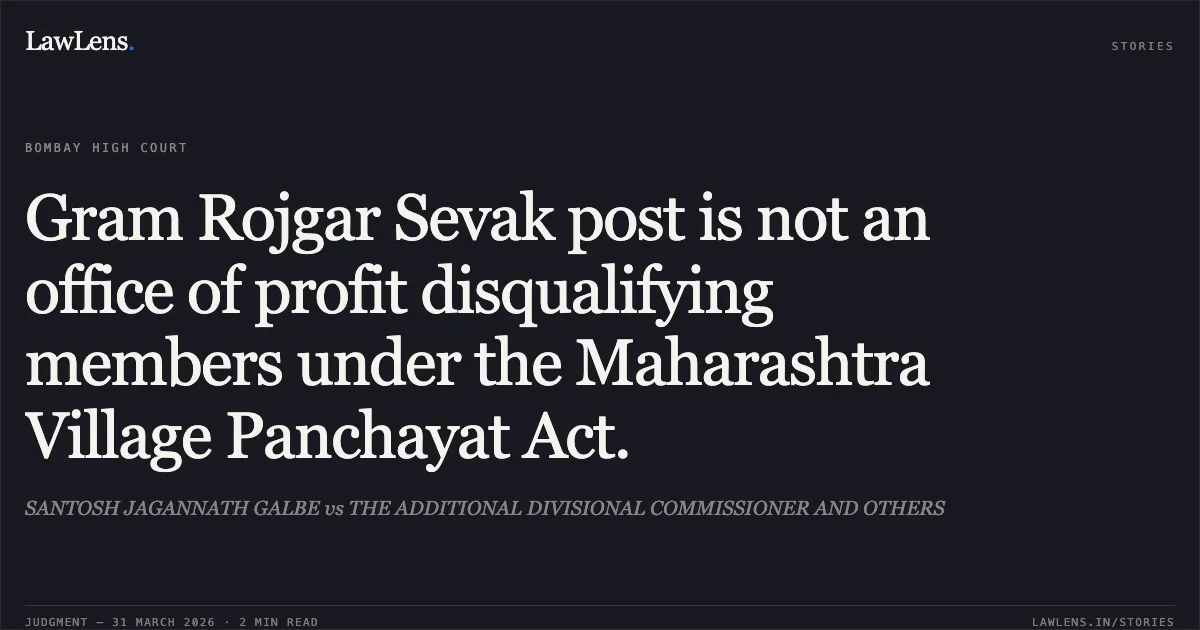
1. Whether the post of ‘Gram Rojgar Sevak’ under the Maharashtra Employment Guarantee Act, 1977 and MGNREGA 2005 constitutes a 'salaried office' or 'place of profit' in the gift or disposal of the Panchayat under Section 14(1)(f) of the Act of 1958?
Source reference: para 22. Whether the remuneration received as a Gram Rojgar Sevak constitutes a 'share or interest' in work done by the order of the Panchayat under Section 14(1)(g) of the Act of 1958?
Source reference: para 2Law Applied
The Court primarily applied Section 14(1)(f) and (g) of the Maharashtra Village Panchayat Act, 1958, which mandates disqualification for members holding a salaried office/place of profit or having a direct/indirect interest in Panchayat contracts or work
Source reference: para 5.1It relied on the service conditions for GRS defined in the Government Resolution dated 02.05.2011
Source reference: para 5.5The Court invoked constitutional principles from Articles 102(1)(a) and 191(1)(a) regarding "office of profit"
Source reference: para 5.11applied judicial tests from Shivamurthy Swami Inamdar v. Chanbasangouda Hanumanthagouda Patil and Shibu Soren v. Dayanand Sahay to determine if a post constitutes an office of profit based on appointment authority, remuneration source, and disciplinary control
Source reference: para 5.15, 5.19Reasoning
The Court examined the nature of the GRS post through the 2011 GR, concluding it is a part-time, contractual, and outsourced role
Source reference: para 5.6It noted that the appointing and dismissing authority is the Gram Sabha, specifically excluding the Gram Panchayat or Sarpanch from such powers
Source reference: para 5.8Furthermore, the remuneration is an honorarium paid out of a 6% administrative fund reserved for the Employment Guarantee Scheme, not from the Village Panchayat’s general account
Source reference: para 5.9, 5.16Thus, the post is not "in the gift or disposal of the Panchayat"
Source reference: para 5.17Regarding Section 14(1)(g), the Court reasoned that since the roles of the State, Gram Sabha, and Panchayat are distinctly earmarked under the 1977 Act, a GRS has no occasion to derive a "share or interest" in Panchayat contracts or works
Source reference: para 5.21The Court found that both lower authorities failed to appreciate these service conditions and statutory distinctions
Source reference: para 5.24Holding
The Court allowed the Writ Petition and quashed the disqualification orders passed by the Collector and the Additional Divisional Commissioner
It held that a Gram Rojgar Sevak is not a salaried office or place of profit under Section 14(1)(f) and does not hold a disqualifying interest under Section 14(1)(g) of the Maharashtra Village Panchayat Act, 1958
Source reference: para 5.23The Court ordered the immediate restoration of the Petitioner to his position as an elected member of the Gram Panchayat
Source reference: para 6Acts & Sections Cited
2 provisions across 1 statute referred to in this judgment. Each provision opens on LawLens.
Maharashtra Inferior Village Watans Abolition Act.2
Original Court PDF
SANTOSH JAGANNATH GALBEvsTHE ADDITIONAL DIVISIONAL COMMISSIONER AND OTHERS
Click to open original judgment
Original judgment, available to read, download and summarize on LawLens.in