Facts
The Appellant, Salim Malik @ Munna, challenged an order dated January 29, 2026, passed by the Special Court (Karkardooma), which rejected his application for regular bail.
Source reference: p. 1-2The case pertains to FIR No. 59/2020 (Crime Branch), involving allegations of a conspiracy related to the February 2020 North East Delhi riots.
Source reference: p. 2The Appellant was charged under various sections of the IPC, Arms Act, Prevention of Damage to Public Property Act, and notably, Sections 13, 16, 17, and 18 of the Unlawful Activities (Prevention) Act (UAPA).
Source reference: p. 3The prosecution alleged that the Appellant attended conspiratorial meetings in February 2020 at the basement of one 'Ayaz', delivered inflammatory speeches, and participated in mobs carrying stones and rods.
Source reference: p. 3At the time of this appeal, the Appellant had been in custody for over five years and ten months.
Source reference: p. 11Issues
1. Whether the Appellant is entitled to regular bail based on the principle of parity with co-accused persons who were granted bail by the Supreme Court.
Source reference: p. 3 / para. 42. Whether the stringent requirements for bail under Section 43D(5) of the UAPA are satisfied in view of the Appellant’s specific role and the duration of his incarceration.
Source reference: p. 2 / para. 5Law Applied
The Court primarily relied upon the Supreme Court’s precedent in Gulfisha Fatima v. State (Govt. of NCT of Delhi), 2026 INSC 2, which established a structural differentiation between "core ideological drivers" and "local-level facilitators/field operators" in the riot conspiracy.
Source reference: p. 3-6It also applied Section 21(4) of the National Investigation Agency Act, 2008, regarding appeals against bail orders.
Source reference: p. 1considered the rigorous bail threshold under Section 43D(5) of the Unlawful Activities (Prevention) Act, 1967.
Source reference: p. 2the Court adhered to the constitutional guarantee of personal liberty under Article 21, emphasizing that indefinite pre-trial detention should not assume a punitive character.
Source reference: p. 9Reasoning
The Court observed that the prosecution’s narrative in the Delhi riots conspiracy distinguishes between "architects" (like Umar Khalid) and "executors".
Source reference: para. 104-110Upon comparing the allegations, the Court found that the Appellant’s role—attending meetings and local mobilization—mirrored that of Mohd. Saleem Khan and Shadab Ahmad, whom the Supreme Court had classified as "local-level facilitators" and subsequently granted bail.
Source reference: para. 11-12The Court noted that the Appellant’s involvement was "site-specific and operational" rather than "directive".
Source reference: para. 106, 385Applying the logic from Gulfisha Fatima, the Court reasoned that since the evidentiary record was substantially crystallized and the trial was expected to be prolonged (currently at the stage of arguments on charge), continued incarceration was unnecessary.
Source reference: para. 13-14, 386The Court determined that the State's apprehensions regarding witness interference could be mitigated through stringent conditions rather than continued detention.
Source reference: para. 14, 384Holding
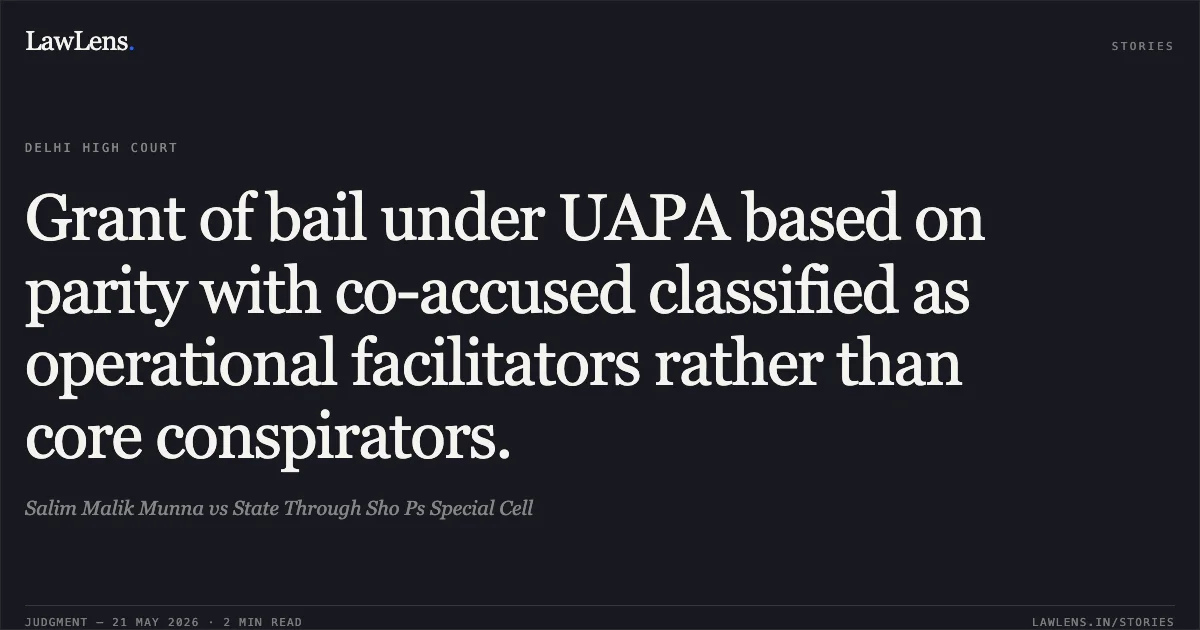
It held that the Appellant stood on the same footing as co-accused persons granted bail by the Supreme Court, and the threshold for continued detention was not met.
The Court allowed the appeal and set aside the impugned order. The Appellant was ordered to be released on regular bail subject to executing a personal bond of ₹2,00,000/- and complying with twelve stringent conditions, including surrendering his passport, marking attendance twice weekly at the PS Special Cell, and refraining from making social media posts or attending public rallies related to the case.
Source reference: p. 11-14Acts & Sections Cited
32 provisions across 5 statutes referred to in this judgment. Each provision opens on LawLens.
National Investigation Agency Act, 20081
Unlawful Activities (Prevention) Act, 19674
Indian Penal Code, 1860
Arms Act, 19592
Original Court PDF
Salim Malik MunnavsState Through Sho Ps Special Cell
Click to open original judgment
Original judgment, available to read, download and summarize on LawLens.in


![Subsequent exoneration does not retrospectively invalidate a finalized promotion select list.. UNNIKRISHNAN M vs M/o Environment And Forests. CAT - ['Ernakulam']. LawLens](/stories/thumbnails/subsequent-exoneration-does-not-retrospectively-invalidate-a-finalized-promotion-select-li-ce80a0e84f2f4887857271e8b4341c42.webp)