Facts
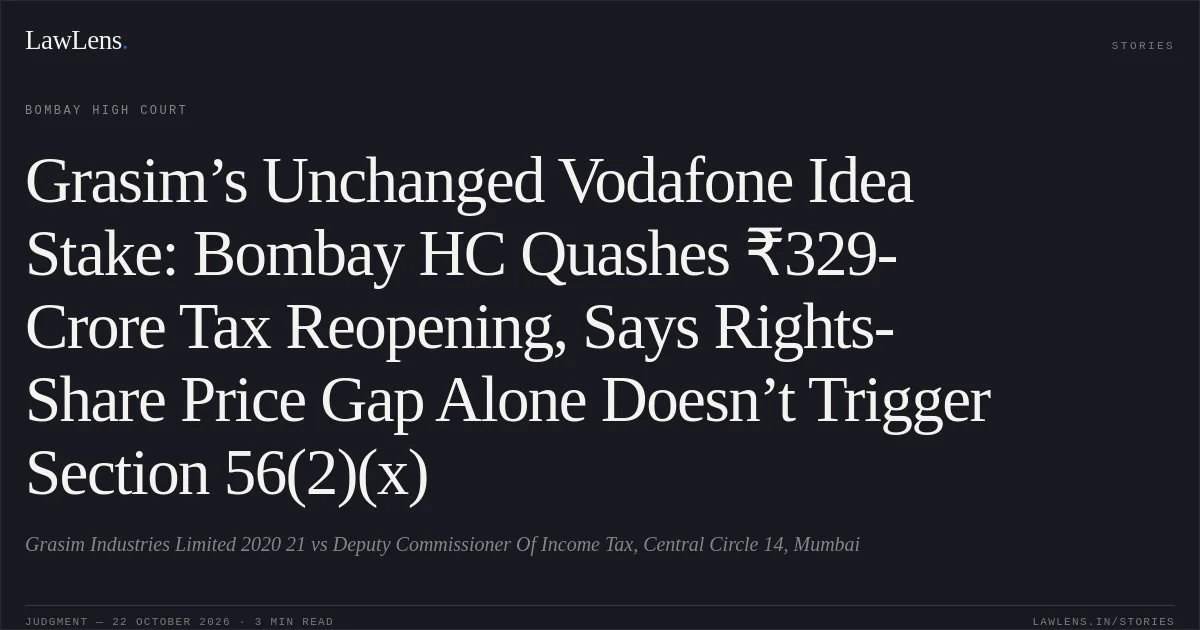
For AY 2020–21, Grasim subscribed to 2,30,90,26,052 rights equity shares of Vodafone Idea Limited (VIL) at ₹12.50 per share; its percentage shareholding remained unchanged after the proportionate allotment
Source reference: para. 3(a), 51The assessment was completed after scrutiny and DRP proceedings
Source reference: para. 3(c)–(d)On 24 March 2026, the Assessing Officer issued a notice under Section 148A(1), referring to a VIL-related amount but not disclosing the transaction’s nature, the computation, or the proposed basis under Section 56(2)(x). Those particulars were provided on 27 May 2026, after Grasim sought them
Source reference: para. 3(e)–(h), 35–38On 30 June 2026, the officer passed an order under Section 148A(3) and issued a notice under Section 148, proposing to tax ₹329,03,62,124 as the difference between the issue price and the stated fair market value
Source reference: para. 3(i)–(j)Grasim challenged the proceedings on limitation and merits, among other grounds
Source reference: para. 4–20Issues
1. Whether the Section 148A(1) notice complied with the statutory requirement to be accompanied by information suggesting escapement of income, and was issued within the limitation prescribed by Section 149(2)(b).
Source reference: para. 28–402. Whether Section 56(2)(x) applied to the difference between the subscription price and fair market value of shares allotted proportionately to an existing shareholder through a rights issue.
Source reference: para. 47–51Law Applied
Section 148A(1) requires the show-cause notice to be accompanied by the information suggesting that income chargeable to tax has escaped assessment; Section 149(2)(b) limits issuance of such a notice, in the relevant circumstances, to five years from the end of the relevant assessment year.
Source reference: para. 29–34The notice must disclose sufficient particulars to permit an effective response, and information supplied only after limitation expires cannot retrospectively validate a deficient notice.
Source reference: para. 34, 40–44Section 56(2)(x)(c)(B) concerns receipt of specified property for consideration below its fair market value by more than the prescribed threshold.
Source reference: para. 48–49Sections 55(2)(aa) and 49(4) are relevant to the statutory treatment and cost of acquisition of rights, bonus, and other shares, and must be read harmoniously with Section 56(2)(x).
Source reference: para. 52–53The Court relied on Anurag Gupta v. Income Tax Officer and Union of India v. Rajeev Bansal on meaningful disclosure and an effective opportunity to respond; Khoday Distilleries Ltd. v. CIT and PCIT v. Jigar Jashwantlal Shah on the distinction between allotment of newly created shares and transfer of existing property; and K. P. Varghese v. ITO and CIT v. J. H. Gotla on interpreting statutory language in context to avoid unintended or absurd results.
Source reference: para. 41–42, 54–55, 60Reasoning
The notice issued on 24 March 2026 stated an amount but did not disclose the rights-share transaction, the valuation basis, or the proposed application of Section 56(2)(x); those essential particulars were supplied only on 27 May 2026.
Source reference: para. 35–38Because the five-year period for AY 2020–21 expired on 31 March 2026, the later disclosure could not cure the deficient notice after limitation had run.
Source reference: para. 39–46On the merits, the shares were newly allotted under a proportionate rights issue, and Grasim’s percentage holding remained unchanged. The Revenue relied only on the difference between the issue price and the stated fair market value, without identifying a transfer of existing shares or a disproportionate benefit to Grasim.
Source reference: para. 50–58The Court therefore held that the price difference alone did not justify applying Section 56(2)(x) to this allotment.
Source reference: para. 61–62Holding
The Court held that the proceedings were not validly initiated within limitation and that Section 56(2)(x) could not, on the facts of this proportionate rights allotment, be invoked merely to tax the difference between the subscription price and fair market value.
It made the Rule absolute and set aside the notice dated 24 March 2026 under Section 148A(1), the order dated 30 June 2026 under Section 148A(3), and the consequential notice dated 30 June 2026 under Section 148. There was no order as to costs; the other grounds were left open.
Source reference: para. 64–65Acts & Sections Cited
13 provisions across 2 statutes referred to in this judgment. Linked provisions open on LawLens.
Income Tax Act, 1961
Finance Act, 20171
Original Court PDF
Grasim Industries Limited 2020 21vsDeputy Commissioner Of Income Tax, Central Circle 14, Mumbai
Click to open original judgment
Original judgment, available to read, download and summarize on LawLens.in