Facts
The petitioner’s husband, a peon at the respondent-department, was regularized in 1997.
Source reference: p. 2Following a period of medical absence in 2009 and a subsequent departmental enquiry into his unauthorized absence, his services were terminated on 27.03.2014.
Source reference: p. 2He died on 10.12.2016.
Source reference: p. 1-2The petitioner sought the release of his gratuity, which the respondents denied on the grounds that a terminated employee is only entitled to Provident Fund deposits and that the petition was barred by the availability of an alternative remedy and a lack of territorial jurisdiction.
Source reference: p. 3, 5Issues
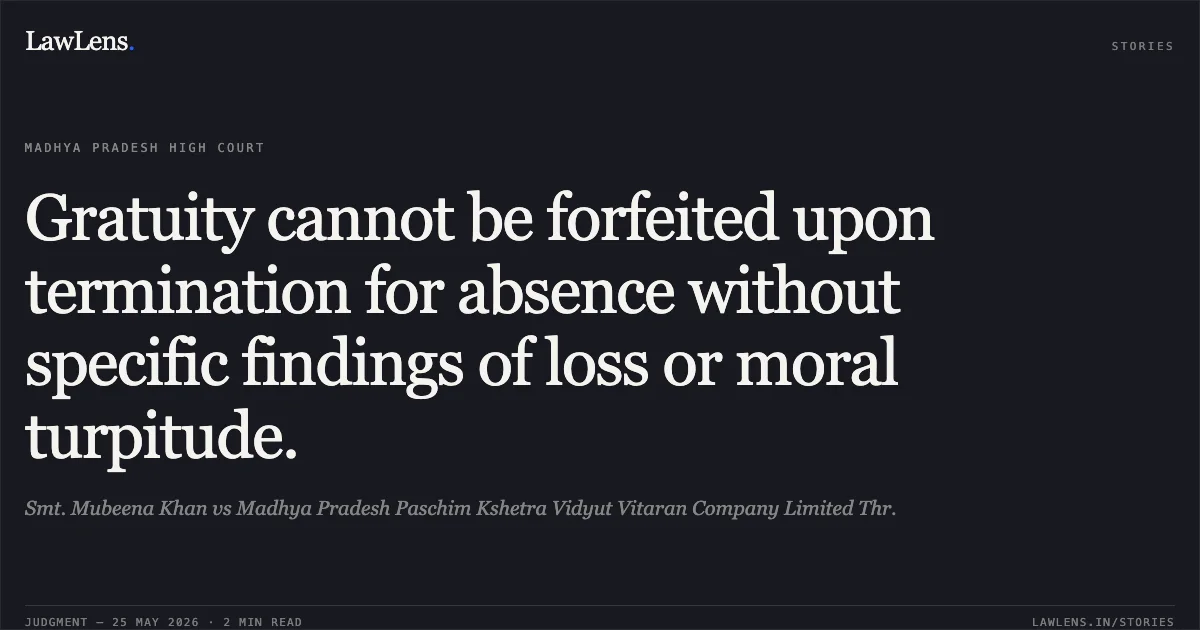
1. Whether the employer can forfeit or withhold the gratuity of an employee terminated for unauthorized absence without a specific order of forfeiture or proof of financial loss.
Source reference: p. 5, 82. Whether the writ petition is maintainable despite the availability of an alternative remedy and objections regarding territorial jurisdiction.
Source reference: p. 3, 7, 9Law Applied
The court applied Section 4(6) of the Payment of Gratuity Act, which stipulates that gratuity can only be forfeited if termination is due to an act causing damage or loss to the employer (to the extent of the loss), or for riotous conduct or acts involving moral turpitude.
Source reference: p. 5-6It relied on Delhi Cloth and General Mills Co. Ltd. vs. Workmen [AIR 1970 SC 919] and The Management of Tournamulla Estate vs. Workmen [(1973) 2 SCC 502], which categorize misconduct and limit forfeiture to cases of financial loss or grave indiscipline.
Source reference: p. 6-7The court cited Permali Wallance Ltd. vs. State of M.P. [1996 (0) MPLJ 262] to emphasize that principles of natural justice must be followed before forfeiting gratuity.
Source reference: p. 7-8Reasoning
The court reasoned that under Section 4(6) of the Gratuity Act, the respondents failed to show any allegation of willful omission, negligence, or damage to property caused by the deceased.
Source reference: p. 7The termination order was based solely on absence from duty and contained no specific direction for the forfeiture of gratuity.
Source reference: p. 7The court observed that retiral dues are property under Article 300A of the Constitution and cannot be withheld without statutory enablement.
Source reference: p. 7Regarding procedural objections, the court held that since the petition had been pending since 2018 and involved a pure question of law rather than factual disputes, the alternative remedy was not a bar.
Source reference: p. 7It further dismissed the jurisdictional objection, noting the respondent has offices in Gwalior and the petitioner is a widow seeking aged relief.
Source reference: p. 9-10Holding
The court allowed the petition, holding that the petitioner is entitled to the gratuity as the statutory conditions for forfeiture were not met.
The respondents were directed to release the gratuity amount with interest as per Central Government notifications from the date of entitlement (27.03.2014) within three months. Failure to comply within the stipulated time would attract a cost/compensation of Rs. 1,00,000.
Source reference: p. 10Acts & Sections Cited
1 provisions across 1 statute referred to in this judgment. Linked provisions open on LawLens.
PAYMENT OF GRATUITY ACT, 19721
Original Court PDF
Smt. Mubeena KhanvsMadhya Pradesh Paschim Kshetra Vidyut Vitaran Company Limited Thr.
Click to open original judgment
Original judgment, available to read, download and summarize on LawLens.in


![Authorities must decide pensionary and retiral-benefit claims through a reasoned order within eight weeks.. Habibullah khan vs HOME DEPARTMENT. CAT - ['Srinagar']. LawLens](/stories/thumbnails/authorities-must-decide-pensionary-and-retiral-benefit-claims-through-a-reasoned-order-wit-d0cbe8a8119c48fbabe7df9f2d353488.webp)