Facts
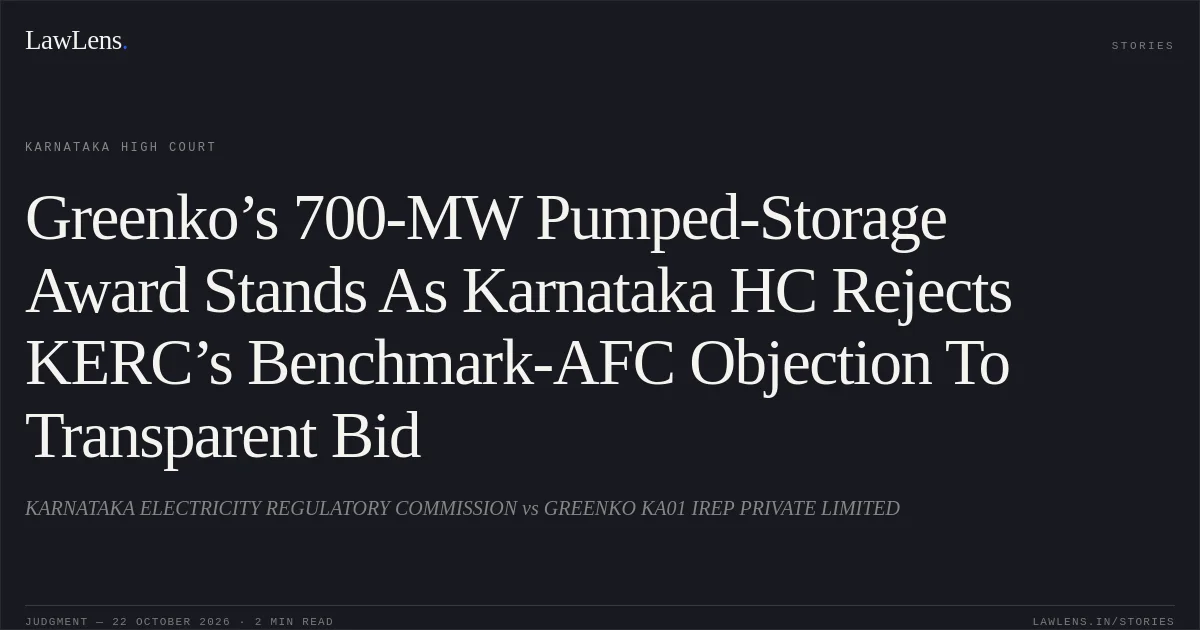
The State Government directed PCKL to invite bids for a 1,000 MW pumped hydro storage project.
Source reference: p. 3–4PCKL issued a tender on 10 February 2023, and Greenko was selected for 700 MW.
Source reference: p. 3–4KERC had given in-principle approval but later refused to adopt the discovered tariff, principally because the tender did not incorporate a benchmark capital cost and annual fixed cost (AFC) that KERC had specified.
Source reference: p. 6–8, 26–27Greenko challenged PCKL’s refusal to issue a Letter of Award (LOA).
Source reference: p. 4–5The Single Judge allowed the petition and directed steps to facilitate the project agreement; KERC appealed.
Source reference: p. 4–5During the appeal, PCKL issued an LOA subject to its outcome, and Greenko furnished performance bank guarantees.
Source reference: p. 21, 24Issues
1. Whether KERC could refuse to adopt a tariff discovered through competitive bidding because the tender did not specify a benchmark AFC, where KERC did not dispute the transparency of the bidding process.
Source reference: p. 252. Whether KERC’s role under Section 63 of the Electricity Act, 2003, extended to assessing whether the discovered tariff aligned with the objective of protecting consumers.
Source reference: p. 25Law Applied
Section 63 of the Electricity Act, 2003 requires the Appropriate Commission to adopt a tariff determined through a transparent bidding process conducted in accordance with Central Government guidelines; this differs from tariff determination under Section 62.
Source reference: p. 25, 29–30In Energy Watchdog v. Central Electricity Regulatory Commission, the Supreme Court explained that, under Section 63, the Commission must ensure compliance with the applicable bidding guidelines.
Source reference: p. 31–32Jaipur Vidyut Vitran Nigam Ltd. v. MB Power (Madhya Pradesh) Ltd. confirms that judicial review of contractual decisions is limited, but permits scrutiny for arbitrariness or unreasonableness, subject to caution and the public interest.
Source reference: p. 9–11, 32–33Reasoning
The Court found that no Central Government guidelines governed the tender when it was issued, and that KERC’s objection concerned the absence of its proposed benchmark AFC and supporting project details—not the transparency of the bidding process.
Source reference: p. 25–28, 32It held that Section 63 did not permit KERC to treat the benchmark AFC requirement as a condition for adoption in these circumstances.
Source reference: p. 25–28, 32The tariff obtained was lower than tariffs accepted for comparable projects, and the Court found no undue consumer burden.
Source reference: p. 28–30It also noted that the later 2025 Ministry of Power guidelines did not require a benchmark AFC and that the existing tender was substantially consistent with those guidelines; restarting the process would therefore serve no useful purpose.
Source reference: p. 29–31The Court concluded that the Single Judge’s intervention was consistent with the public-interest principles governing judicial review.
Source reference: p. 32–34Holding
The Court answered the issues against KERC, upheld the Single Judge’s order, and dismissed the appeal as devoid of merit.
No order as to costs was made.
Source reference: p. 34–35Acts & Sections Cited
3 provisions across 2 statutes referred to in this judgment. Each provision opens on LawLens.
KARNATAKA HIGH COURT ACT, 19611
Electricity Act, 20032
Original Court PDF
KARNATAKA ELECTRICITY REGULATORY COMMISSIONvsGREENKO KA01 IREP PRIVATE LIMITED
Click to open original judgment
Original judgment, available to read, download and summarize on LawLens.in