Facts
The appellant (informant) runs a sweet shop in Buxar. On June 4, 2011, while the appellant was laying bricks on land adjacent to his shop, the private respondents (Nos. 2-5) allegedly arrived armed with weapons, exhorted to kill him, and assaulted the appellant and his son, causing head and shoulder injuries.
Source reference: p. 3Allegations of theft of cash, a gold chain, and a watch were also made.
Source reference: p. 3The Trial Court convicted the respondents under Sections 341, 325/34 IPC but acquitted them of charges under Sections 307 (Attempt to Murder) and 379 (Theft) IPC.
Source reference: p. 8The appellant challenged this partial acquittal and the adequacy of the ₹25,000 compensation awarded to each victim.
Source reference: p. 2Issues
1. Whether the acquittal of the respondents under Section 307 and 379 IPC was legally justified based on the evidence of intent and the nature of the injuries.
Source reference: p. 11, para 182. Whether the compensation awarded by the Trial Court was inadequate under the circumstances of the case.
Source reference: p. 9, para 13Law Applied
The court primarily applied Section 307 IPC (Attempt to Murder), emphasizing that the "intent" to cause death is the critical element rather than the extent of injury.
Source reference: p. 16, para 31It relied on Shoyeb Raja v. State of Madhya Pradesh (2024) and State of Maharashtra v. Kashirao (2003) to establish that the act must be imminently dangerous and capable of causing death.
Source reference: p. 16, para 31Regarding appeals against acquittal, the court applied the "double presumption of innocence" doctrine from Rajesh Prasad v. State of Bihar (2022) and Nikhil Chandra Mondal v. State of W.B. (2023), stating that unless a finding is perverse or illegal, appellate interference is unwarranted.
Source reference: p. 20, para 38-39Reasoning
The court found no evidence of premeditated intent to kill. It noted that although the respondents were allegedly armed with country-made pistols, they did not use them, which strongly countered the allegation of an intent to murder.
Source reference: p. 17, para 30The medical evidence showed only one blow to the appellant's head with no repetition, and injuries to the son were on non-vital parts (shoulder/ankle).
Source reference: p. 15, para 28The court observed that the dispute arose at the spur of the moment over a land/shop conflict, for which cross-cases were filed.
Source reference: p. 15, para 29Regarding Section 379, the court deemed the theft allegations "ornamental" as they were inconsistent across witness testimonies and emerged from a general melee.
Source reference: p. 19, para 36The court concluded that the Trial Court’s findings were a "possible view" and lacked perversity.
Source reference: p. 20, para 40Holding
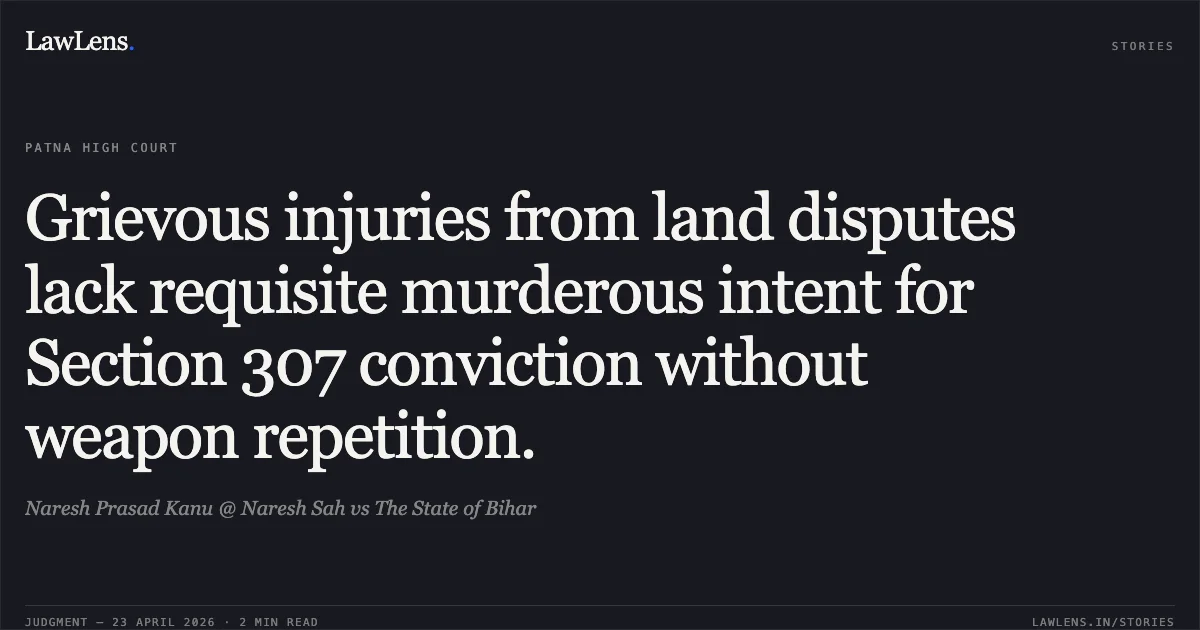
The High Court held that the ingredients of "intent to kill" were not established beyond reasonable doubt and that the theft charge was unsubstantiated by credible evidence.
The compensation of ₹25,000 to be paid by each respondent (totaling ₹1,00,000 for the victims) was found to be judicious and equitable.
Source reference: p. 21, para 41The High Court dismissed the appeal and upheld the acquittal of the respondents under Sections 307 and 379 IPC. Final order: Appeal dismissed.
Source reference: p. 22, para 44Acts & Sections Cited
10 provisions across 2 statutes referred to in this judgment. Each provision opens on LawLens.
Code of Criminal Procedure, 19732
Indian Penal Code, 18608
Original Court PDF
Naresh Prasad Kanu @ Naresh SahvsThe State of Bihar
Click to open original judgment
Original judgment, available to read, download and summarize on LawLens.in


