Facts
The appellant filed a suit in 1965 under Section 88 of the Rajasthan Tenancy Act, 1955, seeking a declaration of 'khatedari' (tenant-occupant) rights over 158.3 bighas of land and recovery of possession from encroachers
Source reference: p. 2The claim was based on succession from his father, whose name was mutated in revenue records in 1961
Source reference: p. 2The defendants contested the suit, alleging that the appellant’s mother had executed a sale deed in their favor in 1963
Source reference: p. 6Although the first defendant (Keshi) appeared through counsel and examined witnesses, she was eventually declared ex-parte for non-appearance on 21.05.1974
Source reference: p. 8The suit was decreed in favor of the appellant on 16.08.1975
Source reference: p. 2After a delay of 31 years, the first defendant filed an appeal in 2006, claiming she was unaware of the decree due to fraud and lack of service
Source reference: p. 2, 8The First Appellate Authority dismissed the appeal for gross delay, but the Board of Revenue and the High Court subsequently condoned the delay and remanded the matter for a fresh trial
Source reference: p. 2-3Issues
1. Whether the condonation of a 31-year delay in filing an appeal against the 1975 decree was legally sustainable
Source reference: p. 142. Whether the original decree was obtained through fraud or if the defendant was denied a reasonable opportunity to defend the case
Source reference: p. 3, 83. Whether a sale deed executed by a guardian on behalf of a minor without court permission is valid and requires a formal suit for cancellation
Source reference: p. 11, 13Law Applied
The Court primarily applied Section 88 of the Rajasthan Tenancy Act, 1955 regarding tenancy declarations
Source reference: p. 2It relied on Section 114(g) of the Evidence Act, 1872, establishing that an adverse inference may be drawn when a party withholds the best evidence
Source reference: p. 11Regarding minors, the Court applied Section 8(2) of the Hindu Minority and Guardianship Act, 1956, which prohibits the disposal of a minor’s immovable property without court permission
Source reference: p. 13The Court followed the principle in Union of India v. Jahangir Byramji Jeejeebhoy, holding that delay condonation cannot be an act of "generosity" that defeats substantial justice
Source reference: p. 6, 14Furthermore, it applied K.S. Shivappa v. K. Neelamma, which permits the repudiation of a voidable transaction through unequivocal conduct without a formal suit
Source reference: p. 6, 11Reasoning
The Court observed that the trial records contradicted the defendants' claim of lack of notice, as Defendant No. 1 had appeared via counsel, filed a written statement, and examined two witnesses (DW1 and DW2)
Source reference: p. 8-9The Court found the allegations of fraud regarding the vakalatnama to be "deliberate falsehoods" and "improved upon at every stage"
Source reference: p. 8, 14Critically, the defendants failed to produce the 1963 sale deed during the trial despite seeking permission to do so, leading the Court to draw an adverse inference under the "best evidence" rule
Source reference: p. 10-11Upon perusing the sale deed produced during the current proceedings, the Court noted that the appellant was a 12-year-old minor at the time of execution, and since no court permission was obtained as required by Section 8(2) of the HMGA, the transaction was voidable
Source reference: p. 13The appellant effectively repudiated this transaction by obtaining the 1975 decree
Source reference: p. 11Finally, the Court held that a 31-year delay is "gross" and cannot be condoned where the grounds for delay are belied by the record
Source reference: p. 14Holding
The Supreme Court allowed the appeal and set aside the orders of the High Court and the Board of Revenue
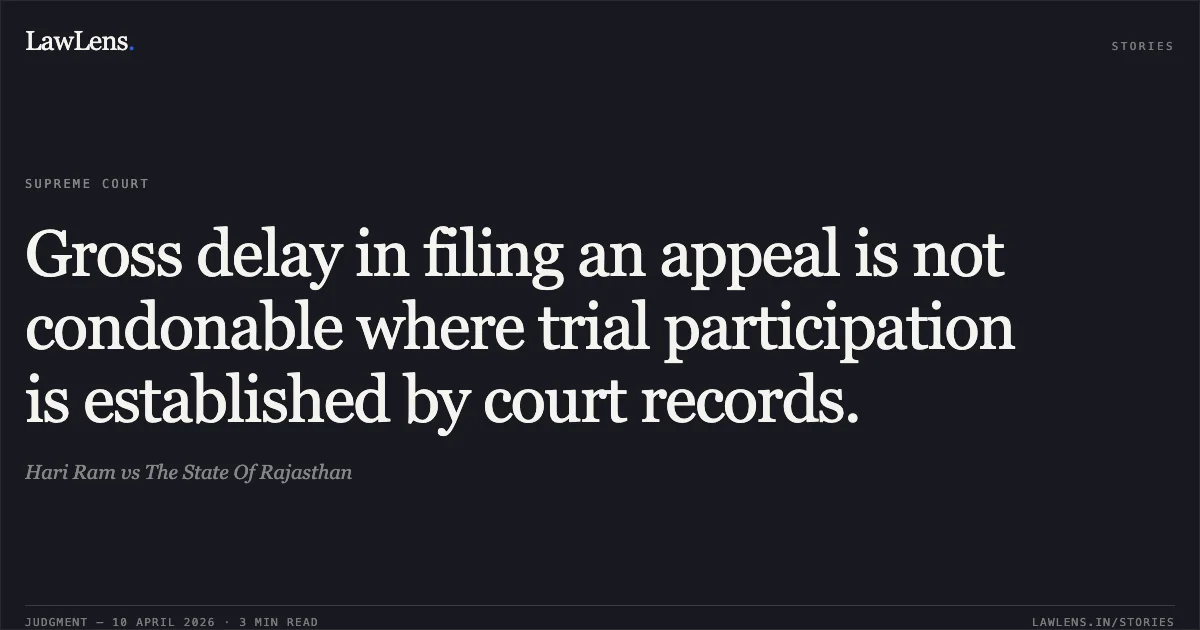
The Court held that the condonation of a 31-year delay was illegal given the defendant's active participation in the original suit and failure to produce title documents
Source reference: p. 14The Court restored the original order of the Revenue Court dated 16.08.1975, confirming the appellant's 'khatedari' rights
Source reference: p. 15All pending applications were disposed of accordingly
Source reference: p. 15Acts & Sections Cited
1 provisions across 1 statute referred to in this judgment. Each provision opens on LawLens.
Hindu Minority and Guardianship Act, 19561
Original Court PDF
Hari RamvsThe State Of Rajasthan
Click to open original judgment
Original judgment, available to read, download and summarize on LawLens.in


